To create the bogus test, we'll make a new test using the it callback function:
it('should expect some values');
We can put whatever we want in here, it's not too important. And we'll pass in an arrow function (=>) as our callback function:
it('should expect some values', () => {

});
Now as we've seen already, one of the most fundamental assertions you'll make is you're just going to check for equality. We want to check if something like the response variable equals something else, like the number 44. Inside expect, we can also do the opposite. We can expect that a value like 12 does not equal, using toNotBe. And then we can assert that it doesn't equal some other value, like 11:
it('should expect some values', () => {
  expect(12).toNotBe(11);
});
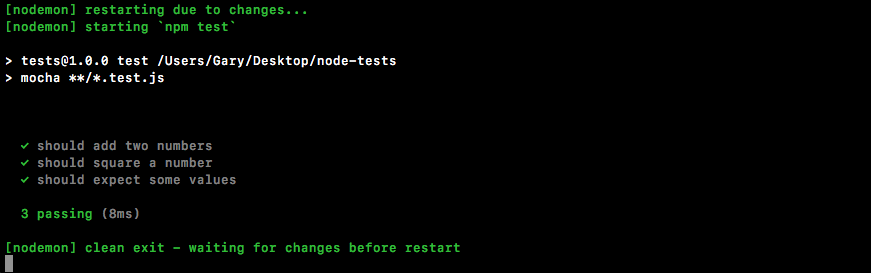
The two aren't equal, so when we save the file over in the Terminal, all three tests should be passing:
If I set that equal to the same value, it'll not work as expected:
it('should expect some values', () => {
  expect(12).toNotBe(12);
});
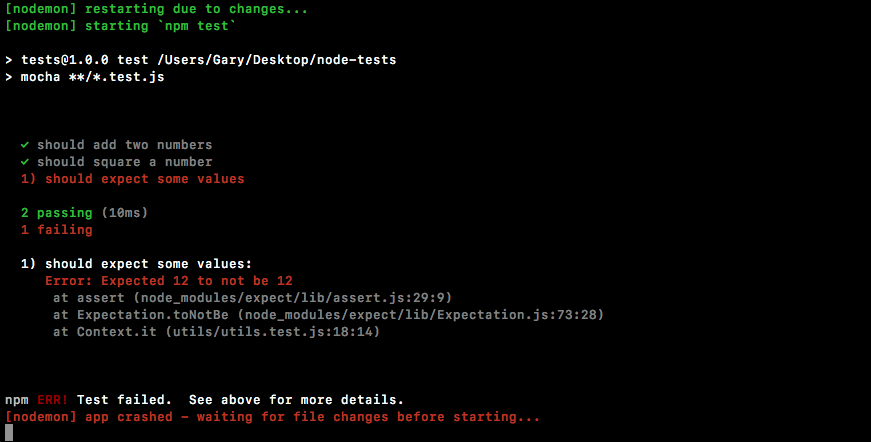
We'll get an error, Expected 12 to not be 12:
Now toBe and toNotBe work great for numbers, strings, and Booleans, but if you're trying to compare arrays or objects, they will not work as expected and we can prove this.