Table of Contents for
Practical Malware Analysis
 Practical Malware Analysis
Published by
No Starch Press, 2012
Practical Malware Analysis
Published by
No Starch Press, 2012
- Cover
- Practical Malware Analysis: The Hands-On Guide to Dissecting Malicious Software
- Praise for Practical Malware Analysis
- Warning
- About the Authors
- About the Technical Reviewer
- About the Contributing Authors
- Foreword
- Acknowledgments
- Individual Thanks
- Introduction
- What Is Malware Analysis?
- Prerequisites
- Practical, Hands-On Learning
- What’s in the Book?
- 0. Malware Analysis Primer
- The Goals of Malware Analysis
- Malware Analysis Techniques
- Types of Malware
- General Rules for Malware Analysis
- I. Basic Analysis
- 1. Basic Static Techniques
- Antivirus Scanning: A Useful First Step
- Hashing: A Fingerprint for Malware
- Finding Strings
- Packed and Obfuscated Malware
- Portable Executable File Format
- Linked Libraries and Functions
- Static Analysis in Practice
- The PE File Headers and Sections
- Conclusion
- Labs
- 2. Malware Analysis in Virtual Machines
- The Structure of a Virtual Machine
- Creating Your Malware Analysis Machine
- Using Your Malware Analysis Machine
- The Risks of Using VMware for Malware Analysis
- Record/Replay: Running Your Computer in Reverse
- Conclusion
- 3. Basic Dynamic Analysis
- Sandboxes: The Quick-and-Dirty Approach
- Running Malware
- Monitoring with Process Monitor
- Viewing Processes with Process Explorer
- Comparing Registry Snapshots with Regshot
- Faking a Network
- Packet Sniffing with Wireshark
- Using INetSim
- Basic Dynamic Tools in Practice
- Conclusion
- Labs
- II. Advanced Static Analysis
- 4. A Crash Course in x86 Disassembly
- Levels of Abstraction
- Reverse-Engineering
- The x86 Architecture
- Conclusion
- 5. IDA Pro
- Loading an Executable
- The IDA Pro Interface
- Using Cross-References
- Analyzing Functions
- Using Graphing Options
- Enhancing Disassembly
- Extending IDA with Plug-ins
- Conclusion
- Labs
- 6. Recognizing C Code Constructs in Assembly
- Global vs. Local Variables
- Disassembling Arithmetic Operations
- Recognizing if Statements
- Recognizing Loops
- Understanding Function Call Conventions
- Analyzing switch Statements
- Disassembling Arrays
- Identifying Structs
- Analyzing Linked List Traversal
- Conclusion
- Labs
- 7. Analyzing Malicious Windows Programs
- The Windows API
- The Windows Registry
- Networking APIs
- Following Running Malware
- Kernel vs. User Mode
- The Native API
- Conclusion
- Labs
- III. Advanced Dynamic Analysis
- 8. Debugging
- Source-Level vs. Assembly-Level Debuggers
- Kernel vs. User-Mode Debugging
- Using a Debugger
- Exceptions
- Modifying Execution with a Debugger
- Modifying Program Execution in Practice
- Conclusion
- 9. OllyDbg
- Loading Malware
- The OllyDbg Interface
- Memory Map
- Viewing Threads and Stacks
- Executing Code
- Breakpoints
- Loading DLLs
- Tracing
- Exception Handling
- Patching
- Analyzing Shellcode
- Assistance Features
- Plug-ins
- Scriptable Debugging
- Conclusion
- Labs
- 10. Kernel Debugging with WinDbg
- Drivers and Kernel Code
- Setting Up Kernel Debugging
- Using WinDbg
- Microsoft Symbols
- Kernel Debugging in Practice
- Rootkits
- Loading Drivers
- Kernel Issues for Windows Vista, Windows 7, and x64 Versions
- Conclusion
- Labs
- IV. Malware Functionality
- 11. Malware Behavior
- Downloaders and Launchers
- Backdoors
- Credential Stealers
- Persistence Mechanisms
- Privilege Escalation
- Covering Its Tracks—User-Mode Rootkits
- Conclusion
- Labs
- 12. Covert Malware Launching
- Launchers
- Process Injection
- Process Replacement
- Hook Injection
- Detours
- APC Injection
- Conclusion
- Labs
- 13. Data Encoding
- The Goal of Analyzing Encoding Algorithms
- Simple Ciphers
- Common Cryptographic Algorithms
- Custom Encoding
- Decoding
- Conclusion
- Labs
- 14. Malware-Focused Network Signatures
- Network Countermeasures
- Safely Investigate an Attacker Online
- Content-Based Network Countermeasures
- Combining Dynamic and Static Analysis Techniques
- Understanding the Attacker’s Perspective
- Conclusion
- Labs
- V. Anti-Reverse-Engineering
- 15. Anti-Disassembly
- Understanding Anti-Disassembly
- Defeating Disassembly Algorithms
- Anti-Disassembly Techniques
- Obscuring Flow Control
- Thwarting Stack-Frame Analysis
- Conclusion
- Labs
- 16. Anti-Debugging
- Windows Debugger Detection
- Identifying Debugger Behavior
- Interfering with Debugger Functionality
- Debugger Vulnerabilities
- Conclusion
- Labs
- 17. Anti-Virtual Machine Techniques
- VMware Artifacts
- Vulnerable Instructions
- Tweaking Settings
- Escaping the Virtual Machine
- Conclusion
- Labs
- 18. Packers and Unpacking
- Packer Anatomy
- Identifying Packed Programs
- Unpacking Options
- Automated Unpacking
- Manual Unpacking
- Tips and Tricks for Common Packers
- Analyzing Without Fully Unpacking
- Packed DLLs
- Conclusion
- Labs
- VI. Special Topics
- 19. Shellcode Analysis
- Loading Shellcode for Analysis
- Position-Independent Code
- Identifying Execution Location
- Manual Symbol Resolution
- A Full Hello World Example
- Shellcode Encodings
- NOP Sleds
- Finding Shellcode
- Conclusion
- Labs
- 20. C++ Analysis
- Object-Oriented Programming
- Virtual vs. Nonvirtual Functions
- Creating and Destroying Objects
- Conclusion
- Labs
- 21. 64-Bit Malware
- Why 64-Bit Malware?
- Differences in x64 Architecture
- Windows 32-Bit on Windows 64-Bit
- 64-Bit Hints at Malware Functionality
- Conclusion
- Labs
- A. Important Windows Functions
- B. Tools for Malware Analysis
- C. Solutions to Labs
- Lab 1-1 Solutions
- Lab 1-2 Solutions
- Lab 1-3 Solutions
- Lab 1-4 Solutions
- Lab 3-1 Solutions
- Lab 3-2 Solutions
- Lab 3-3 Solutions
- Lab 3-4 Solutions
- Lab 5-1 Solutions
- Lab 6-1 Solutions
- Lab 6-2 Solutions
- Lab 6-3 Solutions
- Lab 6-4 Solutions
- Lab 7-1 Solutions
- Lab 7-2 Solutions
- Lab 7-3 Solutions
- Lab 9-1 Solutions
- Lab 9-2 Solutions
- Lab 9-3 Solutions
- Lab 10-1 Solutions
- Lab 10-2 Solutions
- Lab 10-3 Solutions
- Lab 11-1 Solutions
- Lab 11-2 Solutions
- Lab 11-3 Solutions
- Lab 12-1 Solutions
- Lab 12-2 Solutions
- Lab 12-3 Solutions
- Lab 12-4 Solutions
- Lab 13-1 Solutions
- Lab 13-2 Solutions
- Lab 13-3 Solutions
- Lab 14-1 Solutions
- Lab 14-2 Solutions
- Lab 14-3 Solutions
- Lab 15-1 Solutions
- Lab 15-2 Solutions
- Lab 15-3 Solutions
- Lab 16-1 Solutions
- Lab 16-2 Solutions
- Lab 16-3 Solutions
- Lab 17-1 Solutions
- Lab 17-2 Solutions
- Lab 17-3 Solutions
- Lab 18-1 Solutions
- Lab 18-2 Solutions
- Lab 18-3 Solutions
- Lab 18-4 Solutions
- Lab 18-5 Solutions
- Lab 19-1 Solutions
- Lab 19-2 Solutions
- Lab 19-3 Solutions
- Lab 20-1 Solutions
- Lab 20-2 Solutions
- Lab 20-3 Solutions
- Lab 21-1 Solutions
- Lab 21-2 Solutions
- Index
- Index
- Index
- Index
- Index
- Index
- Index
- Index
- Index
- Index
- Index
- Index
- Index
- Index
- Index
- Index
- Index
- Index
- Index
- Index
- Index
- Index
- Index
- Index
- Index
- Index
- Index
- Updates
- About the Authors
- Copyright
Unlike C, C++ is an object-oriented programming language, following a programming model that uses objects that contain data as well as functions to manipulate the data. The functions in object-oriented programming are like functions in C programs, except that they are associated with a particular object or class of objects. Functions within a C++ class are often called methods to draw a distinction. Although many features of object-oriented programming are irrelevant to malware analysis because they do not impact the assembly, a few can complicate analysis.
Note
To learn more about C++, consider reading Thinking in C++ by Bruce Eckel, available as a free download from http://www.mindviewinc.com/.
In object-orientation, code is arranged in user-defined data types called classes. Classes are like structs, except that they store function information in addition to data. Classes are like a blueprint for creating an object—one that specifies the functions and data layout for an object in memory.
When executing object-oriented C++ code, you use the class to create an object of the class. This object is referred to as an instance of the class. You can have multiple instances of the same class. Each instance of a class has its own data, but all objects of the same type share the same functions. To access data or call a function, you must reference an object of that type.
Example 20-1 shows a simple C++ program with a class and a single object.
Example 20-1. A simple C++ class
class SimpleClass {
public:
      int x;
      void HelloWorld() {
            printf("Hello World\n");
      }
};

int _tmain(int argc, _TCHAR* argv[])
{
      SimpleClass myObject;
      myObject.HelloWorld();
}
In this example, the class is called SimpleClass. It has
one data element, x, and a single function, HelloWorld. We create an instance of SimpleClass named myObject and call the HelloWorld function for that object. (The public keyword is a compiler-enforced abstraction mechanism with no impact on the
assembly code.)
As we have established, data and functions are associated with objects. In order to access a
piece of data, you use the form ObjectName.variableName. Functions are called similarly with
ObjectName.functionName. For example, in
Example 20-1, if we wanted to access the x variable, we would use myObject.x.
In addition to accessing variables using the object name and the variable name, you can also access variables for the current object using only the variable name. Example 20-2 shows an example.
Example 20-2. A C++ example with the this pointer
class SimpleClass {
public:
      int x;
      void HelloWorld() {
            if (❶x == 10) printf("X is 10.\n");
      }
      ...
};

int _tmain(int argc, _TCHAR* argv[])
{
      SimpleClass myObject;
     ❷myObject.x = 9;
     ❸myObject.HelloWorld();
      SimpleClass myOtherObject;
      myOtherOject.x = 10;
      myOtherObject.HelloWorld();
}
In the HelloWorld function, the variable x is accessed as just x at ❶, and not ObjectName.x. That same variable, which
refers to the same address in memory, is accessed in the main method at ❷ using myObject.x.
Within the HelloWorld method, the variable can be accessed
just as x because it is assumed to refer to the object that was
used to call the function, which in the first case is myObject
❸. Depending on which object is used to call the
HelloWorld function, a different memory address storing the
x variable will be accessed. For example, if the function were
called with myOtherObject.HelloWorld, then an x reference at ❶ would access
a different memory location than when that is called with myObject.HelloWorld. The this pointer is used to keep
track of which memory address to access when accessing the x
variable.
The this pointer is implied in every variable access within
a function that doesn’t specify an object; it is an implied parameter to every object function
call. Within Microsoft-generated assembly code, the this
parameter is usually passed in the ECX register, although sometimes ESI is used instead.
In Chapter 6, we covered the stdcall, cdecl, and fastcall calling conventions. The C++ calling convention for the this pointer is often called thiscall. Identifying
the thiscall convention can be one easy way to identify
object-oriented code when looking at disassembly.
The assembly in Example 20-3, generated from
Example 20-2, demonstrates the usage of the this pointer.
Example 20-3. The this pointer shown in disassembly
;Main Function
00401100                 push    ebp
00401101                 mov     ebp, esp
00401103                 sub     esp, 1F0h
00401109                ❶mov     [ebp+var_10], offset off_404768
00401110                ❷mov     [ebp+var_C], 9
00401117                ❸lea     ecx, [ebp+var_10]
0040111A                 call    sub_4115D0
0040111F                 mov     [ebp+var_34], offset off_404768
00401126                 mov     [ebp+var_30], 0Ah
0040112D                 lea     ecx, [ebp+var_34]
00401130                 call    sub_4115D0

;HelloWorld Function
004115D0                 push    ebp
004115D1                 mov     ebp, esp
004115D3                 sub     esp, 9Ch
004115D9                 push    ebx
004115DA                 push    esi
004115DB                 push    edi
004115DC                 mov    ❹[ebp+var_4], ecx
004115DF                 mov    ❺eax, [ebp+var_4]
004115E2                 cmp     dword ptr [eax+4], 0Ah
004115E6                 jnz     short loc_4115F6
004115E8                 push    offset aXIs10_  ; "X is 10.\n"
004115ED                 call    ds:__imp__printf
The main method first allocates space on the stack. The beginning of the object is stored at
var_10 on the stack at ❶. The first data value stored in that object is the variable x, which is set at an offset of 4 from the beginning of the object. The value x is accessed at ❷ and is
labeled var_C by IDA Pro. IDA Pro can’t determine whether
the values are both part of the same object, and it labels x as a
separate value. The pointer to the object is then placed into ECX for the function call ❸. Within the HelloWorld
function, the value of ECX is retrieved and used as the this
pointer ❹. Then at an offset of 4, the code accesses the
value for x
❺. When the main function calls HelloWorld for the second time, it loads a different pointer into ECX.
C++ supports a coding construct known as method overloading, which is the ability to have multiple functions with the same name, but that accept different parameters. When the function is called, the compiler determines which version of the function to use based on the number and types of parameters used in the call, as shown in Example 20-4.
Example 20-4. Function overloading example
LoadFile (String filename) {
...
}
LoadFile (String filename, int Options) {
...
}

Main () {
      LoadFile ("c:\myfile.txt"); //Calls the first LoadFile function
      LoadFile ("c:\myfile.txt", GENERIC_READ); //Calls the second LoadFile
}
As you can see in the listing, there are two LoadFile
functions: one that takes only a string and another that takes a string and an integer. When the
LoadFile function is called within the main method, the compiler
selects the function to call based on the number of parameters supplied.
C++ uses a technique called name mangling to support method overloading. In the PE file format, each function is labeled with only its name, and the function parameters are not specified in the compiled binary format.
To support overloading, the names in the file format are modified so that the name information
includes the parameter information. For example, if a function called TestFunction is part of the SimpleClass class and
accepts two integers as parameters, the mangled name of that function would be ?TestFunction@SimpleClass@@QAEXHH@Z.
The algorithm for mangling the names is compiler-specific, but IDA Pro can demangle the names
for most compilers. For example, Figure 20-1 shows the
function TestFunction. IDA Pro demangles the function and shows
the original name and parameters.
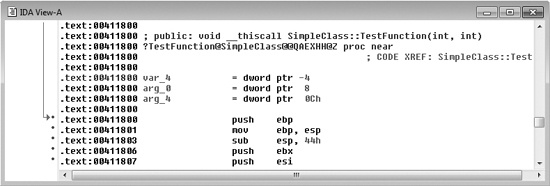
The internal function names are visible only if there are symbols in the code you are analyzing. Malware usually has the internal symbols removed; however, some imported or exported C++ functions with mangled names may be visible in IDA Pro.
Inheritance is an object-oriented programming concept in which
parent-child relationships are established between classes. Child classes inherit functions and data
from parent classes. A child class automatically has all the functions and data of the parent class,
and usually defines additional functions and data. For example, Example 20-5 shows a class called Socket.
Example 20-5. Inheritance example
class Socket {
...
public:
      void setDestinationAddr (INetAddr * addr) {
      ...
      }
      ...
};

class UDPSocket : publicSocket {
public:
     ❶void sendData (char * buf, INetAddr * addr) {
     ❷    setDestinationAddr(addr)
          ...
      }
      ...
};
The Socket class has a function to set the destination
address, but it has no function to sendData because it’s
not a specific type of socket. A child class called UDPSocket can
send data and implements the sendData function at ❶, and it can also call the setDestinationAddr function defined in the Socket
class.
In Example 20-5, the sendData
function at ❶ can call the setDestinationAddr function at ❷ even though
that function is not defined in the UDPSocket class, because the
functionality of the parent class is automatically included in the child class.
Inheritance helps programmers more efficiently reuse code, but it’s a feature that does not require any runtime data structures and generally isn’t visible in assembly code.