Table of Contents for
Practical Malware Analysis
 Practical Malware Analysis
Published by
No Starch Press, 2012
Practical Malware Analysis
Published by
No Starch Press, 2012
- Cover
- Practical Malware Analysis: The Hands-On Guide to Dissecting Malicious Software
- Praise for Practical Malware Analysis
- Warning
- About the Authors
- About the Technical Reviewer
- About the Contributing Authors
- Foreword
- Acknowledgments
- Individual Thanks
- Introduction
- What Is Malware Analysis?
- Prerequisites
- Practical, Hands-On Learning
- What’s in the Book?
- 0. Malware Analysis Primer
- The Goals of Malware Analysis
- Malware Analysis Techniques
- Types of Malware
- General Rules for Malware Analysis
- I. Basic Analysis
- 1. Basic Static Techniques
- Antivirus Scanning: A Useful First Step
- Hashing: A Fingerprint for Malware
- Finding Strings
- Packed and Obfuscated Malware
- Portable Executable File Format
- Linked Libraries and Functions
- Static Analysis in Practice
- The PE File Headers and Sections
- Conclusion
- Labs
- 2. Malware Analysis in Virtual Machines
- The Structure of a Virtual Machine
- Creating Your Malware Analysis Machine
- Using Your Malware Analysis Machine
- The Risks of Using VMware for Malware Analysis
- Record/Replay: Running Your Computer in Reverse
- Conclusion
- 3. Basic Dynamic Analysis
- Sandboxes: The Quick-and-Dirty Approach
- Running Malware
- Monitoring with Process Monitor
- Viewing Processes with Process Explorer
- Comparing Registry Snapshots with Regshot
- Faking a Network
- Packet Sniffing with Wireshark
- Using INetSim
- Basic Dynamic Tools in Practice
- Conclusion
- Labs
- II. Advanced Static Analysis
- 4. A Crash Course in x86 Disassembly
- Levels of Abstraction
- Reverse-Engineering
- The x86 Architecture
- Conclusion
- 5. IDA Pro
- Loading an Executable
- The IDA Pro Interface
- Using Cross-References
- Analyzing Functions
- Using Graphing Options
- Enhancing Disassembly
- Extending IDA with Plug-ins
- Conclusion
- Labs
- 6. Recognizing C Code Constructs in Assembly
- Global vs. Local Variables
- Disassembling Arithmetic Operations
- Recognizing if Statements
- Recognizing Loops
- Understanding Function Call Conventions
- Analyzing switch Statements
- Disassembling Arrays
- Identifying Structs
- Analyzing Linked List Traversal
- Conclusion
- Labs
- 7. Analyzing Malicious Windows Programs
- The Windows API
- The Windows Registry
- Networking APIs
- Following Running Malware
- Kernel vs. User Mode
- The Native API
- Conclusion
- Labs
- III. Advanced Dynamic Analysis
- 8. Debugging
- Source-Level vs. Assembly-Level Debuggers
- Kernel vs. User-Mode Debugging
- Using a Debugger
- Exceptions
- Modifying Execution with a Debugger
- Modifying Program Execution in Practice
- Conclusion
- 9. OllyDbg
- Loading Malware
- The OllyDbg Interface
- Memory Map
- Viewing Threads and Stacks
- Executing Code
- Breakpoints
- Loading DLLs
- Tracing
- Exception Handling
- Patching
- Analyzing Shellcode
- Assistance Features
- Plug-ins
- Scriptable Debugging
- Conclusion
- Labs
- 10. Kernel Debugging with WinDbg
- Drivers and Kernel Code
- Setting Up Kernel Debugging
- Using WinDbg
- Microsoft Symbols
- Kernel Debugging in Practice
- Rootkits
- Loading Drivers
- Kernel Issues for Windows Vista, Windows 7, and x64 Versions
- Conclusion
- Labs
- IV. Malware Functionality
- 11. Malware Behavior
- Downloaders and Launchers
- Backdoors
- Credential Stealers
- Persistence Mechanisms
- Privilege Escalation
- Covering Its Tracks—User-Mode Rootkits
- Conclusion
- Labs
- 12. Covert Malware Launching
- Launchers
- Process Injection
- Process Replacement
- Hook Injection
- Detours
- APC Injection
- Conclusion
- Labs
- 13. Data Encoding
- The Goal of Analyzing Encoding Algorithms
- Simple Ciphers
- Common Cryptographic Algorithms
- Custom Encoding
- Decoding
- Conclusion
- Labs
- 14. Malware-Focused Network Signatures
- Network Countermeasures
- Safely Investigate an Attacker Online
- Content-Based Network Countermeasures
- Combining Dynamic and Static Analysis Techniques
- Understanding the Attacker’s Perspective
- Conclusion
- Labs
- V. Anti-Reverse-Engineering
- 15. Anti-Disassembly
- Understanding Anti-Disassembly
- Defeating Disassembly Algorithms
- Anti-Disassembly Techniques
- Obscuring Flow Control
- Thwarting Stack-Frame Analysis
- Conclusion
- Labs
- 16. Anti-Debugging
- Windows Debugger Detection
- Identifying Debugger Behavior
- Interfering with Debugger Functionality
- Debugger Vulnerabilities
- Conclusion
- Labs
- 17. Anti-Virtual Machine Techniques
- VMware Artifacts
- Vulnerable Instructions
- Tweaking Settings
- Escaping the Virtual Machine
- Conclusion
- Labs
- 18. Packers and Unpacking
- Packer Anatomy
- Identifying Packed Programs
- Unpacking Options
- Automated Unpacking
- Manual Unpacking
- Tips and Tricks for Common Packers
- Analyzing Without Fully Unpacking
- Packed DLLs
- Conclusion
- Labs
- VI. Special Topics
- 19. Shellcode Analysis
- Loading Shellcode for Analysis
- Position-Independent Code
- Identifying Execution Location
- Manual Symbol Resolution
- A Full Hello World Example
- Shellcode Encodings
- NOP Sleds
- Finding Shellcode
- Conclusion
- Labs
- 20. C++ Analysis
- Object-Oriented Programming
- Virtual vs. Nonvirtual Functions
- Creating and Destroying Objects
- Conclusion
- Labs
- 21. 64-Bit Malware
- Why 64-Bit Malware?
- Differences in x64 Architecture
- Windows 32-Bit on Windows 64-Bit
- 64-Bit Hints at Malware Functionality
- Conclusion
- Labs
- A. Important Windows Functions
- B. Tools for Malware Analysis
- C. Solutions to Labs
- Lab 1-1 Solutions
- Lab 1-2 Solutions
- Lab 1-3 Solutions
- Lab 1-4 Solutions
- Lab 3-1 Solutions
- Lab 3-2 Solutions
- Lab 3-3 Solutions
- Lab 3-4 Solutions
- Lab 5-1 Solutions
- Lab 6-1 Solutions
- Lab 6-2 Solutions
- Lab 6-3 Solutions
- Lab 6-4 Solutions
- Lab 7-1 Solutions
- Lab 7-2 Solutions
- Lab 7-3 Solutions
- Lab 9-1 Solutions
- Lab 9-2 Solutions
- Lab 9-3 Solutions
- Lab 10-1 Solutions
- Lab 10-2 Solutions
- Lab 10-3 Solutions
- Lab 11-1 Solutions
- Lab 11-2 Solutions
- Lab 11-3 Solutions
- Lab 12-1 Solutions
- Lab 12-2 Solutions
- Lab 12-3 Solutions
- Lab 12-4 Solutions
- Lab 13-1 Solutions
- Lab 13-2 Solutions
- Lab 13-3 Solutions
- Lab 14-1 Solutions
- Lab 14-2 Solutions
- Lab 14-3 Solutions
- Lab 15-1 Solutions
- Lab 15-2 Solutions
- Lab 15-3 Solutions
- Lab 16-1 Solutions
- Lab 16-2 Solutions
- Lab 16-3 Solutions
- Lab 17-1 Solutions
- Lab 17-2 Solutions
- Lab 17-3 Solutions
- Lab 18-1 Solutions
- Lab 18-2 Solutions
- Lab 18-3 Solutions
- Lab 18-4 Solutions
- Lab 18-5 Solutions
- Lab 19-1 Solutions
- Lab 19-2 Solutions
- Lab 19-3 Solutions
- Lab 20-1 Solutions
- Lab 20-2 Solutions
- Lab 20-3 Solutions
- Lab 21-1 Solutions
- Lab 21-2 Solutions
- Index
- Index
- Index
- Index
- Index
- Index
- Index
- Index
- Index
- Index
- Index
- Index
- Index
- Index
- Index
- Index
- Index
- Index
- Index
- Index
- Index
- Index
- Index
- Index
- Index
- Index
- Index
- Updates
- About the Authors
- Copyright
The malware appears to be packed. The only import is
ExitProcess, although the strings appear to be mostly clear and not obfuscated.The malware creates a mutex named
WinVMX32, copies itself into C:\Windows\System32\vmx32to64.exe. and installs itself to run on system startup by creating the registry keyHKLM\SOFTWARE\Microsoft\Windows\CurrentVersion\Run\VideoDriverset to the copy location.The malware beacons a consistently sized 256-byte packet containing seemingly random data after resolving www.practicalmalwareanalysis.com.
We begin with basic static analysis techniques, by looking at the malware’s PE file structure and strings. Figure C-1 shows that only kernel32.dll is imported.
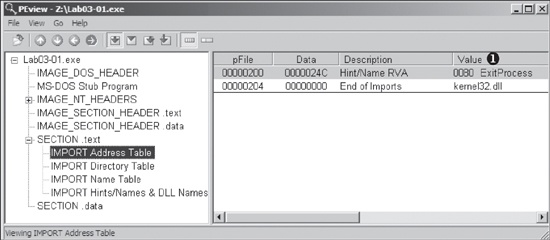
There is only one import to this binary, ExitProcess,
as seen at ❶ in the import address table. Without any
imports, it is tough to guess the program’s functionality. This program may be packed, since
the imports will likely be resolved at runtime.
Next, we look at the strings, as shown in the following listing.
StubPath
SOFTWARE\Classes\http\shell\open\commandV
Software\Microsoft\Active Setup\Installed Components\
test
www.practicalmalwareanalysis.com
admin
VideoDriver
WinVMX32-
vmx32to64.exe
SOFTWARE\Microsoft\Windows\CurrentVersion\Run
SOFTWARE\Microsoft\Windows\CurrentVersion\Explorer\Shell Folders
AppData
We wouldn’t expect to see strings, since the imports led us to believe that the file is
packed, but there are many interesting strings, such as registry locations and a domain name, as
well as WinVMX32, VideoDriver,
and vmx32to64.exe. Let’s see if basic dynamic analysis
techniques will show us how these strings are used.
Before we run the malware, we run procmon and clear out all events; start Process Explorer; and set up a virtual network, including ApateDNS, Netcat (listening on ports 80 and 443), and network capturing with Wireshark.
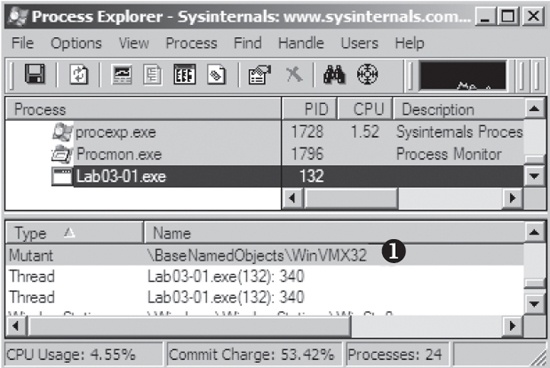
Once we run the malware, we start examining the process in Process Explorer, as shown in Figure C-2. We begin by clicking
Lab03-01.exe in the process listing and select View
▸ Lower Pane View ▸ Handles. In this view, we can see that the malware has
created the mutex named WinVMX32 at ❶. We also select View ▸ Lower Pane
View ▸ DLLs and see that the malware has dynamically loaded DLLs such as
ws2_32.dll and wshtcpip.dll, which means that it has
networking functionality.
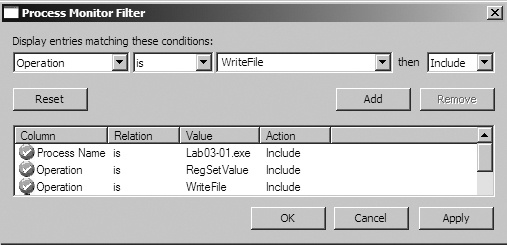
Next, we use procmon to look for additional information. We bring up the Filter dialog
by selecting Filter ▸ Filter, and then set three filters:
one on the Process Name (to show what Lab03-01.exe does to the system), and two
more on Operation, as shown in Figure C-3. We
include RegSetValue and WriteFile to show changes the malware makes to the filesystem and registry.
Having set our filters, we click Apply to see the filtered
result. The entries are reduced from thousands to just the 10 seen in Figure C-4. Notice that there is only one entry for
WriteFile, and there are nine entries for RegSetValue.
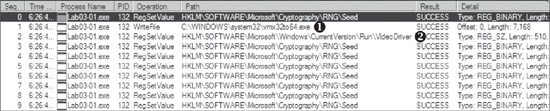
As discussed in Chapter 3, we often need to filter out
a certain amount of noise, such as entries 0 and 3 through 9 in Figure C-4. The RegSetValue on HKLM\SOFTWARE\Microsoft\Cryptography\RNG\Seed is typical noise in the results because the
random number generator seed is constantly updated in the registry by software.
We are left with two interesting entries, as shown in Figure C-4 at ❶ and ❷. The first is the WriteFile operation at ❶.
Double-clicking this entry tells us that it wrote 7,168 bytes to
C:\WINDOWS\system32\vmx32to64.exe, which happens to be the same size as that of
the file Lab03-01.exe. Opening Windows Explorer and browsing to that location
shows that this newly created file has the same MD5 hash as Lab03-01.exe, which
tells us that the malware has copied itself to that name and location. This can be a useful
host-based indicator for the malware because it uses a hard-coded filename.
Next, we double-click the entry at ❷ in the figure, and see that the malware wrote the following data to the registry:
HKLM\SOFTWARE\Microsoft\Windows\CurrentVersion\Run\VideoDriver:C:\WINDOWS\system32\vmx32to64.exe
This newly created registry entry is used to run vmx32to64.exe on system
startup using the HKLM\SOFTWARE\Microsoft\Windows\CurrentVersion\Run location and creating a key named
VideoDriver. We can now bring up procmon’s Filter dialog,
remove the Operation filters, and slowly comb through the entries for any information we may have
missed.
Next, we turn our attention to the network analysis tools we set up for basic dynamic analysis. First we check ApateDNS to see if the malware performed any DNS requests. Examining the output, we see a request for www.practicalmalwareanalysis.com, which matches the strings listing shown earlier. (To be sure that the malware has a chance to make additional DNS requests, if any, perform the analysis process a couple of times to see if the DNS request changes or use the NXDOMAIN functionality of ApateDNS.)
We complete the network analysis by examining the Netcat results, as shown in the following listing.
C:\>nc -l -p 443
\7⌠ëÅ¿A :°I,j!Yûöí?Ç:lfh↨O±ⁿ)α←εg%┬∟#xp╧O+╙3Ω☺nåiE☼?═■p}»╝/
º_∞~]ò£»ú¿¼▬F^"Äμ▒├
♦∟ªòj╡<û(y!∟♫5Z☺!♀va╪┴╗úI┤ßX╤â8╫²ñö'i¢k╢╓(√Q‼%O¶╡9.▐σÅw♀‼±Wm^┐#ñæ╬°☻/
[⌠│⌡xH╫▲É║‼
x?╦ƺ│ºLf↕x┌gYΦ<└§☻μºx)╤SBxè↕◄╟♂4AÇ
It looks like we got lucky: The malware appears to beacon out over port 443, and we were listening with Netcat over ports 80 and 443. (Use INetSim to listen on all ports at once.) We run this test several times, and the data appears to be random each time.
A follow-up in Wireshark tells us that the beacon packets are of consistent size (256 bytes) and appear to contain random data not related to the SSL protocol that normally operates over port 443.