
Inside users.test.js we can add the test case below our other test case, it ('should return names for node course'). We're going to write the case that returns all of the users inside the Node course, we should get the two users back, Mike and Julie. We'll make a variable, we'll call that variable userList, and what we're going to do is call the users variable defined already:
it('should return names for node course', () => {
  var userList = users
});
This is the one with our seed data. We do not need to create a custom one like we do for the other test case, users.getUserList. And we know getUserList takes one argument, the name of the room you want to fetch the list for, this one is called Node Course. Make sure your capitalization lines up. Then we can go ahead and add a semicolon at the end:
it('should return names for node course', () => {
  var userList = users.getUserList('Node Course');
});
The last thing to do is add our assertion, making sure that what we get back is what's expected. We'll expect that userList equals, using toEqual, the following array. It's going to be an array where the first item is Mike and the second item is Julie:
it('should return names for node course', () => {
  var userList = users.getUserList('Node Course');

  expect(userList).toEqual(['Mike', 'Julie']);
});
If that assertion passes, we know getUserList worked as expected because that's exactly what we have defined up above.
Now we can go ahead and copy this test case. Doing the exact same thing for the React Course should return names for react course, we'll change Node to React and we're going to go ahead and update what we expect. The React Course has just one user, that user has name equal to Jen:
it('should return names for react course', () => {
  var userList = users.getUserList('React Course');

  expect(userList).toEqual(['Jen']);
});
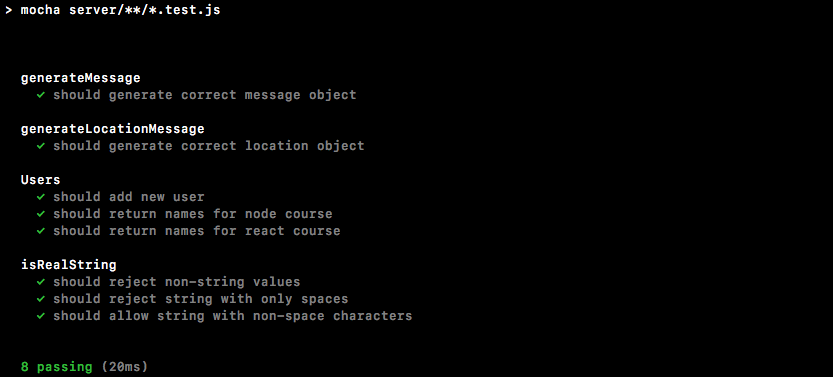
Now this is a pretty good test case. If we save users.test.js it's going to rerun the entire test suite. We should see we have our three tests under the users describe block, and they should all be passing, that is indeed the case:
The next two methods that we're going to be creating are removeUser and getUser. Let's go ahead and write the it statements for the test cases together, and you'll be responsible for actually filling out the method and filling out the test case:
it('should remove a user', () => {

});
This method is going to take the ID of one of our seed users, whether it's 1, 2 or 3. It's going to pass it to the function removeUser, and your job is going to be to assert that the user was indeed removed. Next up, it('should not remove user'):
it ('should not remove user', () => {

});
In this case, I want you to pass in an ID that is not part of our seed user array, that means something like 44, 128, or basically any string that's not 1, 2, or 3. In this case, you should be asserting that the array has not changed; we should still have those three items.
Now those are the two test cases for our removeUser method, next up is getUser. We're going to add two similar test cases. First up, it('should find user'), you should pass in a valid ID and you should get the user object back. And the other one is going to be it ('should not find user'), just like it('should not remove a user'). Pass in an invalid ID and make sure you do not get a user object back.