Table of Contents for
QGIS: Becoming a GIS Power User
 QGIS: Becoming a GIS Power User
Published by
Packt Publishing, 2017
QGIS: Becoming a GIS Power User
Published by
Packt Publishing, 2017
- Cover
- Table of Contents
- QGIS: Becoming a GIS Power User
- QGIS: Becoming a GIS Power User
- QGIS: Becoming a GIS Power User
- Credits
- Preface
- What you need for this learning path
- Who this learning path is for
- Reader feedback
- Customer support
- 1. Module 1
- 1. Getting Started with QGIS
- Running QGIS for the first time
- Introducing the QGIS user interface
- Finding help and reporting issues
- Summary
- 2. Viewing Spatial Data
- Dealing with coordinate reference systems
- Loading raster files
- Loading data from databases
- Loading data from OGC web services
- Styling raster layers
- Styling vector layers
- Loading background maps
- Dealing with project files
- Summary
- 3. Data Creation and Editing
- Working with feature selection tools
- Editing vector geometries
- Using measuring tools
- Editing attributes
- Reprojecting and converting vector and raster data
- Joining tabular data
- Using temporary scratch layers
- Checking for topological errors and fixing them
- Adding data to spatial databases
- Summary
- 4. Spatial Analysis
- Combining raster and vector data
- Vector and raster analysis with Processing
- Leveraging the power of spatial databases
- Summary
- 5. Creating Great Maps
- Labeling
- Designing print maps
- Presenting your maps online
- Summary
- 6. Extending QGIS with Python
- Getting to know the Python Console
- Creating custom geoprocessing scripts using Python
- Developing your first plugin
- Summary
- 2. Module 2
- 1. Exploring Places – from Concept to Interface
- Acquiring data for geospatial applications
- Visualizing GIS data
- The basemap
- Summary
- 2. Identifying the Best Places
- Raster analysis
- Publishing the results as a web application
- Summary
- 3. Discovering Physical Relationships
- Spatial join for a performant operational layer interaction
- The CartoDB platform
- Leaflet and an external API: CartoDB SQL
- Summary
- 4. Finding the Best Way to Get There
- OpenStreetMap data for topology
- Database importing and topological relationships
- Creating the travel time isochron polygons
- Generating the shortest paths for all students
- Web applications – creating safe corridors
- Summary
- 5. Demonstrating Change
- TopoJSON
- The D3 data visualization library
- Summary
- 6. Estimating Unknown Values
- Interpolated model values
- A dynamic web application – OpenLayers AJAX with Python and SpatiaLite
- Summary
- 7. Mapping for Enterprises and Communities
- The cartographic rendering of geospatial data – MBTiles and UTFGrid
- Interacting with Mapbox services
- Putting it all together
- Going further – local MBTiles hosting with TileStream
- Summary
- 3. Module 3
- 1. Data Input and Output
- Finding geospatial data on your computer
- Describing data sources
- Importing data from text files
- Importing KML/KMZ files
- Importing DXF/DWG files
- Opening a NetCDF file
- Saving a vector layer
- Saving a raster layer
- Reprojecting a layer
- Batch format conversion
- Batch reprojection
- Loading vector layers into SpatiaLite
- Loading vector layers into PostGIS
- 2. Data Management
- Joining layer data
- Cleaning up the attribute table
- Configuring relations
- Joining tables in databases
- Creating views in SpatiaLite
- Creating views in PostGIS
- Creating spatial indexes
- Georeferencing rasters
- Georeferencing vector layers
- Creating raster overviews (pyramids)
- Building virtual rasters (catalogs)
- 3. Common Data Preprocessing Steps
- Converting points to lines to polygons and back – QGIS
- Converting points to lines to polygons and back – SpatiaLite
- Converting points to lines to polygons and back – PostGIS
- Cropping rasters
- Clipping vectors
- Extracting vectors
- Converting rasters to vectors
- Converting vectors to rasters
- Building DateTime strings
- Geotagging photos
- 4. Data Exploration
- Listing unique values in a column
- Exploring numeric value distribution in a column
- Exploring spatiotemporal vector data using Time Manager
- Creating animations using Time Manager
- Designing time-dependent styles
- Loading BaseMaps with the QuickMapServices plugin
- Loading BaseMaps with the OpenLayers plugin
- Viewing geotagged photos
- 5. Classic Vector Analysis
- Selecting optimum sites
- Dasymetric mapping
- Calculating regional statistics
- Estimating density heatmaps
- Estimating values based on samples
- 6. Network Analysis
- Creating a simple routing network
- Calculating the shortest paths using the Road graph plugin
- Routing with one-way streets in the Road graph plugin
- Calculating the shortest paths with the QGIS network analysis library
- Routing point sequences
- Automating multiple route computation using batch processing
- Matching points to the nearest line
- Creating a routing network for pgRouting
- Visualizing the pgRouting results in QGIS
- Using the pgRoutingLayer plugin for convenience
- Getting network data from the OSM
- 7. Raster Analysis I
- Using the raster calculator
- Preparing elevation data
- Calculating a slope
- Calculating a hillshade layer
- Analyzing hydrology
- Calculating a topographic index
- Automating analysis tasks using the graphical modeler
- 8. Raster Analysis II
- Calculating NDVI
- Handling null values
- Setting extents with masks
- Sampling a raster layer
- Visualizing multispectral layers
- Modifying and reclassifying values in raster layers
- Performing supervised classification of raster layers
- 9. QGIS and the Web
- Using web services
- Using WFS and WFS-T
- Searching CSW
- Using WMS and WMS Tiles
- Using WCS
- Using GDAL
- Serving web maps with the QGIS server
- Scale-dependent rendering
- Hooking up web clients
- Managing GeoServer from QGIS
- 10. Cartography Tips
- Using Rule Based Rendering
- Handling transparencies
- Understanding the feature and layer blending modes
- Saving and loading styles
- Configuring data-defined labels
- Creating custom SVG graphics
- Making pretty graticules in any projection
- Making useful graticules in printed maps
- Creating a map series using Atlas
- 11. Extending QGIS
- Defining custom projections
- Working near the dateline
- Working offline
- Using the QspatiaLite plugin
- Adding plugins with Python dependencies
- Using the Python console
- Writing Processing algorithms
- Writing QGIS plugins
- Using external tools
- 12. Up and Coming
- Preparing LiDAR data
- Opening File Geodatabases with the OpenFileGDB driver
- Using Geopackages
- The PostGIS Topology Editor plugin
- The Topology Checker plugin
- GRASS Topology tools
- Hunting for bugs
- Reporting bugs
- Bibliography
- Index
PostGIS is the spatial add-on to the popular PostgreSQL database. It's a server-style database with authentication, permissions, schemas, and handling of simultaneous users. When you want to store large amounts of vector data and query them efficiently, especially in a multicomputer networked environment, consider PostGIS. This works fine for small data too, but many users find its configuration too much work when SpatiaLite may be better suited.
Pick a vector layer and load it in QGIS. You will also need to have a working copy of Postgres/PostGIS running, a PostGIS database created, and an account that allows table creation.
Tip
BostonGIS maintains a decent tutorial on installation for Windows, and getting a PostGIS set up for everyone. You can find this at http://www.bostongis.com/?content_name=postgis_tut01#316.
You should configure QGIS to be aware of your database and its connection parameters by creating a new database item in the PostGIS load dialog or by right-clicking on PostGIS in the Browser tab and selecting New Connection:
You can find more information about PostGIS at http://docs.qgis.org/2.8/en/docs/user_manual/working_with_vector/supported_data.html#postgis-layers.
Now that you can connect to a PostGIS database, you are ready to try importing data:
- Open DB Manager from the Database menu.
- Expand the PostGIS item to list your databases. Expand the database that you want to connect to, and you should be prompted to authenticate (if you haven't saved your password in the settings).
- Expand the list and select the Public schema.
- Click on the following import layer icon:

- A dialog will pop up, providing you with import options.
- Select the layer to import from the drop-down list.
- Fill in a name for the new table.
- Check whether schema is set to public.
- In most cases, the only thing left to do is check the Create spatial index checkbox:
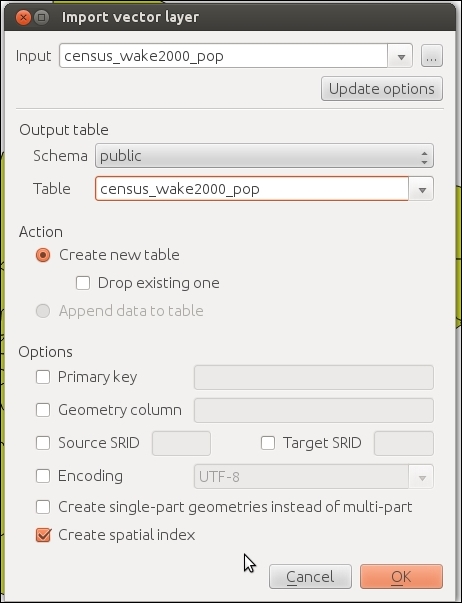
QGIS converts your geometries to a format that is compatible with PostGIS, and inserts it, along with importing the attributes. Afterwards, it updates the metadata views in PostGIS to register the geometry column and build the spatial index on it. These two post-processes make the database table appear as a spatial layer to QGIS and speed up the loading of data from the table when panning and zooming.
The options presented in the dialog are not all the options that are available. If you need more control or advanced options present, you'll likely be looking at the command-line tools: shp2pgsql (a graphical plugin for pgadmin3 is available on some platforms) and ogr2ogr. The shp2pgsql tool generally only handles shapefiles. If you have other formats, ogr2ogr can handle everything that QGIS is capable of loading. You can also use these tools to develop batch import scripts.
To import large or complicated CSV or text files, you sometimes will need to use the pgadmin3 or psql command-line interface to Postgres.
Need even more control? Then, consider scripting. OGR and Postgres both have very capable Python libraries.
Another option is using the OpenGeo Suite plugin, which has some additional options, such as allowing importing multiple layers into a single table or into one table per layer. To learn more about this, including how to install it, refer to http://qgis.boundlessgeo.com/static/docs/intro.html.
What happens if this fails? Databases can be really picky sometimes:
- It could be character encoding (accents, non-Latin languages), which requires specifying the encoding.
- It could be picky about mixing multilayers with regular layers. Multilayers is when you have several separate geometries that are part of one record. For example, Hawaii is actually many islands. So, if you only have one row representing Hawaii, you need to cram all the island polygons into one geometry field. However, if you mix this with North Dakota that is just a polygon, the import will fail. If you have this problem, you'll need to perform the import on the command-line using ogr2ogr and its new feature,
-nlt PROMOTE_TO_MULTI, which converts all single items to multi-items, to fix this. - Depending on your original source, you may have a mix of points, lines, and polygons. You'll either need to convert this to a Geometry Collection, or you need to split each type of geometry into a separate layer. Geometry Collections are currently poorly supported in many GIS viewers, so this is only recommended for advanced users.
For more information on PostGIS installation and setup, refer to http://postgis.net/install.
For a more in-depth text on using PostGIS, there are many books available, including Packt Publishing's PostGIS Cookbook.