Table of Contents for
QGIS: Becoming a GIS Power User
 QGIS: Becoming a GIS Power User
Published by
Packt Publishing, 2017
QGIS: Becoming a GIS Power User
Published by
Packt Publishing, 2017
- Cover
- Table of Contents
- QGIS: Becoming a GIS Power User
- QGIS: Becoming a GIS Power User
- QGIS: Becoming a GIS Power User
- Credits
- Preface
- What you need for this learning path
- Who this learning path is for
- Reader feedback
- Customer support
- 1. Module 1
- 1. Getting Started with QGIS
- Running QGIS for the first time
- Introducing the QGIS user interface
- Finding help and reporting issues
- Summary
- 2. Viewing Spatial Data
- Dealing with coordinate reference systems
- Loading raster files
- Loading data from databases
- Loading data from OGC web services
- Styling raster layers
- Styling vector layers
- Loading background maps
- Dealing with project files
- Summary
- 3. Data Creation and Editing
- Working with feature selection tools
- Editing vector geometries
- Using measuring tools
- Editing attributes
- Reprojecting and converting vector and raster data
- Joining tabular data
- Using temporary scratch layers
- Checking for topological errors and fixing them
- Adding data to spatial databases
- Summary
- 4. Spatial Analysis
- Combining raster and vector data
- Vector and raster analysis with Processing
- Leveraging the power of spatial databases
- Summary
- 5. Creating Great Maps
- Labeling
- Designing print maps
- Presenting your maps online
- Summary
- 6. Extending QGIS with Python
- Getting to know the Python Console
- Creating custom geoprocessing scripts using Python
- Developing your first plugin
- Summary
- 2. Module 2
- 1. Exploring Places – from Concept to Interface
- Acquiring data for geospatial applications
- Visualizing GIS data
- The basemap
- Summary
- 2. Identifying the Best Places
- Raster analysis
- Publishing the results as a web application
- Summary
- 3. Discovering Physical Relationships
- Spatial join for a performant operational layer interaction
- The CartoDB platform
- Leaflet and an external API: CartoDB SQL
- Summary
- 4. Finding the Best Way to Get There
- OpenStreetMap data for topology
- Database importing and topological relationships
- Creating the travel time isochron polygons
- Generating the shortest paths for all students
- Web applications – creating safe corridors
- Summary
- 5. Demonstrating Change
- TopoJSON
- The D3 data visualization library
- Summary
- 6. Estimating Unknown Values
- Interpolated model values
- A dynamic web application – OpenLayers AJAX with Python and SpatiaLite
- Summary
- 7. Mapping for Enterprises and Communities
- The cartographic rendering of geospatial data – MBTiles and UTFGrid
- Interacting with Mapbox services
- Putting it all together
- Going further – local MBTiles hosting with TileStream
- Summary
- 3. Module 3
- 1. Data Input and Output
- Finding geospatial data on your computer
- Describing data sources
- Importing data from text files
- Importing KML/KMZ files
- Importing DXF/DWG files
- Opening a NetCDF file
- Saving a vector layer
- Saving a raster layer
- Reprojecting a layer
- Batch format conversion
- Batch reprojection
- Loading vector layers into SpatiaLite
- Loading vector layers into PostGIS
- 2. Data Management
- Joining layer data
- Cleaning up the attribute table
- Configuring relations
- Joining tables in databases
- Creating views in SpatiaLite
- Creating views in PostGIS
- Creating spatial indexes
- Georeferencing rasters
- Georeferencing vector layers
- Creating raster overviews (pyramids)
- Building virtual rasters (catalogs)
- 3. Common Data Preprocessing Steps
- Converting points to lines to polygons and back – QGIS
- Converting points to lines to polygons and back – SpatiaLite
- Converting points to lines to polygons and back – PostGIS
- Cropping rasters
- Clipping vectors
- Extracting vectors
- Converting rasters to vectors
- Converting vectors to rasters
- Building DateTime strings
- Geotagging photos
- 4. Data Exploration
- Listing unique values in a column
- Exploring numeric value distribution in a column
- Exploring spatiotemporal vector data using Time Manager
- Creating animations using Time Manager
- Designing time-dependent styles
- Loading BaseMaps with the QuickMapServices plugin
- Loading BaseMaps with the OpenLayers plugin
- Viewing geotagged photos
- 5. Classic Vector Analysis
- Selecting optimum sites
- Dasymetric mapping
- Calculating regional statistics
- Estimating density heatmaps
- Estimating values based on samples
- 6. Network Analysis
- Creating a simple routing network
- Calculating the shortest paths using the Road graph plugin
- Routing with one-way streets in the Road graph plugin
- Calculating the shortest paths with the QGIS network analysis library
- Routing point sequences
- Automating multiple route computation using batch processing
- Matching points to the nearest line
- Creating a routing network for pgRouting
- Visualizing the pgRouting results in QGIS
- Using the pgRoutingLayer plugin for convenience
- Getting network data from the OSM
- 7. Raster Analysis I
- Using the raster calculator
- Preparing elevation data
- Calculating a slope
- Calculating a hillshade layer
- Analyzing hydrology
- Calculating a topographic index
- Automating analysis tasks using the graphical modeler
- 8. Raster Analysis II
- Calculating NDVI
- Handling null values
- Setting extents with masks
- Sampling a raster layer
- Visualizing multispectral layers
- Modifying and reclassifying values in raster layers
- Performing supervised classification of raster layers
- 9. QGIS and the Web
- Using web services
- Using WFS and WFS-T
- Searching CSW
- Using WMS and WMS Tiles
- Using WCS
- Using GDAL
- Serving web maps with the QGIS server
- Scale-dependent rendering
- Hooking up web clients
- Managing GeoServer from QGIS
- 10. Cartography Tips
- Using Rule Based Rendering
- Handling transparencies
- Understanding the feature and layer blending modes
- Saving and loading styles
- Configuring data-defined labels
- Creating custom SVG graphics
- Making pretty graticules in any projection
- Making useful graticules in printed maps
- Creating a map series using Atlas
- 11. Extending QGIS
- Defining custom projections
- Working near the dateline
- Working offline
- Using the QspatiaLite plugin
- Adding plugins with Python dependencies
- Using the Python console
- Writing Processing algorithms
- Writing QGIS plugins
- Using external tools
- 12. Up and Coming
- Preparing LiDAR data
- Opening File Geodatabases with the OpenFileGDB driver
- Using Geopackages
- The PostGIS Topology Editor plugin
- The Topology Checker plugin
- GRASS Topology tools
- Hunting for bugs
- Reporting bugs
- Bibliography
- Index
At this point, you may be wondering, what about the maps? So far, we have not included any geospatial data or visualization. We will be offloading some of the effort in managing and providing geospatial data and services to OpenStreetMap—our favorite public open source geospatial data repository!
Note
Why do we use OpenStreetMap?
- OSM already provides mirrored map services for quick reproduction in the basemaps
- OSM provides a very extensive and scalable schema for the kind of geographic features that you might find on a campus
- Various web, mobile, and desktop clients have already been written to interact with the OSM API
- OSM provides the databases and other infrastructure, so we don't have to
- OSM has a granular and reliable way to track changes, using the
osm_versionandosm_userfields, which complement theosm_idunique ID field
To use the OSM data, we need to get it in a format that will be interoperable with other GIS software components. A quick and powerful solution is to store the OSM data in a SQLite SpatiaLite database instance, which, if you remember, is a single file with full spatial and SQL functionality.
To use QGIS to download and convert OSM to SQLite, perform the following steps:
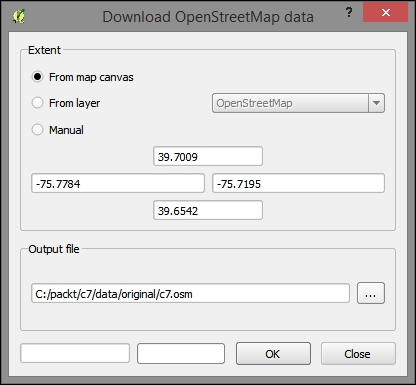
- Obtain the OSM data in the same way that we did in Chapter 4, Finding the Best Way to Get There. Use the OpenLayers plugin to zoom into Newark, DE (or use the extent,
39.7009,-75.7195,39.6542,-75.7784, clockwise from the top of the dialog in the next step):- Navigate to Vector | OpenStreetMap | Download Data to download the OSM data for this extent.
- Next, export the XML data in the
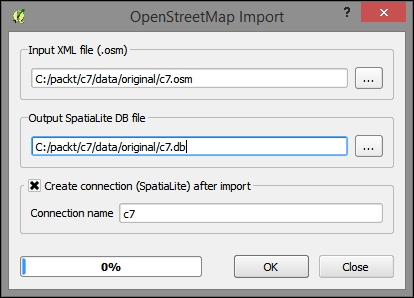
.osmfile to a topological SQLite database. This could potentially be used for routing; although, we will not be doing so here.- Navigate to Vector | OpenStreetMap | Import Topology from XML.
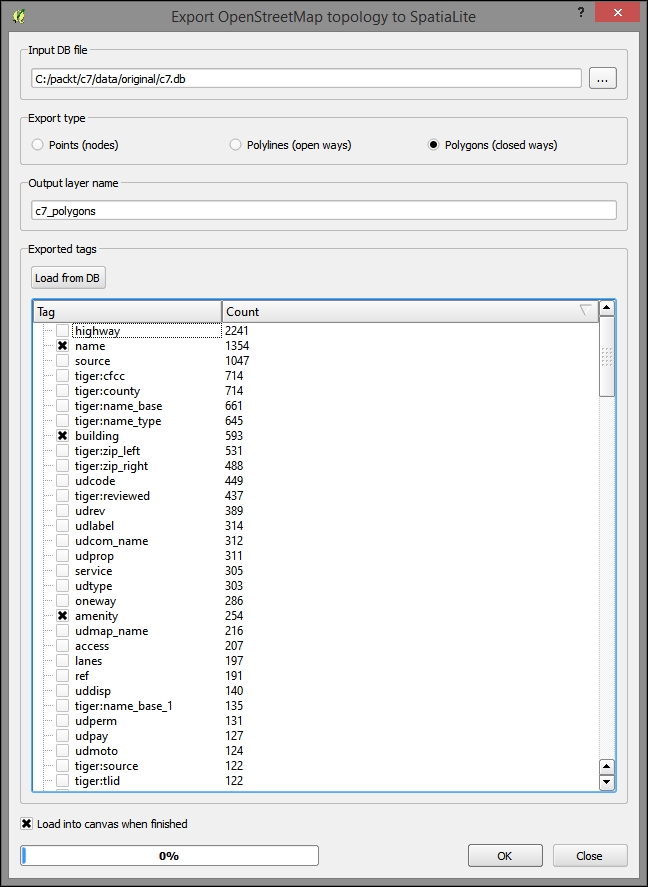
- Next, export the topological data to normal geospatial data—polygons in this case.
- Navigate to Vector | OpenStreetMap | Export topology to SpatiaLite.
- Export type: Polygons (closed ways).
- Click on Load from DB to populate the list of fields in the data. Select the fields amenity, building, name, and leisure, as shown in the following screenshot, as fit allowed:
- Use DB Manager to display the university buildings.
- Navigate to Database | DB Manager | DB Manager.
- Highlight the c7 SQLite database.
- Execute the following query, ensuring that Load as new layer is selected:
SELECT * FROM c7_polygons WHERE building = 'yes' and amenity = 'university'
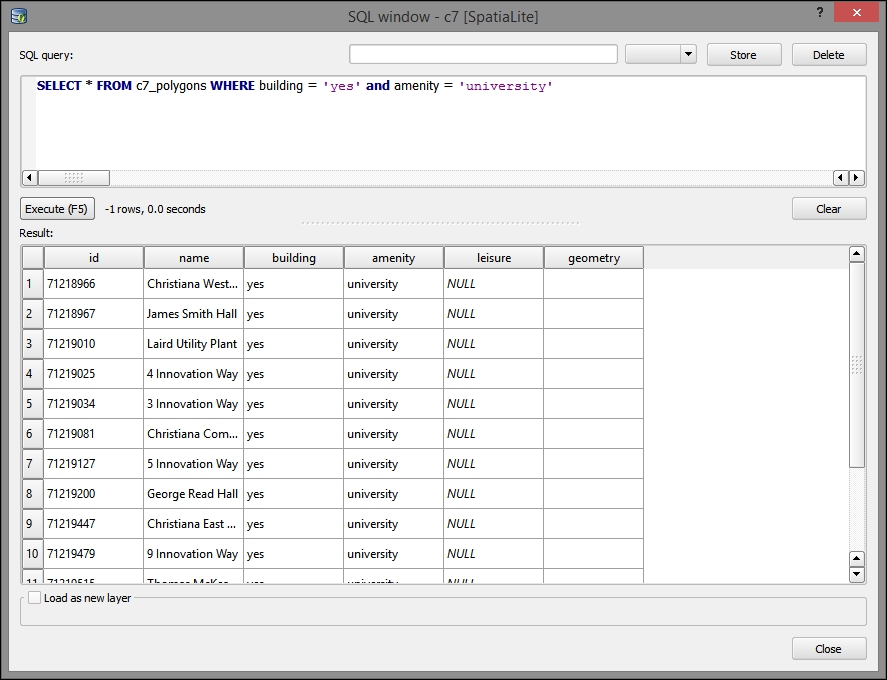
- Export the query layer to
c7/data/original/delaware-latest-3875/buildings.shpwith the EPSG:3857 projection.
Although TileMill is no longer under active production by its creator Mapbox, it is still useful for us to produce MBTiles tiled images rendered by Mapnik using CartoCSS and a UTFGrid interaction layer.
TileMill requires that all the data be rendered and tiled together and, therefore, only supports vector data input, including JSON, shapefile, SpatiaLite, and PostGIS.
In the following steps, we will render a cartographically pleasing map as a .mbtiles (single-file-based) tile cache:
- Install and open TileMill.
- Download the Delaware data from the North America section of the Geofabrik OSM extracts site (http://download.geofabrik.de/north-america.html) as a shapefile. Alternatively, you can directly download it from http://download.geofabrik.de/north-america/us/delaware-latest.shp.zip. Ensure that you expand and copy the zip archive to your project directory after you've downloaded it.
- Reproject all the data from EPSG:4326 to :3875. If you remember, QGIS can do this in batch as with other Processing Toolbox algorithms, as you learned in Chapter 2, Identifying the Best Places, making this process a bit quicker.
Output all the layers to
c7/data/original/delaware-latest-3875.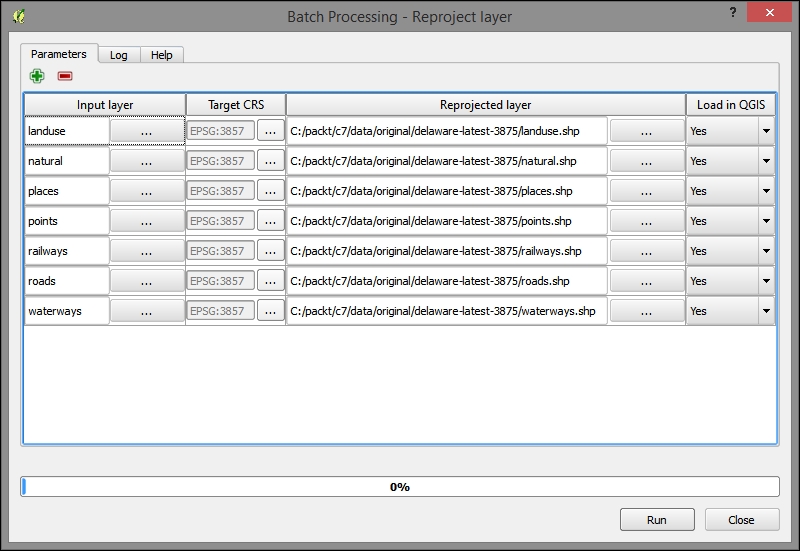
- Copy the DC example to a new project.
- You will find it in
C:\Program Files (x86)\TileMill-v0.10.1\tilemill\examples\open-streets-dc - Copy it to
C:\Users\[YOURUSERNAME]\Documents\MapBox\project\c7
- You will find it in
- Delete all the files from the
layersdirectory. - Copy and extract all the shapefiles from
c7/data/original/delaware-latest-3875into thelayersdirectory in theprojectdirectory ofc7, which can be found atC:\Users\[YOURUSERNAME]\Documents\MapBox\project\c7\layers. - Edit the
project.mmlfile.- Change all the instances of the
open-streets-dcstring toc7. - Change the single instance of
Open Streets, DCtoc7. - Substitute the following
boundsandcenter:"bounds": [ -75.7845, 39.6586, -75.7187, 39.71 ], "center": [ -75.7538, 39.6827, 14 ], - Change the following layer references to files:
Land usages: Change this layer fromosm-landusages.shptolanduse.shpocean: Remove this layer or ignorewater: Change this layer fromosm-waterareas.shptowaterways.shptunnels: Change this layer fromosm-roads.shptoroads.shproads: Change this layer fromosm-roads.shptoroads.shpmainroads: Change this layer fromosm-mainroads.shptoroads.shpmotorways: Change this layer fromosm-motorways.shptoroads.shpbridges: Change this layer fromosm-roads.shptoroads.shpplaces: Change this layer fromosm-places.shptoplaces.shproad-label: Change this layer fromosm-roads.shptoroads.shp
- Change all the instances of the
- Open TileMill and select the
c7project from the Projects dialog, as shown in the following screenshot: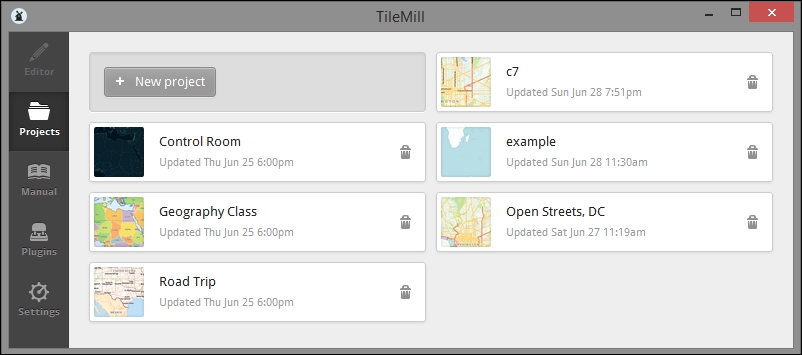
- Open the Layers panel from the bottommost button in the bottom-left corner. Refer to the next image.
- Click on + Add layer.
- Populate the parameters with the following values:
- ID:
buildings. - Datasource:
c7/data/original/delaware-latest-3875/buildings.shp. - Click on Save & Style. You can return to this dialog later by clicking on the Editor button (pencil icon) in the Layers panel, by the
#c7layer, as shown in the next image.
- ID:
- If you don't yet see your layer, ensure that you have some style defined in the tab on the right that will be applied to the layer (this should be populated by default with a minimal style). Then, click on Save in the top-right corner.
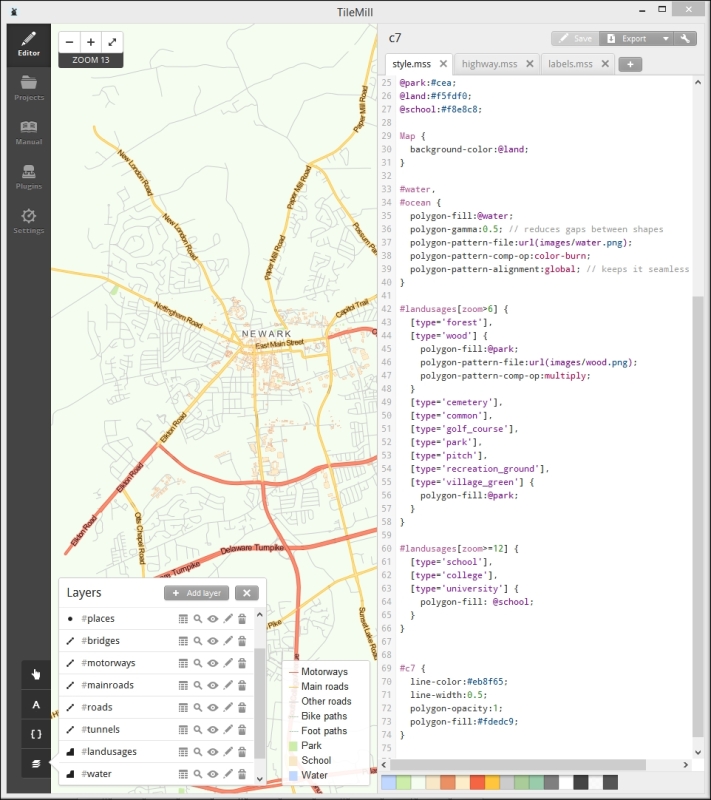
- Use the CartoCSS syntax to change the style in
style.mss. TileMill provides a color picker, which we can access by clicking on a swatch color at the bottom of the CartoCSS/style pane. After changing a color, you can view the hex code down there. Just pick a color, place the hex code in your CartoCSS, and save it. For example, consider the following code:#buildings { line-color:#eb8f65; line-width:0.5; polygon-opacity:1; polygon-fill:#fdedc9; } - Click on Save (with the pencil icon) in the upper-right corner of the main screen (above the CartoCSS input) to view the changes, as shown in the following screenshot:
- Go to the Templates tab by clicking on the topmost button in the lower-left corner and change the Teaser and Full interaction types to use
{{{id}}}from buildings, as shown in the following screenshot: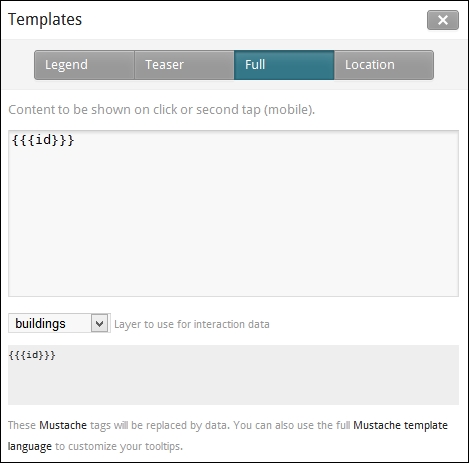
MBTiles is a format developed by Mapbox to store geographic information. There are two compelling aspects of this format, besides interaction with a small but impressive suite of software and services developed by Mapbox: firstly, MBTiles stores a whole tile store in a single file, which is easy to transfer and maintain and secondly, UTFGrid, which is the use of UTF characters for highly performant data interaction, is enabled by this format.
- Create an account on mapbox.com.
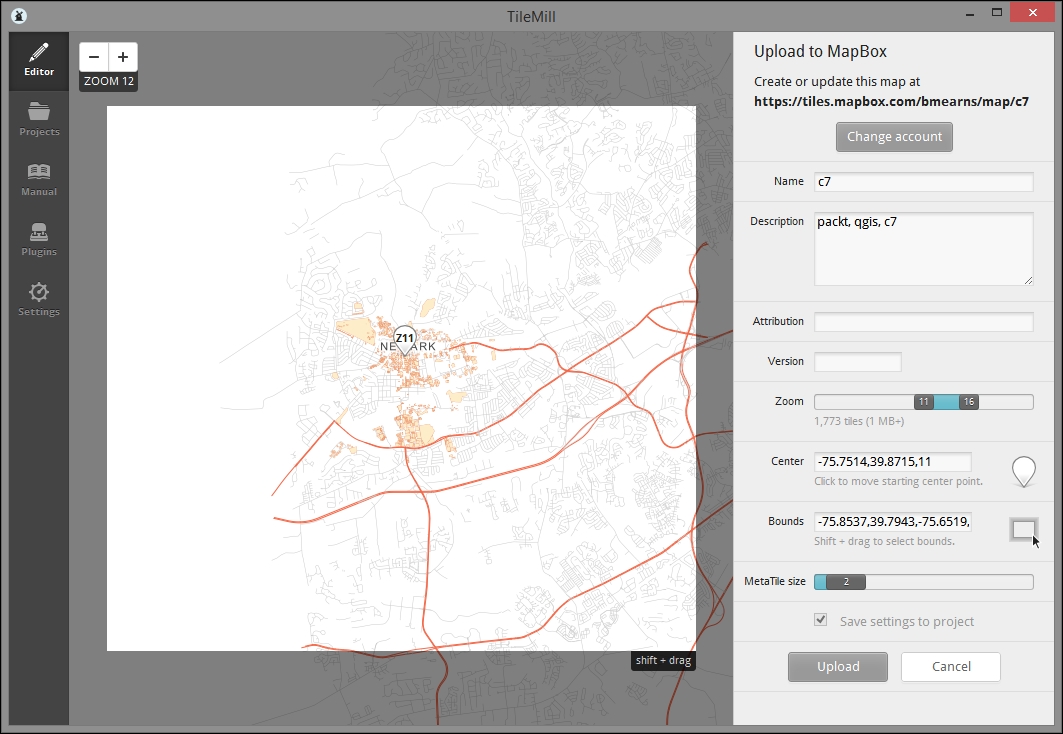
- Access the Export dialog from the Export button in the upper-right corner. Select Upload from this menu.
- Sign in to your Mapbox account by clicking on the button at the top of the dialog.
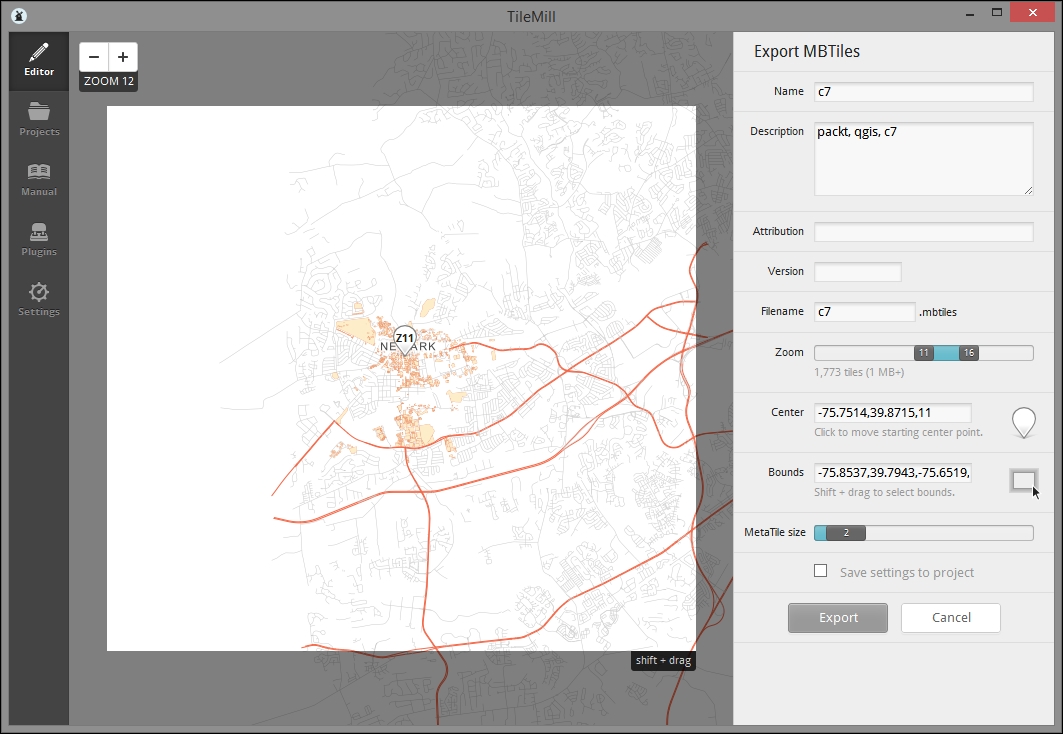
- Press Shift, click on it, and drag to define an extent in the map.
- Zoom to one level above your intended minimum zoom to preview the extent.
- Fill in the descriptive information in the export dialog.
- Name:
c7 - Zoom:
11to16
- Name:
- Click on the map to establish a Center coordinate.
- Select Save settings to project.
- Upload, as shown in the following screenshot:
The steps for exporting directly to an MBTiles file are similar to the previous procedure. This format can be uploaded to mapbox.com or served with software that supports the format, such as TileStream. Of course, no sign-on is needed.