Table of Contents for
Mastering OpenLayers 3
 Mastering OpenLayers 3
Published by
Packt Publishing, 2016
Mastering OpenLayers 3
Published by
Packt Publishing, 2016
- Cover
- Table of Contents
- Mastering OpenLayers 3
- Mastering OpenLayers 3
- Credits
- About the Author
- About the Reviewer
- www.PacktPub.com
- Preface
- What you need for this book
- Who this book is for
- Conventions
- Reader feedback
- Customer support
- 1. Creating Simple Maps with OpenLayers 3
- Structure of OpenLayers 3
- Building the layout
- Using the API documentation
- Debugging the code
- Summary
- 2. Applying Custom Styles
- Customizing the default appearance
- Styling vector layers
- Customizing the appearance with JavaScript
- Creating a WebGIS client layout
- Summary
- 3. Working with Layers
- Building a layer tree
- Adding layers dynamically
- Adding vector layers with the File API
- Adding vector layers with a library
- Removing layers dynamically
- Changing layer attributes
- Changing the layer order with the Drag and Drop API
- Clearing the message bar
- Summary
- 4. Using Vector Data
- Accessing attributes
- Setting attributes
- Validating attributes
- Creating thematic layers
- Saving vector data
- Saving with WFS-T
- Modifying the geometry
- Summary
- 5. Creating Responsive Applications with Interactions and Controls
- Building the toolbar
- Mapping interactions to controls
- Building a set of feature selection controls
- Adding new vector layers
- Building a set of drawing tools
- Modifying and snapping to features
- Creating new interactions
- Building a measuring control
- Summary
- 6. Controlling the Map – View and Projection
- Customizing a view
- Constraining a view
- Creating a navigation history
- Working with extents
- Rotating a view
- Changing the map's projection
- Creating custom animations
- Summary
- 7. Mastering Renderers
- Using different renderers
- Creating a WebGL map
- Drawing lines and polygons with WebGL
- Blending layers
- Clipping layers
- Exporting a map
- Creating a raster calculator
- Creating a convolution matrix
- Clipping a layer with WebGL
- Summary
- 8. OpenLayers 3 for Mobile
- Responsive styling with CSS
- Generating geocaches
- Adding device-dependent controls
- Vectorizing the mobile version
- Making the mobile application interactive
- Summary
- 9. Tools of the Trade – Integrating Third-Party Applications
- Exporting a QGIS project
- Importing shapefiles
- Spatial analysis with Turf
- Spatial analysis with JSTS
- 3D rendering with Cesium
- Summary
- 10. Compiling Custom Builds with Closure
- Configuring Node JS
- Compiling OpenLayers 3
- Bundling an application with OpenLayers 3
- Extending OpenLayers 3
- Creating rich documentation with JSDoc
- Summary
- Index
In the first example, called ch07_webgl, we will create our first WebGL map. We bring our application to its limits, displaying more than 200,000 points on a single map. If you haven't performed this test already, you must be thinking that the magnitude of features will render our application totally unresponsive and useless. Let's make an attempt to perform this test, though. For this example, we only have to modify our map constructor using our new vector layer and the WebGL renderer:
var map = new ol.Map({
    target: 'map',
    layers: [
        […]
        new ol.layer.Vector({
            source: new ol.source.Vector({
                format: new ol.format.GeoJSON({
                    defaultDataProjection: 'EPSG:4326'
                }),
                url: '../../res/switzerland_points_osm.geojson',
                attributions: [
                    new ol.Attribution({
                        html: 'Switzerland Points © OpenStreetMap Contributors'
                    })
                ]
            }),
            name: 'Switzerland Points'
        })
    ],
    […]
   view: new ol.View({
        center: [910000, 5900000],
        zoom: 9
    }),
    renderer: 'webgl'
});
If you save the example and load it in a browser, you will be able to take a look at all the points that are rendered after some processing time. The map is quite hard to handle on lower scales; however, it is still manageable. When we zoom in and out on higher scales, the map becomes responsive again:
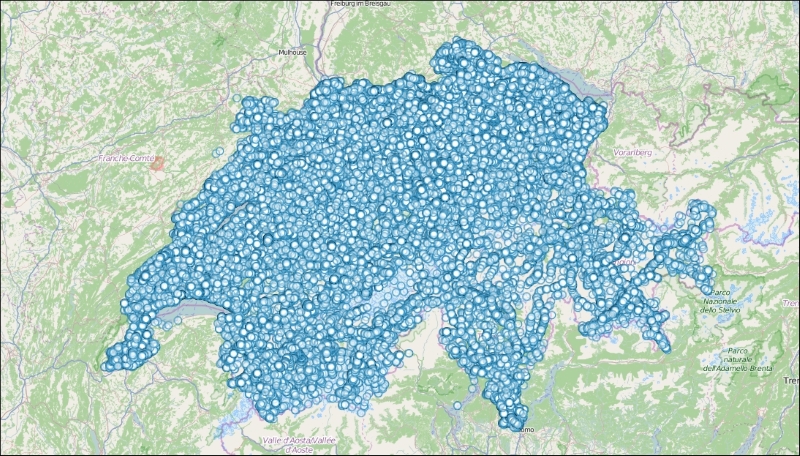
The only reason our application didn't freeze was due to the utilization of the GPU via the WebGL renderer. With proper hardware acceleration, we can display bigger datasets with acceptable performance.
There is only one serious limitation of this renderer: it cannot draw lines or polygons. The library will support such rendering methods over time; however, using vector lines and polygons are currently not supported. Furthermore, if we try to use line and polygon datasets with the WebGL renderer, the application will throw an error and stop running.