They are many JavaScript frameworks we can use if we want to build a client-side rendering website. ReactJS, AngularJS, and VueJS are among the most well-known frameworks—not surprising when you know that they're backed by Google and Facebook.
VueJS is one of the easiest to learn. That's why we chose to start with this one. In the last chapter of this book, we'll do a quick introduction to VueJS so that you can understand how it works and what are the possibilities for it:
VueJS allows you to create everything from small widgets, driven by JavaScript, which you drop into existing applications. Over medium-sized applications where you control the whole page through JavaScript and therefore re-render various parts, making it very reactive, and all the way up to building big enterprise-level applications, single-page application, where your whole web page, multiple pages (at least it feels like this to the user), are driven by VueJS, which renders significant parts of the DOMs, to make it look like they were different pages being loaded, but, in the end, JavaScript handles all of that.
Why JavaScript? Since JavaScript runs in the browser, you don't need to reach out to any server and wait for any responses if you only want to re-render parts of the application. This makes the application very reactive, makes it feel nice, and provides awesome user experiences.
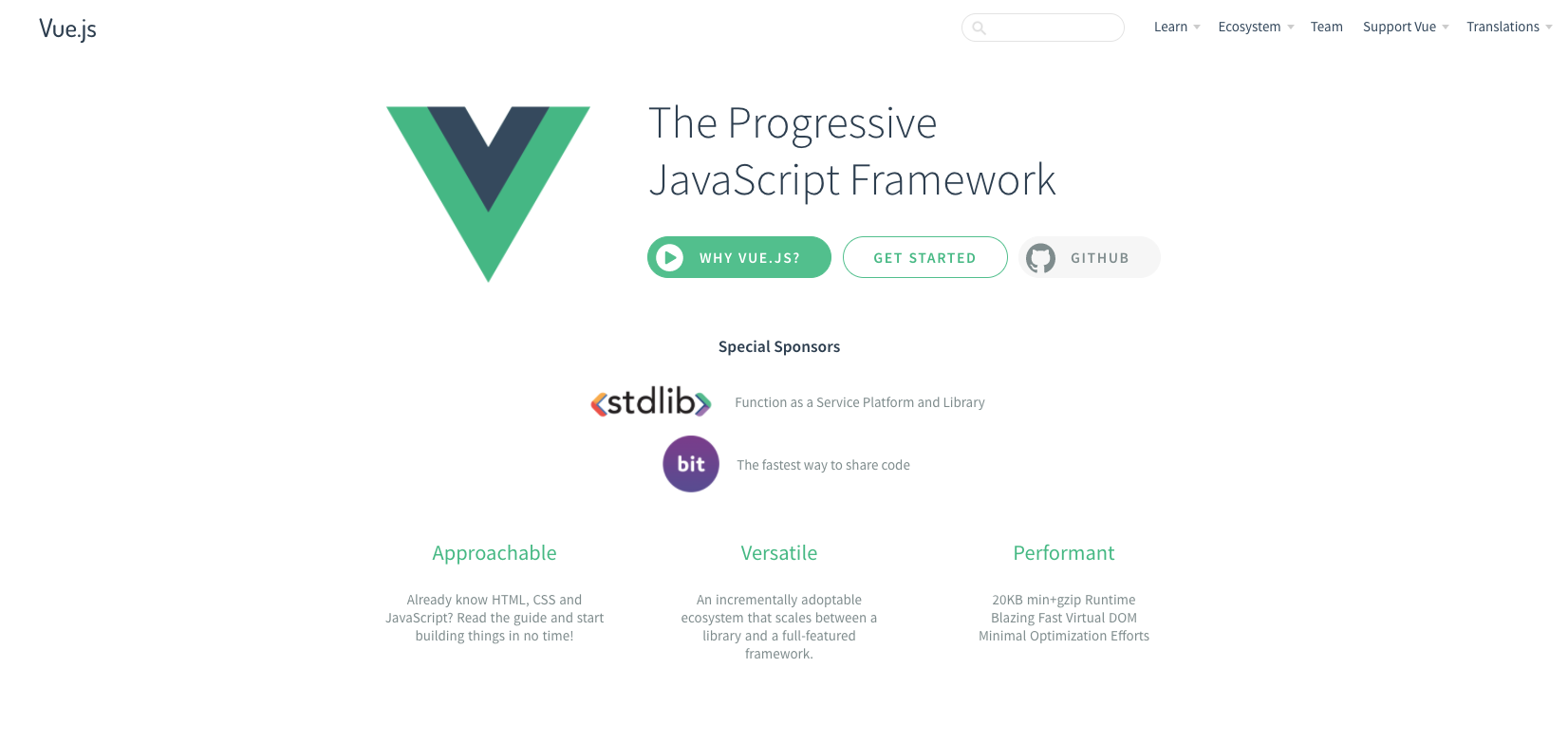
This is what you can do with VueJS. Now, why would you choose VueJS and not, let's say, Angular 2 or ReactJS, which you may know and does a similar thing. Well, first of all, VueJS is extremely lean and small regarding the file size. We're talking about 16 kilobytes, minified in gzip, for the core framework.
It's a very focused and to-the-point framework. However, it's not only small, hence providing a fast loading time, it's also fast at runtime, and, judging by some benchmarks, it even beats Angular 2 and ReactJS. Now, of course, it will always depend on your specific application.
I'd say let's dive right into it now and get started with VueJS and build our first little application and take a look at how we can actually get it set up.