Table of Contents for
Magento 2 - Build World-Class online stores
 Magento 2 - Build World-Class online stores
Published by
Packt Publishing, 2017
Magento 2 - Build World-Class online stores
Published by
Packt Publishing, 2017
- Cover
- Table of Contents
- Magento 2 - Build World-Class online stores
- Magento 2 - Build World-Class online stores
- Credits
- Preface
- 1. Module 1
- 1. Magento Fundamentals
- XAMPP installation
- Magento
- Summary
- 2. Magento 2.0 Features
- An introduction to the Magento order management system
- Magento 2.0 command-line configuration
- The command-line utility
- Summary
- 3. Working with Search Engine Optimization
- Store configuration
- SEO and searching
- SEO catalog configuration
- Google Analytics tracking code
- Optimizing Magento pages
- Summary
- 4. Magento 2.0 Theme Development – the Developers' Holy Grail
- Magento 2.0 theme structure
- The Magento Luma theme
- Magento theme inheritance
- CMS blocks and pages
- Custom variables
- Creating a basic Magento 2.0 theme
- Summary
- 5. Creating a Responsive Magento 2.0 Theme
- Composer – the PHP dependency manager
- Building the CompStore theme
- CSS preprocessing with LESS
- Applying new CSS to the CompStore theme
- Creating the CompStore logo
- Applying the theme
- Creating CompStore content
- Customizing Magento 2.0 templates
- Summary
- 6. Write Magento 2.0 Extensions – a Great Place to Go
- Using the Zend framework
- Magento 2.0 extension structure
- Developing your first Magento extension
- The Twitter REST API
- The TweetsAbout module structure
- Using TwitterOAuth to authenticate our extension
- Developing the module
- Summary
- 7. Go Mobile with Magento 2.0!
- Adjusting the CompStore theme for mobile devices
- The Magento 2.0 responsive design
- The Magento UI
- Implementing a new CSS mixin media query
- Adjusting tweets about extensions for mobile devices
- Summary
- 8. Speeding up Your Magento 2.0
- Indexing and caching Magento
- Indexing and re-indexing data
- The Magento cron job
- Caching
- Fine-tuning the Magento hosting server
- Selecting the right Magento hosting service
- Apache web server deflation
- Enabling the expires header
- Minifying scripts
- Summary
- 9. Improving Your Magento Skills
- Magento knowledge center
- Improving your Magento skills
- Summary
- 2. Module 2
- 1. Magento 2 System Tools
- Installing Magento 2 sample data via GUI
- Installing Magento 2 sample data via the command line
- Managing Magento 2 indexes via the command line
- Managing Magento 2 cache via the command line
- Managing Magento 2 backup via the command line
- Managing Magento 2 set mode (MAGE_MODE)
- Transferring your Magento 1 database to Magento 2
- 2. Enabling Performance in Magento 2
- Configuring Redis for backend cache
- Configuring Memcached for session caching
- Configuring Varnish as the Full Page Cache
- Configuring Magento 2 with CloudFlare
- Configuring optimized images in Magento 2
- Configuring Magento 2 with HTTP/2
- Configuring Magento 2 performance testing
- 3. Creating Catalogs and Categories
- Create a Root Catalog
- Create subcategories
- Manage attribute sets
- Create products
- Manage products in a catalog grid
- 4. Managing Your Store
- Creating shipping and tax rules
- Managing customer groups
- Configuring inventories
- Configuring currency rates
- Managing advanced pricing
- 5. Creating Magento 2 Extensions – the Basics
- Initializing extension basics
- Working with database models
- Creating tables using setup scripts
- Creating a web route and controller to display data
- Creating system configuration fields
- Creating a backend data grid
- Creating a backend form to add/edit data
- 6. Creating Magento 2 Extensions – Advanced
- Using dependency injection to pass classes to your own class
- Modifying functions with the use of plugins – Interception
- Creating your own XML module configuration file
- Creating your own product type
- Working with service layers/contracts
- Creating a Magento CLI command option
- 3. Module 3
- 1. Planning for Magento
- Technical considerations
- Global-Website-Store methodology
- Planning for multiple stores
- Summary
- 2. Managing Products
- Managing products the customer focused way
- Creating products
- Managing inventory
- Pricing tools
- Autosettings
- Related products, up-sells, and cross-sells
- Importing products
- Summary
- 3. Designs and Themes
- The concept of theme inheritance
- Default installation of design packages and themes
- Installing third-party themes
- Inline translations
- Working with theme variants
- Customizing themes
- Customizing layouts
- Summary
- 4. Configuring to Sell
- Payment methods
- Shipping methods
- Managing taxes
- Transactional e-mails
- Summary
- 5. Managing Non-Product Content
- Summary
- 6. Marketing Tools
- Promotions
- Newsletters
- Using sitemaps
- Optimizing for search engines
- Summary
- 7. Extending Magento
- The new Magento module architecture
- Extending Magento functionality with Magento plugins
- Building your own extensions
- Summary
- 8. Optimizing Magento
- Indexing and caching
- Caching in Magento 2 – not just FPC
- Tuning your server for speed
- Summary
- 9. Advanced Techniques
- Version control
- Magento cron
- Backing up your database
- Upgrading Magento
- Summary
- 10. Pre-Launch Checklist
- System configurations
- Design configurations
- Search engine optimization
- Sales configurations
- Product configurations
- Maintenance configurations
- Summary
- Index
One of Magento's strengths is the fact that the platform can be extended to provide additional features and functions. These extensions—or add-ons—number in the thousands. They include themes, payment gateway integrations, site management enhancements, utilities and many, many more features.
In this chapter, we will discuss the two primary ways of extending Magento:
- Extending existing Magento functionality to meet your own needs
- A quick overview of the current iteration of Magento Connect
- Creating your own Magento extensions
By learning how Magento can be enhanced, you will find that the power of Magento can be broadened to meet almost any specific e-commerce need you might imagine.
Third-party extensions that are offered to the Magento community are, for the most part, listed in a special section of the Magento website called Magento Connect (http://www.Magentocommerce.com/Magento-connect/):
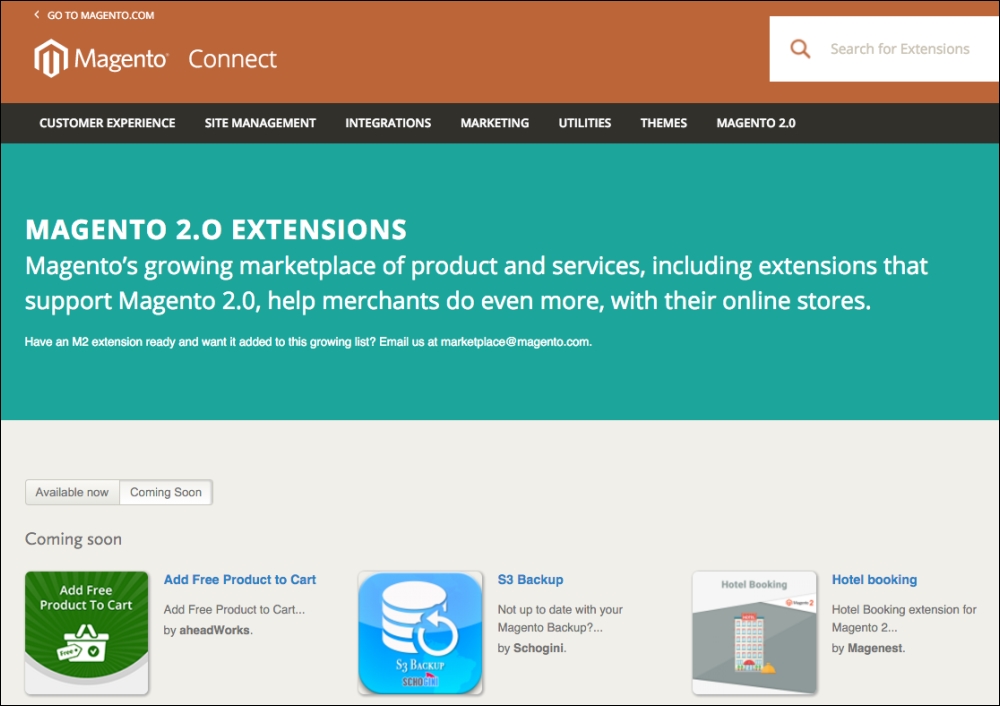
Let's now review some of the features of Magento Connect, as they relate to researching possible add-ons for your Magento installation.
At the center-right of the Magento Connect home page is a search field. As with any intuitive search, simply enter in one or more keywords. You can also select the specific version – which Magento calls a platform—in the drop-down menu to the right of the keyword entry field. As shown in the following screenshot, we are searching for any extensions relating to sales:
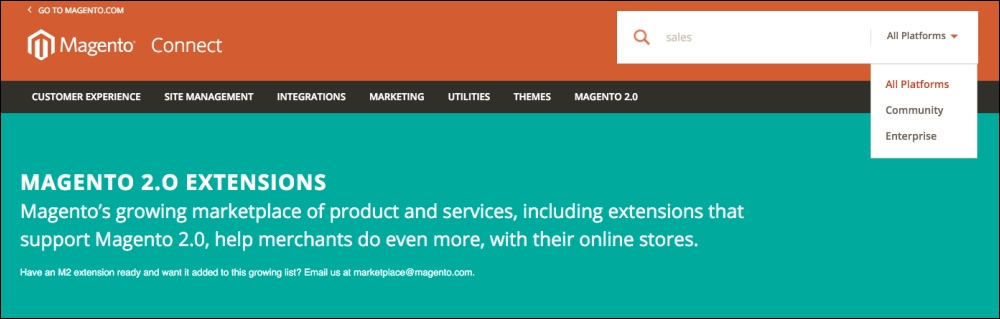
Search field in Magento Connect
Furthermore, we can narrow our search to the specific Magento platform, such as the one on which this book is focused: Community.
The results of our search can be further refined by identifying extensions that are free versus paid, or, if paid, fall within a certain price range.
You can also browse the extensions using the categories in the top navigation bar, or the groupings listed below the search form on the main Magento Connect page.
Magento extensions take time to create, test, package and distribute. Additionally, responsible developers provide support to those who install their extensions. Considering this investment of time and effort, why would any developer offer a free extension?
- In some case, the free extension is a light, or less-featured, version of a paid extension. If you like how the light version works in your Magento installation, you might pay to get additional functionality.
- Some extension developers provide other paid extensions as well. Again, if you like how the free extension works, you might be more trusting of the developer's paid extensions. This is particularly popular among theme developers who create one or more free themes with modest features, but sell much more feature-laden themes.
- I downloaded an extension once that did exactly what it promised, but I needed it to do something slightly different. Rather than change the code myself, I hired the extension developer to create a modified version to meet my needs. I ended up paying a lot less than if I had hired a developer to create the entire extension from scratch.
- Finally, there are developers who simply like to share. Amazing as it may seem, some people actually like to contribute to the overall success of Magento. Of course, I'm being cheeky here, but in many cases a developer has created a solution for their own needs that they realize could benefit others in the world of Magento. By providing a free extension, or theme, the developer is also validating their expertise. If I need to hire a developer for a specific Magento need, I would first look to developers who have solved similar issues. For example, if I need a payment gateway extension that doesn't already exist, I would first look to those developers who have demonstrated their ability to successfully create payment gateway integrations for Magento. A free extension, therefore, becomes a portfolio piece for a developer.
Note
At the time of writing this, the Magento Connect site for 2.0 was still evolving, and there were no protocols available for uploading extensions to the Connect marketplace. In its current iteration, the Connect site is a module catalog that directs the user to different developer websites. For the latest information on submitting extensions, go to http://www.magentocommerce.com/magento-connect/create_your_extension. The packaging process here is still specific to 1.0 extensions, but will be updated with information when Magento Connect for 2.0 comes online.