Table of Contents for
Magento 2 - Build World-Class online stores
 Magento 2 - Build World-Class online stores
Published by
Packt Publishing, 2017
Magento 2 - Build World-Class online stores
Published by
Packt Publishing, 2017
- Cover
- Table of Contents
- Magento 2 - Build World-Class online stores
- Magento 2 - Build World-Class online stores
- Credits
- Preface
- 1. Module 1
- 1. Magento Fundamentals
- XAMPP installation
- Magento
- Summary
- 2. Magento 2.0 Features
- An introduction to the Magento order management system
- Magento 2.0 command-line configuration
- The command-line utility
- Summary
- 3. Working with Search Engine Optimization
- Store configuration
- SEO and searching
- SEO catalog configuration
- Google Analytics tracking code
- Optimizing Magento pages
- Summary
- 4. Magento 2.0 Theme Development – the Developers' Holy Grail
- Magento 2.0 theme structure
- The Magento Luma theme
- Magento theme inheritance
- CMS blocks and pages
- Custom variables
- Creating a basic Magento 2.0 theme
- Summary
- 5. Creating a Responsive Magento 2.0 Theme
- Composer – the PHP dependency manager
- Building the CompStore theme
- CSS preprocessing with LESS
- Applying new CSS to the CompStore theme
- Creating the CompStore logo
- Applying the theme
- Creating CompStore content
- Customizing Magento 2.0 templates
- Summary
- 6. Write Magento 2.0 Extensions – a Great Place to Go
- Using the Zend framework
- Magento 2.0 extension structure
- Developing your first Magento extension
- The Twitter REST API
- The TweetsAbout module structure
- Using TwitterOAuth to authenticate our extension
- Developing the module
- Summary
- 7. Go Mobile with Magento 2.0!
- Adjusting the CompStore theme for mobile devices
- The Magento 2.0 responsive design
- The Magento UI
- Implementing a new CSS mixin media query
- Adjusting tweets about extensions for mobile devices
- Summary
- 8. Speeding up Your Magento 2.0
- Indexing and caching Magento
- Indexing and re-indexing data
- The Magento cron job
- Caching
- Fine-tuning the Magento hosting server
- Selecting the right Magento hosting service
- Apache web server deflation
- Enabling the expires header
- Minifying scripts
- Summary
- 9. Improving Your Magento Skills
- Magento knowledge center
- Improving your Magento skills
- Summary
- 2. Module 2
- 1. Magento 2 System Tools
- Installing Magento 2 sample data via GUI
- Installing Magento 2 sample data via the command line
- Managing Magento 2 indexes via the command line
- Managing Magento 2 cache via the command line
- Managing Magento 2 backup via the command line
- Managing Magento 2 set mode (MAGE_MODE)
- Transferring your Magento 1 database to Magento 2
- 2. Enabling Performance in Magento 2
- Configuring Redis for backend cache
- Configuring Memcached for session caching
- Configuring Varnish as the Full Page Cache
- Configuring Magento 2 with CloudFlare
- Configuring optimized images in Magento 2
- Configuring Magento 2 with HTTP/2
- Configuring Magento 2 performance testing
- 3. Creating Catalogs and Categories
- Create a Root Catalog
- Create subcategories
- Manage attribute sets
- Create products
- Manage products in a catalog grid
- 4. Managing Your Store
- Creating shipping and tax rules
- Managing customer groups
- Configuring inventories
- Configuring currency rates
- Managing advanced pricing
- 5. Creating Magento 2 Extensions – the Basics
- Initializing extension basics
- Working with database models
- Creating tables using setup scripts
- Creating a web route and controller to display data
- Creating system configuration fields
- Creating a backend data grid
- Creating a backend form to add/edit data
- 6. Creating Magento 2 Extensions – Advanced
- Using dependency injection to pass classes to your own class
- Modifying functions with the use of plugins – Interception
- Creating your own XML module configuration file
- Creating your own product type
- Working with service layers/contracts
- Creating a Magento CLI command option
- 3. Module 3
- 1. Planning for Magento
- Technical considerations
- Global-Website-Store methodology
- Planning for multiple stores
- Summary
- 2. Managing Products
- Managing products the customer focused way
- Creating products
- Managing inventory
- Pricing tools
- Autosettings
- Related products, up-sells, and cross-sells
- Importing products
- Summary
- 3. Designs and Themes
- The concept of theme inheritance
- Default installation of design packages and themes
- Installing third-party themes
- Inline translations
- Working with theme variants
- Customizing themes
- Customizing layouts
- Summary
- 4. Configuring to Sell
- Payment methods
- Shipping methods
- Managing taxes
- Transactional e-mails
- Summary
- 5. Managing Non-Product Content
- Summary
- 6. Marketing Tools
- Promotions
- Newsletters
- Using sitemaps
- Optimizing for search engines
- Summary
- 7. Extending Magento
- The new Magento module architecture
- Extending Magento functionality with Magento plugins
- Building your own extensions
- Summary
- 8. Optimizing Magento
- Indexing and caching
- Caching in Magento 2 – not just FPC
- Tuning your server for speed
- Summary
- 9. Advanced Techniques
- Version control
- Magento cron
- Backing up your database
- Upgrading Magento
- Summary
- 10. Pre-Launch Checklist
- System configurations
- Design configurations
- Search engine optimization
- Sales configurations
- Product configurations
- Maintenance configurations
- Summary
- Index
Creating products one-by-one is fine if you're only selling a few products, but many people choose Magento as a platform to sell hundreds and thousands of different products. Entering each product individually can take a long time, especially if you're writing unique product descriptions, uploading photos, and adding crosslinked products.
With Version 2.0.1, Magento has greatly improved the performance of product imports. In previous versions, importing thousands of products could take hours – literally. We once tried to import 19,000 products and the job took 20 hours to complete! The improvements to Magento importing have greatly decreased that time.
After spending hundreds of hours wrestling with the importing schemas of Magento over several versions of the platform, I'm happy to say that, starting with Version 2.0.1, there is one shortcut to helping you import products successfully.
Magento imports CSV files according to a specific layout scheme. Trying to configure an import file to accurately import a variety of different products, product types, attribute sets, and so on, will lead to many, many failed attempts as you try different ways of configuring the CSV to meet your needs. Therefore, my best advice is:
- Enter at least one product into your store representing the different types (simple, complex, bundle, and so on) that you will be using.
- Fully enter the data for each product, including all options. You don't have to upload images, however.
- Go to System | Import/Export | Export in your backend.
- Export a product CSV file to your computer using your browser (in previous Magento versions, this export would be placed on your server and you would have had to FTP to your server to retrieve it).
- Open the downloaded CSV file in Excel or Numbers.
Now you can easily see how each type of product is configured in the export file. Using this format, you can easily add additional products, simply by following a similar pattern.
In the Magento 2.0.1 import interface, there is an option to download a sample file. This is a great step in the right direction and can be very helpful as a reference. Because this file only covers default products, though, we would suggest entering the type of product(s) you intend to sell into your store as described above to generate a more specific reference template.
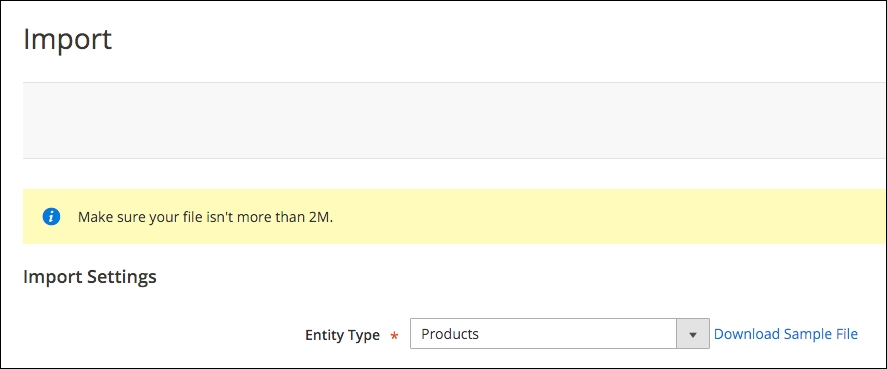
Notice that for products with various options, particularly configurable products, only the differences between each iteration are included on the rows below the main product row. Never repeat any other fields that are the same between variations. A unique SKU is required of each product, though. For configurable products, you'll need to include a pipe delimited list of the configurable SKUS and the attribute they vary by (in the example below, this is the Color attribute).
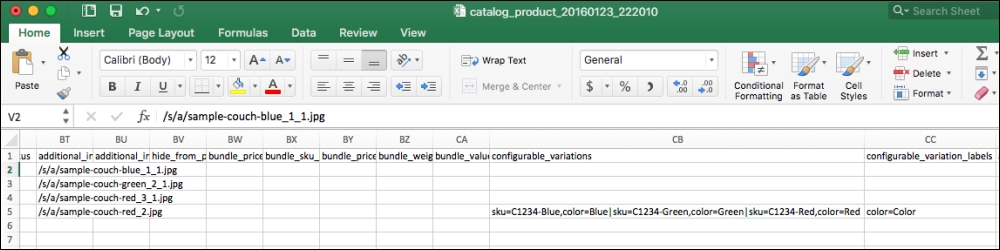
You don't need to worry about this for simple products, but if you do have a batch of configurable products it will really help to have a sample configurable product export file as a starting point.
To import images, you must upload the images to your server in the /var/import folder. If the /var/import folder doesn't exist, you can create it (or another of your directory) and specify it as part of the import process.
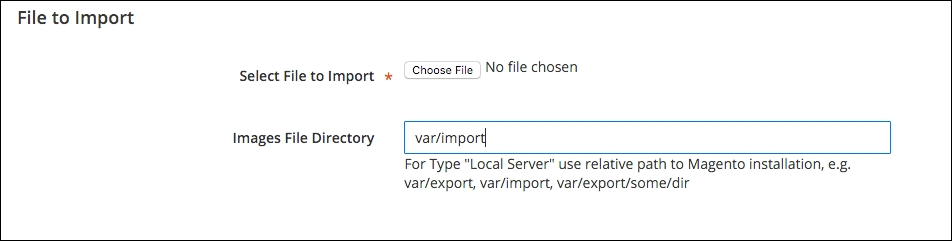
Put the name of the image file in the image columns of your import CSV file (don't include any path). Magento will pick the image out of the /var/import folder, resize it as needed, and store it within the images/catalog folder hierarchy. Never use capitals, spaces, or other strange characters in your image names; only the letters a through z, the numbers 0 through 9, and the underscore.
Note
The most important thing to remember is to remove any unused columns before importing. For example, if you are not going to include categories in your import, leave that column out. This is especially important if you are re-importing or importing product updates. If you leave a column blank, then Magento will enter a blank value for that column in your product record. Oops!