The Configuration Translation module requires Interface Translation; however, it does not work in the same fashion. The module modifies all entity types that extend the \Drupal\Core\Config\Entity\ConfigEntityInterface interface. It adds a new handler under the config_translation_list key. This is used to build a list of available configuration entities and their bundles.
The module alters the configuration schema in Drupal, and updates the default configuration element definitions to use a specified class under \Drupal\config_translation\Form. This allows \Drupal\config_translation\Form\ConfigTranslationFormBase and its child classes to properly save translated configuration data, which can then be modified through the configuration translation screens.
When the configuration is saved, it is identified as being part of a collection. The collection is identified as language.LANGCODE, and all translated configuration entities are saved and loaded by this identifier. The following is an example of how the configuration items are stored in the database:
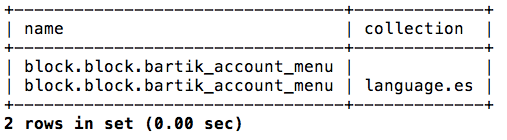
When browsing the site in the es language code, the appropriate block.block.bartik_account_menu configuration entity will be loaded. If you are using the default site, or no language code, the configuration entity with an empty collection will be used.