The topic of discovering RESTful services has a long and complicated history. The HTTP specification states that a resource should be self-descriptive and that it should be identified uniquely by a URI. Dependent resources should be linked by the dependency using their own unique URIs. Discovering a RESTful service means navigating from one service to another, following the links it provides.
In the year 2009, a specification called Web Application Discovery Language (WADL) was invented. It aims to document every URI exposed from a web application, along with the HTTP methods it supports and the parameter it expects. The response media type of the URI is also described. This is very useful for documenting purposes, and it's all that a WADL file can provide us in terms of RESTful service provisioning.
Unfortunately, there is currently no Node.js module that can automatically generate a WADL file for a given express route. We will have to manually create a WADL file to demonstrate how it is used by other clients for discovery.
The following listing shows a sample WADL file describing the resources available at /catalog, /catalog/v2/{categoryId}:
<?xml version="1.0" encoding="UTF-8"?>
<application xmlns="http://wadl.dev.java.net/2009/02" xmlns:service="http://localhost:8080/catalog/" xmlns:xsd="http://www.w3.org/2001/XMLSchema">
   <grammer>
      <include href="items.xsd" />
      <include href="error.xsd" />
   </grammer>
   <resources base="http://localhost:8080/catalog/">
      <resource path="{categoryId}">
         <method name="GET">
            <request>
               <param name="category" type="xsd:string" style="template" />
            </request>
            <response status="200">
               <representation mediaType="application/xml" element="service:item" />
               <representation mediaType="application/json" />
            </response>
            <response status="404">
               <representation mediaType="text/plain" element="service:item" />
            </response>
         </method>
      </resource>
      <resource path="/v2/{categoryId}">
         <method name="GET">
            <request>
               <param name="category" type="xsd:string" style="template" />
            </request>
            <response status="200">
               <representation mediaType="application/xml" element="service:item" />
               <representation mediaType="application/json" />
            </response>
            <response status="404">
               <representation mediaType="text/plain" element="service:item" />
            </response>
         </method>
      </resource>
   </resources>
</application>
As you can see, the WADL format is very straightforward. It basically describes the URI of each resource, providing information about the media types it uses and the status codes that are expected at that URI. Many third-party RESTful clients understand the WADL language and can generate request messages out of a given WADL file.
Let's import the WADL file in Postman. Click on the Import button and select your WADL file:
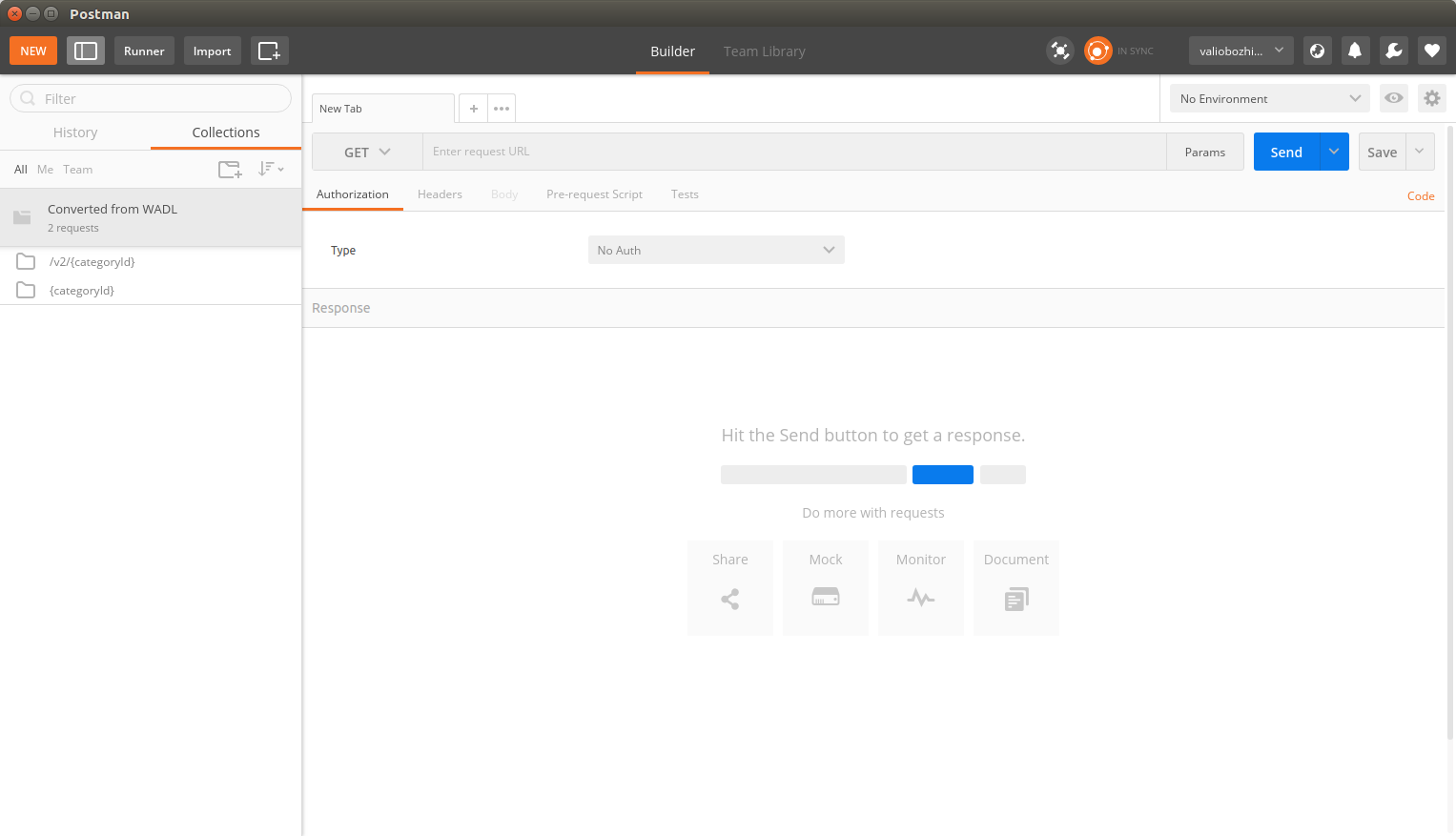
As you can see, the result of importing the WADL file is that we have a project ready to test each aspect of a REST service in the nick of time. All the routes defined in the WADL file are now conveniently available as separate request entities on the right menu. That's not all; apart from the WADL standard, currently the swagger documentation format is heavily adopted and has become an informal standard for describing RESTful services, so we can also use it to ease the adoption and discovery of our service. In the next chapter, we will bind these description files to our service. This is an important step in the phase of production preparation.