
Before we get into deploying the Notes application, we need to review its architecture. To deploy the Notes application, we must understand what we're planning to do.
We have segmented the services into two groups, as shown in the following diagram:
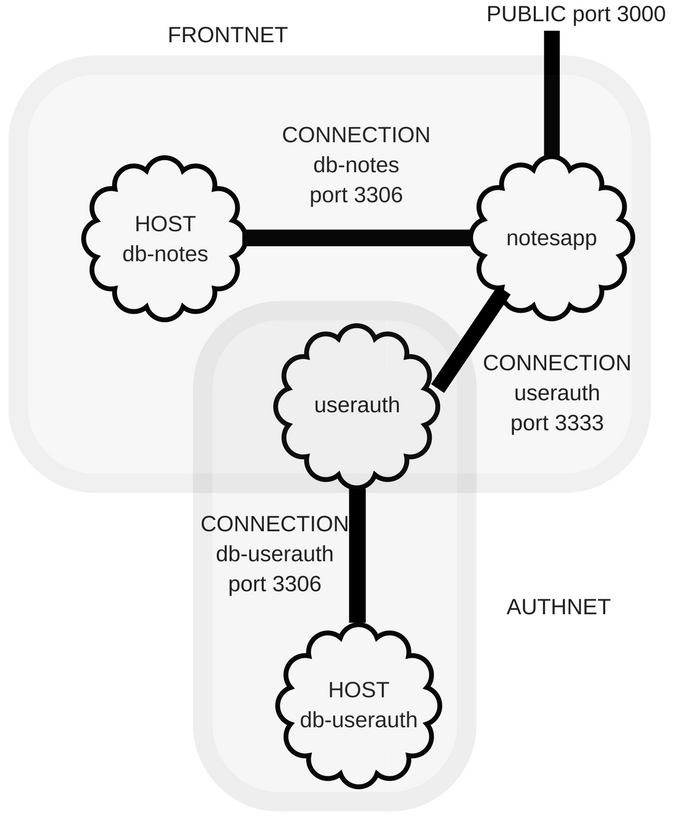
The user authentication server should be the more secure portion of the system. On our laptop, we weren't able to create the envisioned protective wall around that service, but we're about to implement such protection.
One strategy to enhance security is to expose as few ports as possible. That reduces the so-called attack surface, simplifying our work in hardening the application against security bugs. With the Notes application, we have exactly one port to expose, the HTTP service through which users access the application. The other ports, the two for MySQL servers and the user authentication service port, should be hidden.
Internally, the Notes application needs to access both the Notes database and the user authentication service. That service, in turn, needs to access the user authentication database. As currently envisaged, no service outside the Notes application requires access to either database or to the authentication service.
Implementation of this segmentation requires either two or three subnets, depending on the lengths you wish to go to. The first, FrontNet, contains the Notes application and its database. The second, AuthNet, contains the authentication service and its database. A third possible subnet would contain the Notes and authentication services. The subnet configuration must limit the hosts with access to the subnet, and create a security wall between subnets.