
To prove that we have an artificial problem on our hands, here is a much more efficient Fibonacci function:
exports.fibonacciLoop = function(n) {
    var fibos = [];
    fibos[0] = 0;
    fibos[1] = 1;
    fibos[2] = 1;
    for (var i = 3; i <= n; i++) {
        fibos[i] = fibos[i-2] + fibos[i-1];
    }
    return fibos[n];
}
If we substitute a call to math.fibonacciLoop in place of math.fibonacci, the fibotimes program runs much faster. Even this isn't the most efficient implementation; for example, a simple prewired lookup table is much faster at the cost of some memory.
Edit fibotimes.js as follows and rerun the script. The numbers will fly by so fast your head will spin:
for (var num = 1; num < 8000; num++) {
    let now = new Date().toISOString();
    console.log(`${now} Fibonacci for ${num} = ${math.fibonacciLoop(num)}`);
}
Some algorithms aren't so simple to optimize and still take a long time to calculate the result. In this section, we're exploring how to handle inefficient algorithms, and therefore will stick with the inefficient Fibonacci implementation.
It is possible to divide the calculation into chunks and then dispatch the computation of those chunks through the event loop. Add the following code to math.js:
exports.fibonacciAsync = function(n, done) {
    if (n === 0) done(undefined, 0);
    else if (n === 1 || n === 2) done(undefined, 1);
    else {
        setImmediate(() => {
            exports.fibonacciAsync(n-1, (err, val1) => {
                if (err) done(err);
                else setImmediate(() => {
                    exports.fibonacciAsync(n-2, (err, val2) => {
                        if (err) done(err);
                        else done(undefined, val1+val2);
                    });
                });
            });
        });
    }
};
This converts the fibonacci function from asynchronous function to a traditional callback-oriented asynchronous function. We're using setImmediate at each stage of the calculation to ensure the event loop executes regularly and that the server can easily handle other requests while churning away on a calculation. It does nothing to reduce the computation required; this is still the silly, inefficient Fibonacci algorithm. All we've done is spread the computation through the event loop.
In fibotimes.js, we can use this:
const math = require('./math');
const util = require('util');

(async () => {
   for (var num = 1; num < 8000; num++) {
       await new Promise((resolve, reject) => {
           math.fibonacciAsync(num, (err, fibo) => {
               if (err) reject(err);
               else {
                   let now = new Date().toISOString();
                   console.log(`${now} Fibonacci for ${num} =
                   ${fibo}`);
                   resolve();
               }
           })
       })
    }
})().catch(err => { console.error(err); });
This version of fibotimes.js executes the same, we simply type node fibotimes. However, using fibonacciAsync will require changes in the server.
Because it's an asynchronous function, we will need to change our router code. Create a new file, named routes/fibonacci-async1.js, containing the following:
const express = require('express');
const router = express.Router();

const math = require('../math');

router.get('/', function(req, res, next) {
  if (req.query.fibonum) {
    // Calculate using async-aware function, in this server
    math.fibonacciAsync(req.query.fibonum, (err, fiboval) => {
      res.render('fibonacci', {
        title: "Calculate Fibonacci numbers",
        fibonum: req.query.fibonum,
        fiboval: fiboval
      });
    });
  } else {
    res.render('fibonacci', {
      title: "Calculate Fibonacci numbers",
      fiboval: undefined
    });
  }
});

module.exports = router;
This is the same as earlier, just rewritten for an asynchronous Fibonacci calculation.
In app.js, make this change to the application wiring:
// const fibonacci = require('./routes/fibonacci');
const fibonacci = require('./routes/fibonacci-async1');
With this change, the server no longer freezes when calculating a large Fibonacci number. The calculation of course still takes a long time, but at least other users of the application aren't blocked.
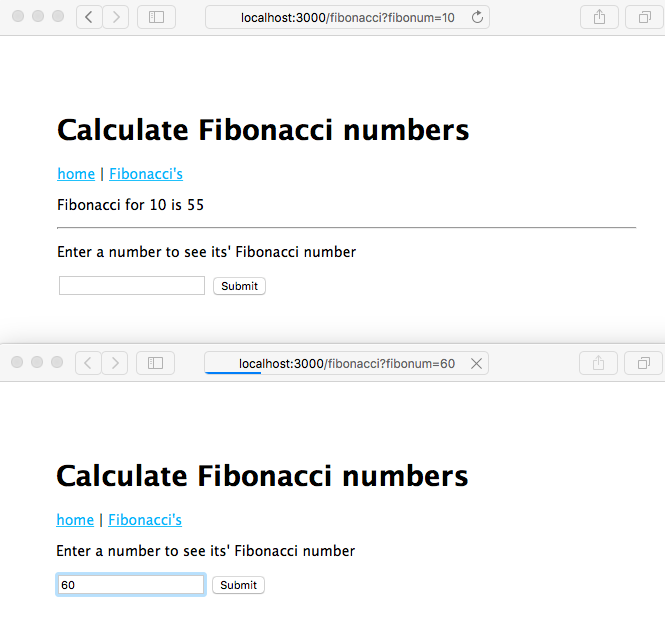
You can verify this by again opening two browser windows in the application. Enter 60 in one window, and in the other start requesting smaller Fibonacci numbers. Unlike with the original fibonacci function, using fibonacciAsync allows both windows to give answers, though if you really did enter 60 in the first window you might as well take that three-month vacation to Tibet:
It's up to you, and your specific algorithms, to choose how to best optimize your code and to handle any long-running computations you may have.