Table of Contents for
Your Code as a Crime Scene
 Your Code as a Crime Scene
Published by
Pragmatic Bookshelf, 2015
Your Code as a Crime Scene
Published by
Pragmatic Bookshelf, 2015
- Title Page
- Your Code as a Crime Scene
- Your Code as a Crime Scene
- For the Best Reading Experience...
- Table of Contents
- Early praise for Your Code as a Crime Scene
- Foreword by Michael Feathers
- Acknowledgments
- Chapter 1: Welcome!
- About This Book
- Optimize for Understanding
- How to Read This Book
- Toward a New Approach
- Get Your Investigative Tools
- Part 1: Evolving Software
- Chapter 2: Code as a Crime Scene
- Meet the Problems of Scale
- Get a Crash Course in Offender Profiling
- Profiling the Ripper
- Apply Geographical Offender Profiling to Code
- Learn from the Spatial Movement of Programmers
- Find Your Own Hotspots
- Chapter 3: Creating an Offender Profile
- Mining Evolutionary Data
- Automated Mining with Code Maat
- Add the Complexity Dimension
- Merge Complexity and Effort
- Limitations of the Hotspot Criteria
- Use Hotspots as a Guide
- Dig Deeper
- Chapter 4: Analyze Hotspots in Large-Scale Systems
- Analyze a Large Codebase
- Visualize Hotspots
- Explore the Visualization
- Study the Distribution of Hotspots
- Differentiate Between True Problems and False Positives
- Chapter 5: Judge Hotspots with the Power of Names
- Know the Cognitive Advantages of Good Names
- Investigate a Hotspot by Its Name
- Understand the Limitations of Heuristics
- Chapter 6: Calculate Complexity Trends from Your Code’s Shape
- Complexity by the Visual Shape of Programs
- Learn About the Negative Space in Code
- Analyze Complexity Trends in Hotspots
- Evaluate the Growth Patterns
- From Individual Hotspots to Architectures
- Part 2: Dissect Your Architecture
- Chapter 7: Treat Your Code As a Cooperative Witness
- Know How Your Brain Deceives You
- Learn the Modus Operandi of a Code Change
- Use Temporal Coupling to Reduce Bias
- Prepare to Analyze Temporal Coupling
- Chapter 8: Detect Architectural Decay
- Support Your Redesigns with Data
- Analyze Temporal Coupling
- Catch Architectural Decay
- React to Structural Trends
- Scale to System Architectures
- Chapter 9: Build a Safety Net for Your Architecture
- Know What’s in an Architecture
- Analyze the Evolution on a System Level
- Differentiate Between the Level of Tests
- Create a Safety Net for Your Automated Tests
- Know the Costs of Automation Gone Wrong
- Chapter 10: Use Beauty as a Guiding Principle
- Learn Why Attractiveness Matters
- Write Beautiful Code
- Avoid Surprises in Your Architecture
- Analyze Layered Architectures
- Find Surprising Change Patterns
- Expand Your Analyses
- Part 3: Master the Social Aspects of Code
- Chapter 11: Norms, Groups, and False Serial Killers
- Learn Why the Right People Don’t Speak Up
- Understand Pluralistic Ignorance
- Witness Groupthink in Action
- Discover Your Team’s Modus Operandi
- Mine Organizational Metrics from Code
- Chapter 12: Discover Organizational Metrics in Your Codebase
- Let’s Work in the Communication Business
- Find the Social Problems of Scale
- Measure Temporal Coupling over Organizational Boundaries
- Evaluate Communication Costs
- Take It Step by Step
- Chapter 13: Build a Knowledge Map of Your System
- Know Your Knowledge Distribution
- Grow Your Mental Maps
- Investigate Knowledge in the Scala Repository
- Visualize Knowledge Loss
- Get More Details with Code Churn
- Chapter 14: Dive Deeper with Code Churn
- Cure the Disease, Not the Symptoms
- Discover Your Process Loss from Code
- Investigate the Disposal Sites of Killers and Code
- Predict Defects
- Time to Move On
- Chapter 15: Toward the Future
- Let Your Questions Guide Your Analysis
- Take Other Approaches
- Let’s Look into the Future
- Write to Evolve
- Appendix 1: Refactoring Hotspots
- Refactor Guided by Names
- Bibliography
- You May Be Interested In…
Learn Why the Right People Don’t Speak Up
In the early 1990s, Sweden had its first serial killer. The case led to an unprecedented manhunt. Not for an offender—he was already locked up—but for the victims. There were no bodies.
A year earlier, Thomas Quick, incarcerated in a mental institution, started confessing to one brutal murder after another. The killings Quick confessed to were all well-known unsolved cases.
Over the course of some hectic years, Swedish and Norwegian law enforcement dug around in forests and traveled all across the country in search of hard evidence. At the height of the craze, they even emptied a lake. Yet not a single bone was found.
This striking lack of evidence didn’t prevent the courts from sentencing Quick to eight of the murders. His story was judged as plausible because he knew detailed facts that only the true killer could’ve known. Except Quick was innocent. He fell prey to powerful cognitive and social biases.
The story about Thomas Quick is a case study in the dangers of social biases in groups. The setting is much different from what we encounter in our daily lives, but the biases aren’t. The social forces that led to the Thomas Quick disaster are present in any software project.
See How We Influence Each Other
We’ll get back to the resolution of the Quick story soon. But let’s first understand the social biases so we can prevent our own group disasters.
When we work together in a group to accomplish something—for example, to design that amazing web application that will knock Google Search down—we influence each other. Together, we turn seemingly impossible things into reality. Other times, the group fails miserably. In both cases, the group exhibits what social scientists call process loss.
Process loss is the theory that groups, just as machines, cannot operate at 100 percent efficiency. The act of working together has several costs that we need to keep in check. These costs are losses in coordination and motivation. In fact, most studies on groups find that they perform below their potential.
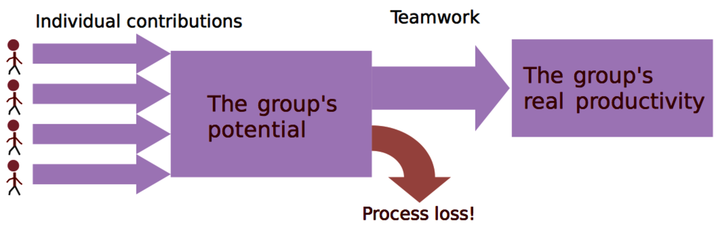
So why do we choose to work in groups when it’s obviously inefficient? Well, often the task itself is too big for a single individual. Today’s software products are so large and complex that we have no other choice than to build an organization around them. We just have to remember that as we move to teams and hierarchies, we pay a price: process loss.
When we pay for something, we expect a return. We know we’ll lose a little efficiency in all team efforts; it’s inevitable. (You’ll learn more about coordination and communication in subsequent chapters.) What’s worse is that social forces may rip your group’s efforts into shreds and leave nothing but broken designs and bug-ridden code behind. Let’s see what we can do to avoid that.
Learn About Social Biases
Pretend for a moment that you’ve joined a new team. On your first day, the team gathers to discuss two design alternatives. You get a short overview before the team leader suggests that you all vote for the best alternative.
It probably sounds a little odd to you. You don’t know enough about the initial problem, and you’d rather see a simple prototype of each suggested design to make an informed decision. So, what do you do?
If you’re like most of us, you start to look around. You look at how your colleagues react. Since they all seem comfortable and accepting of the proposed decision procedure, you choose to go along with the group. After all, you’re fresh on the team, and you don’t want to start by rejecting something everyone else believes in. As in Hans Christian Andersen’s fairy tale, no one mentions that the emperor is naked. Let’s see why. But before we do, we have to address an important question about the role of the overall culture.
Isn’t All This Group Stuff Culture-Dependent?
Sure, different cultures vary in how sensitive they are to certain biases. Most research on the topic has focused on East-West differences. But we don’t need to look that far. To understand how profoundly culture affects us, let’s look at different programming communities.
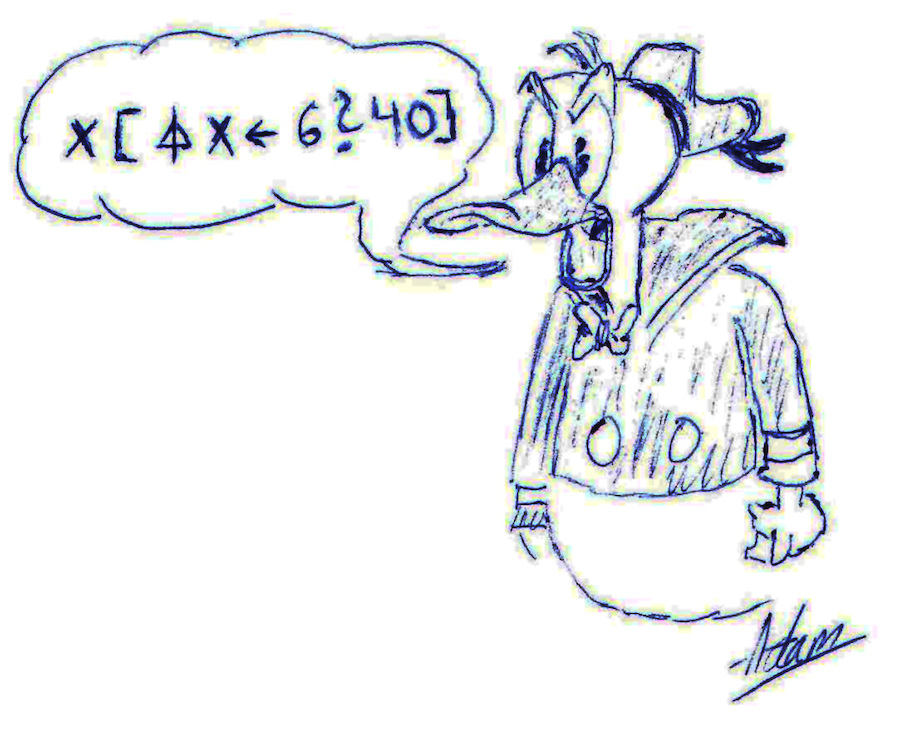
Take a look at the code in the speech balloon. It’s a piece of APL code. APL is part of the family of array programming languages. The first time you see APL code, it will probably look just like this figure: a cursing cartoon character or plain line noise. But there’s a strong logic to it that results in compact programs. This compactness leads to a different mindset.
The APL code calculates six lottery numbers, guaranteed to be unique, and returns them sorted in ascending order.[30] As you see in the code, there are no intermediate variables to reveal the code’s intent. Contrast this with how a corresponding Java solution would look.
Object-oriented programmers value descriptive names such as randomLotteryNumberGenerator. To an APL programmer, that’s line noise that obscures the real intent of the code. The reason we need more names in Java, C#, or C++ is that our logic—the stuff that really does something—is spread out across multiple functions and classes. When our language allows us to express all of that functionality in a one-liner, our context is different, and it affects the way we and our community think.
Different cultures have different values that affect how their members behave. Just remember that when you choose a technology, you also choose a culture.