Table of Contents for
Gaming Hacks
 Gaming Hacks
Published by
O'Reilly Media, Inc., 2004
Gaming Hacks
Published by
O'Reilly Media, Inc., 2004
- Cover
- Gaming Hacks
- Credits
- Contributors
- Acknowledgments
- Foreword
- Preface
- How to Use This Book
- How This Book Is Organized
- Conventions Used in This Book
- Using Code Examples
- Comments and Questions
- Got a Hack?
- 1. Playing Classic Games
- Legal Emulation
- Play Commodore 64 Games Without the C-64
- Play Atari ROMs Without the Atari
- Use Atari Paddles with Your PC
- Run Homebrew Games on the Atari 2600
- Create Your Own Atari 2600 Homebrew Games
- Play Classic PC Graphic Adventures
- Play Old Games Through DOSBox
- Play Reissued All-in-One Joystick Games
- Play Arcade Games Without the Arcade
- Add and Manipulate a MAME Frontend
- Keep Your ROMs Tidy and Organized
- Learn Game-Specific MAME Controls
- Filter Inappropriate MAME ROMs
- Autoboot into MAME Heaven
- Play Emulated Arcade Games Online
- Play Classic Pinball Without the Table
- Emulate the SNES on the Dreamcast
- 2. Playing Portably
- Play Games on Your iPod
- Mod Your Game Boy
- Take and Print Photos with Your Game Boy
- Compose Music on Your Game Boy
- Explore the GP32 Handheld Gaming System
- Take Your Console with You
- Explore the Bandai WonderSwan
- Play Real Games on Your PDA
- Install a PlayStation 2 in Your Car
- 3. Playing Well with Others
- Practice Proper MMORPG Etiquette
- Understand MMORPG Lingo
- Grind Without Going Crazy
- Make a Profit in Vana’diel
- Write MMORPG Macros
- Build an Effective Group
- Catch Half-Life FPS Cheaters Redhanded
- 4. Playing with Hardware
- Build a Quiet, Killer Gaming Rig
- Find and Configure the Best FPS Peripherals
- Adapt Old Video Game Controllers to the PC
- Choose the Right Audio/Video Receiver
- Place Your Speakers Properly
- Connect Your Console to Your Home Theater
- Tune Console Video Output
- Tune Your TV for Console Video
- PC Audio Hacking
- Optimize PC Video Performance
- Build a Dedicated Multimedia PC
- Use a Multimedia Projector for Gaming
- 5. Playing with Console and Arcade Hardware
- Play LAN-Only Console Games Online
- Hack the Nuon DVD Player/Gaming System
- Play Import Games on American Consoles
- Find a Hackable Dreamcast
- Play Movies and Music on Your Dreamcast
- Hack the Dreamcast Visual Memory Unit
- Unblur Your Dreamcast Video
- Use Your Dreamcast Online
- Host Dreamcast Games Online
- Burn Dreamcast-Compatible Discs on Your PC
- Burn Dreamcast Homebrew Discs
- Buy Your Own Arcade Hardware
- Configure Your Arcade Controls, Connectors, and Cartridges
- Reorient and Align Your Arcade Monitor
- Buy Cart-Based JAMMA Boards
- Programming Music for the Nintendo Entertainment System
- 6. Playing Around the Game Engine
- Explore Machinima
- Choose a Machinima Engine
- Film Your First Machinima Movie
- Improve Your Camera Control
- Record Game Footage to Video
- Speedrun Your Way Through Metroid Prime
- Sequence-Break Quake
- Run Classic Game ROM Translations
- Change Games with ROM Hacks
- Apply ROM Hacks and Patches
- Create PS2 Cheat Codes
- Hack Xbox Game Saves
- Cheat on Other Consoles
- Modify PC Game Saves and Settings
- Buff Your Saved Characters
- Create Console Game Levels
- 7. Playing Your Own Games
- Adventure Game Studio Editing Tips
- Create and Play Pinball Tables
- Put Your Face in DOOM
- Create a Vehicle Model for Unreal Tournament 2004
- Add a Vehicle to Unreal Tournament 2004
- Modify the Behavior of a UT2004 Model
- Download, Compile, and Create an Inform Adventure
- Decorate Your IF Rooms
- Add Puzzles to Your IF Games
- Add Nonplayer Characters to IF Adventures
- Make Your IF NPCs Move
- Make Your IF NPCs Talk
- Create Your Own Animations
- Add Interactivity to Your Animations
- Write a Game in an Afternoon
- 8. Playing Everything Else
- Tweak Your Tactics for FPS Glory
- Beat Any Shoot-Em-Up
- Drive a Physics-Crazed Motorcycle
- Play Japanese Games Without Speaking Japanese
- Back Up, Modify, and Restore PlayStation Saved Games
- Access Your Console’s Memory Card Offline
- Overclock Your Console
- Index
- Colophon
Tactics for beating 2D shmups and tips for discovering your own.
Shoot-em-ups, or shmup s, have experienced a resurgence lately after years of neglect (not that we’re bitter) as 3D engines have risen to prominence, which was in part due to the efforts of homebrew and independent developers. The genre features a character, usually a spaceship, progressing through a 2D plane, either horizontally or vertically, dodging projectiles and eliminating enemies. While this is a very broad definition, the core of shmup gameplay lies in the 2D playfield. Classic games, such as Space War and the seminal Xevious, as well as modern games, including DoDonPachi, Ikaruga, and R-Type Final, are all shmups.
This twitchy gaming style requires good reflexes and quick thinking, but don’t despair: a little practice and a few tips can help you dodge and destroy screens full of alien invaders.
Learn the basic mechanics of the game, and adapt to them. Obviously, R-Type plays differently than Border Down. If the game offers some kind of defensive technique, such as a force pod or shield system, know exactly how it works and when to activate it. Are you invincible when firing a mega-laser? Find out. Take note of how long that invincibility lasts. Does the force pod stop every type of weapon, or can some lasers penetrate it? Find out.
Knowledge is power, and losing a life due to a stupid mistake can be costly in the long run. Not every shooter plays the same way; it’s up to you to find the subtle differences.
Get close up and personal when fighting bosses. Close proximity will lead to a higher frequency of bullets hitting the target, making the boss die more quickly. As well, there may be a limit to the number of bullets on the screen at any one time (curse the limited number of sprites!). The closer you are to a target, the sooner your bullets will hit, and the sooner you can fire again.
Of course, you can only fight effectively up close when you know the enemy’s attack patterns. This means you need to know which signals foreshadow specific attacks when fighting larger enemies. The second-level tank boss from DoDonPachi exhibits a pink influx of energy before firing a few turret blasts, and the fourth-level boss emits a ring of circular orbs that collapse into large shoulder-mounted cannons before firing off a few rounds.
In games that allow you to change weapons, find out which weapon types work best for different situations. In Xevious 3-D/G, you may find the final boss much easier to destroy if you attack with the more powerful green laser weapon. In R-Type Final, each colored weapon represents a different angle of attack. Some levels may require you to use an overhead weapon to clear gun turrets, before switching to a more powerful forward red weapon to defeat a boss.
Certain games offer computer-controlled characters that often prove invaluable allies. The options in Konami’s Gradius series are a popular example. Your ship can collect up to four orbs, also known as options, that mimic the path traced by the parent craft, greatly increasing its offensive capability. Position your options strategically, targeting weak points while keeping your ship safe from danger. In a Gradius game, keep the options above the Vic Viper while constantly blasting away at the boss core. You can hover safely underneath all the excitement and stay out of harm’s way.
Speaking of Gradius, keep the powerup meter set to the bonus you need next, and avoid getting the red bonuses until you have used the selection. I tend to keep the force field highlighted. This way, once my current field runs out, the next is ready to go.
Sometimes it’s better not to shoot. Most rounds of shmups are complete blastfests, with little reason to let go of the autofire button, but in some instances, you’re better off with a brief cease-fire. Enemy attacks can blend in with your fire, and bullets can go unseen (the dreaded invisible bullet syndrome). Also, shooting some projectiles can cause them to explode into a storm of bullets. In Border Down, the final boss launches missiles that are best ignored.
This may sound obvious, but watch incoming bullet storms and head for the largest gaps in the cluster. Train your eye to home in on large patches of open space, and guide your ship safely through. While navigating one section, look ahead one or two steps to plan where the next large gap will be. I find that it helps to group close-knit pockets of fire together and imagine them as one large shot. This can be very helpful in dodging because it eliminates possible space for you to consider weaving through. When dealing with a simple spread-shot pattern, back away as far as possible, allowing the distance between bullets to open up and keeping maximum dodging room.
This sounds odd, but don’t look directly at your ship while dodging. I tend to make a mental picture of where I am on the screen, then focus on an area about an inch ahead of the ship towards the largest volley of flak I’m weaving through. Looking directly at the ship doesn’t prepare you for what’s coming in a half second’s time. Shmups force you to think ahead.
It is vital to know your ship’s hit radius, the section of your ship programmed for sprite collision. Though the craft you are piloting may have a large wingspan and many graphical appendages, bullets may pass harmlessly through the wings, only registering when they hit the center of the ship. Many older shmups have a large hit radius, so touching any part of the ship will result in destruction. Newer shmups have a much smaller hit radius, probably due to the increase in difficulty of the games and development of new technology. Ikaruga forces the player to navigate insanely small passages and crazy bullet storms. Knowing the exact location of your hit radius can give you the extra edge you need to survive.
There are two schools of thought for general ship motion during a level. Either restrict movement to as little as possible, jumping from point to point efficiently, or stay fluid and keep in motion the whole time, allowing for quick cutbacks and changes in motion to adapt to oncoming fire. I prefer the second method because it allows you to dodge the invisible bullets. Staying motionless tends to kill me quicker. The most popular fluid motion is the simple-yet-effective side-to-side sweep. This clears the screen of most oncoming enemies while automatically avoiding fire.
When engaging an enemy, I tend to keep my ship away from the center of the screen. This aligns my ship with the center of the opposing craft (usually also the weak point), slightly to the left or right in order to avoid quick laser attacks. Staying off center also helps when enemies dodge laterally. Your ship automatically leads, and all your shots tend to connect.
Smart bombs, used in many shmups to wipe out all enemies on screen, play both offensive and defensive roles. Most shmups make you invincible for a few seconds after you use a bomb. Even if you’re not facing a huge enemy, a well-timed bomb can save you from a nonnegotiable bullet storm. I would sooner trade a bomb for a ship anytime because bomb stock replenishes after your character dies anyway. The Truxton series is an example of the defensive bomb technique, because the bomb creates a large circular radius that bullets cannot penetrate.
Since bombs restock, don’t be stingy with them. If you die with three bombs in reserve, you’ve wasted three bombs that could have furthered your level progression. At the same time, try to save at least one bomb for boss encounters.
If you are fully stocked, and there is a bomb powerup on the screen, use this opportunity as a freebie, and let one fly. Obtaining a bomb when fully stocked is a complete waste. In DoDonPachi, for example, the bomb gauge will flash maximum when you cannot carry anymore bombs. If this is the case, detonate one bomb before picking up another.
When playing simultaneous co-op, be sure to communicate proper bomb usage. Don’t use bombs at the same time and try to balance who collects bomb powerups. One player hogging all the bombs will reduce your long term survival. Four-player Giga Wing 2 on the Dreamcast can get out of hand if the players don’t communicate and start dropping bombs all at once.
Chances are good that you’re aiming for the highest score, or at least trying to better your own skills by earning more points than you had on the last run. To accomplish this, here are a few things to keep in mind.
Learn the scoring system of the game. Thunder Force V hands out more points if you can destroy an enemy quickly. Border Down, on the other hand, gives a heftier point total based on how close the boss timer is to the number zero. Don’t always assume that you’re playing a certain game the way it expects.
Chaining can be a great way to rack up points, and, again, you need to adapt to the current system. Ikaruga forces you to shoot three similar-colored enemies in a row to keep a high score chain running. The best way to accomplish this is to memorize the level. Know which types of enemies are coming and how to deal with them to add more digits to your final score. One good shortcut is to watch replay videos, which you can purchase through DVD specials (available in Japan for games such as Ikaruga) or download from the Internet.
Another popular type of chain is DoDonPachi’s continual enemy hit counter. The player has to keep shooting enemies, or else a meter will begin to drop, eventually ending a high bonus score. The best way to chain in this situation is to leave one or two stragglers between enemy attack patterns. This is another case in which not firing constantly works to your advantage.
For a genre that some people claim is dead, there sure are a lot of web sites and shooter fans popping up. Here are a few of the essentials, arranged roughly in order of update frequency and longevity:
- Shmups.com (http://www.shmups.com/)
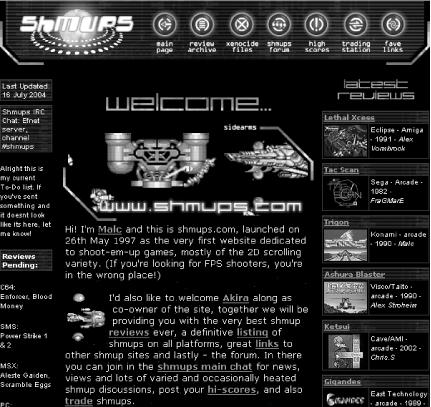
The oldest and largest shmups site on the Net, this one has been around for about six years and features tons of reviews of shmups on all systems. Shmups also features an active forum with gameplay tips, a trading section, and great game links. See Figure 8-1.
- Triggerzone (http://www.2dshooter.de/)
An excellent shmup site for people who can understand German.
- Shmup.com (http://www.shmup.com/)
Another mega-site for shmups, this site is in French.
- Shoot the Core (http://www.shootthecore.com/)
My own site, which focuses on news, fan art, and other goodies. It also links to many shooter demos and dojin games.
- Dodge the Bullet (http://www.sirkain.net/)
This site is great for replays and media.