Table of Contents for
Gaming Hacks
 Gaming Hacks
Published by
O'Reilly Media, Inc., 2004
Gaming Hacks
Published by
O'Reilly Media, Inc., 2004
- Cover
- Gaming Hacks
- Credits
- Contributors
- Acknowledgments
- Foreword
- Preface
- How to Use This Book
- How This Book Is Organized
- Conventions Used in This Book
- Using Code Examples
- Comments and Questions
- Got a Hack?
- 1. Playing Classic Games
- Legal Emulation
- Play Commodore 64 Games Without the C-64
- Play Atari ROMs Without the Atari
- Use Atari Paddles with Your PC
- Run Homebrew Games on the Atari 2600
- Create Your Own Atari 2600 Homebrew Games
- Play Classic PC Graphic Adventures
- Play Old Games Through DOSBox
- Play Reissued All-in-One Joystick Games
- Play Arcade Games Without the Arcade
- Add and Manipulate a MAME Frontend
- Keep Your ROMs Tidy and Organized
- Learn Game-Specific MAME Controls
- Filter Inappropriate MAME ROMs
- Autoboot into MAME Heaven
- Play Emulated Arcade Games Online
- Play Classic Pinball Without the Table
- Emulate the SNES on the Dreamcast
- 2. Playing Portably
- Play Games on Your iPod
- Mod Your Game Boy
- Take and Print Photos with Your Game Boy
- Compose Music on Your Game Boy
- Explore the GP32 Handheld Gaming System
- Take Your Console with You
- Explore the Bandai WonderSwan
- Play Real Games on Your PDA
- Install a PlayStation 2 in Your Car
- 3. Playing Well with Others
- Practice Proper MMORPG Etiquette
- Understand MMORPG Lingo
- Grind Without Going Crazy
- Make a Profit in Vana’diel
- Write MMORPG Macros
- Build an Effective Group
- Catch Half-Life FPS Cheaters Redhanded
- 4. Playing with Hardware
- Build a Quiet, Killer Gaming Rig
- Find and Configure the Best FPS Peripherals
- Adapt Old Video Game Controllers to the PC
- Choose the Right Audio/Video Receiver
- Place Your Speakers Properly
- Connect Your Console to Your Home Theater
- Tune Console Video Output
- Tune Your TV for Console Video
- PC Audio Hacking
- Optimize PC Video Performance
- Build a Dedicated Multimedia PC
- Use a Multimedia Projector for Gaming
- 5. Playing with Console and Arcade Hardware
- Play LAN-Only Console Games Online
- Hack the Nuon DVD Player/Gaming System
- Play Import Games on American Consoles
- Find a Hackable Dreamcast
- Play Movies and Music on Your Dreamcast
- Hack the Dreamcast Visual Memory Unit
- Unblur Your Dreamcast Video
- Use Your Dreamcast Online
- Host Dreamcast Games Online
- Burn Dreamcast-Compatible Discs on Your PC
- Burn Dreamcast Homebrew Discs
- Buy Your Own Arcade Hardware
- Configure Your Arcade Controls, Connectors, and Cartridges
- Reorient and Align Your Arcade Monitor
- Buy Cart-Based JAMMA Boards
- Programming Music for the Nintendo Entertainment System
- 6. Playing Around the Game Engine
- Explore Machinima
- Choose a Machinima Engine
- Film Your First Machinima Movie
- Improve Your Camera Control
- Record Game Footage to Video
- Speedrun Your Way Through Metroid Prime
- Sequence-Break Quake
- Run Classic Game ROM Translations
- Change Games with ROM Hacks
- Apply ROM Hacks and Patches
- Create PS2 Cheat Codes
- Hack Xbox Game Saves
- Cheat on Other Consoles
- Modify PC Game Saves and Settings
- Buff Your Saved Characters
- Create Console Game Levels
- 7. Playing Your Own Games
- Adventure Game Studio Editing Tips
- Create and Play Pinball Tables
- Put Your Face in DOOM
- Create a Vehicle Model for Unreal Tournament 2004
- Add a Vehicle to Unreal Tournament 2004
- Modify the Behavior of a UT2004 Model
- Download, Compile, and Create an Inform Adventure
- Decorate Your IF Rooms
- Add Puzzles to Your IF Games
- Add Nonplayer Characters to IF Adventures
- Make Your IF NPCs Move
- Make Your IF NPCs Talk
- Create Your Own Animations
- Add Interactivity to Your Animations
- Write a Game in an Afternoon
- 8. Playing Everything Else
- Tweak Your Tactics for FPS Glory
- Beat Any Shoot-Em-Up
- Drive a Physics-Crazed Motorcycle
- Play Japanese Games Without Speaking Japanese
- Back Up, Modify, and Restore PlayStation Saved Games
- Access Your Console’s Memory Card Offline
- Overclock Your Console
- Index
- Colophon
The whole issue of emulation is very thorny, not least because a great deal of the work done under emulation is somewhat less than legal, if sometimes tolerated. The user may not own the ROMs he is playing. Even if he does own them, it’s unclear whether he can legally transfer them between media to play them.
I won’t point a finger and disclaim loudly that you’re bad for using emulators and must go to jail without passing Go or collecting 200 dollars. I also won’t pass definitive judgments on legality, either. I will point to a few resources I believe are legal with regard to emulation.
You’ll find constant references to homebrew games in this book, sometimes running on the hardware themselves. As a rule of thumb, if someone has gone to the trouble of creating homebrew games that work on a specific console, PC variant, or handheld, they will work on the emulated version of that system as well. In that case, you need to find the correct emulator and then download the homebrew ROM to play.
If you’re looking for a general source for freely distributable games for multiple systems, even those not covered in detail in this book, the best console source is the PDRoms (http://www.pdroms.de/) site. It features over 1,700 ROMs of various kinds for over 20 different computers and consoles.
Often, hackers with particularly detailed knowledge of an individual computer host specific pages showcasing their wares. For example, The Amiga Legal Emulation (ALE) page at http://ale.emuunlim.com/ has good information and ROM downloads for the Commodore Amiga in particular. Other sites cover their own specialized subjects similarly. Unfortunately, with much of the more obscure abandonware[1] flying under the radar of copyright holders, it’s sometimes difficult to find a page that has really made an effort to separate completely legal disc images from the disc images nobody cares about anymore (but still may be less than legal). Hopefully, this will change as the emulation scene grows and matures.
The only caveat with these public-domain ROMs is that some homebrew or homemade ROMs may reappropriate intellectual property from other famous games. Consider, for example, a homebrew version of Pac-Man with one letter in the name changed “for parody purposes.” It’s not clear how legitimate this is, so be careful when looking into homebrew games that may lack proper permissions.
Most abandonware has a tenuous relationship with legality. The presumption is that if nobody cares about it, it must be okay to distribute it. This concept, while laudable in practical terms of preserving and recognizing relatively unknown classics, doesn’t necessarily justify copyright infringement and definitely flies in the face of copyright law.
Sites such as Home of the Underdogs (http://www.the-underdogs.org/) have major copyright issues but can provide valuable resources, for example, for people who’ve lost legitimate copies of the manuals. The rule is a little fuzzier if you purchased the C-64 version of Skate or Die in the ’80s but can’t find the actual hardware and want to play the game on an emulator.
However, there is another way, and that’s to ask the rights holders for permission to republish their classic material. Many do so to reignite fan interest in certain classic titles, because it may spark them to buy a new title featuring the same characters or otherwise raise the profile of the company. In some cases, companies will give away their classic titles for free. In other cases, they may look for some kind of payment. Either way, you can end up with an emulator-compatible game that’s completely legit.
Examples of the former include Revolution’s wonderful donation of its classic adventure game Beneath A Steel Sky, which runs on the ScummVM adventure game emulator (http://scummvm.org/), or the resurrected Cinemaware’s habit of putting disc images of their classic titles, including Defender Of The Crown and It Came From The Desert (plus rare versions of an It Came From The Desert sequel!) on its web site (http://www.cinemaware.com/).
Tip
What happens when the copyright holder has gone out of business, or no one can find the right contact? It’s a shame, but even if no one’s left to pursue a copyright infringement case or even care, the law still frowns on trading these games.
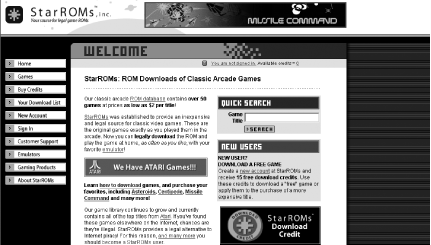
The small but burgeoning market for legitimately sold ROM and disk sets centers around the company StarROMs (http://www.starroms.com/), as shown in Figure 1-1. StarROMs has signed a deal with Atari to sell its classic arcade ROMs for between $2 and $8 apiece. Unfortunately, the company is missing many extras that might sweeten the deal, such as instruction manuals and game-related adverts, but having Multiple Arcade Machine Emulator (MAME)-compatible ROMs officially available helps to legitimize the cause of emulation (see [Hack #10] ).
Various other deals have actually allowed raw ROMs. A small U.K. company did a deal with Gremlin Graphics, now part of Atari, to sell around 50 of its old Amiga releases on CD. This area is still developing slowly because, instead of selling the ROMs of obscure old games individually, companies often like to package their famous old games as entire products. In some ways, this is a shame, because a ROM is often more portable than a single-platform fixed product.
Even if playing freeware or homebrew games, some argue that the very act of running an emulator is less than legal, because the emulator likely uses system ROMs or other proprietary information. Fortunately, officially condoned emulators have started to appear, starting with Cloanto’s Amiga Forever emulator (http://www.amigaforever.com/), of which they indicate:
For Amiga Forever, Cloanto has officially licensed from Amiga International the necessary portfolio of Amiga patents, copyrights and trademarks. Amiga Forever is an official member of the “Powered by Amiga” family!
By buying this completely legal emulator for around $30, you can show your willingness to support emulation of noncopyrighted material (such as public-domain demos and games) and still be completely within the law.
Similar things have occurred in Japan with ASCII Corporation and their official release of the MSX Player MSX emulator, with all the rights issues squared away. This hasn’t yet come to the West, however, largely because the MSX was much less popular outside of Japan.
These more open emulators, which can play any ROM or disc image you plug into them, are less common, however, but game companies have been quite happy to use emulator authors to provide code for some of their official rereleases that have a limited, fixed ROM-set. For example, the PC version of the Sega Smash Pack compilation used an enhanced version of the KGEN98 homebrew Genesis emulator to allow good quality emulation when they didn’t want to duplicate emulators with in-house resources. In a similar vein, LucasArts used Aaron Giles’s Scumm adventure game engine emulator when it distributed the classic Sam & Max Hit The Road as a preorder bonus (though they couldn’t be bothered to finish the sequel, damn their britches).
Hopefully, you’ll be able to explore some of the more interesting emulation-based hacks without needing to walk anywhere near the slippery plank of copyright infringement. As the emulator scene continues to mature, perhaps a situation will arise in which you can reimburse the rights holders and content creators for their work without having to pay continually for media-shifted versions of rights you already own.