Table of Contents for
Gaming Hacks
 Gaming Hacks
Published by
O'Reilly Media, Inc., 2004
Gaming Hacks
Published by
O'Reilly Media, Inc., 2004
- Cover
- Gaming Hacks
- Credits
- Contributors
- Acknowledgments
- Foreword
- Preface
- How to Use This Book
- How This Book Is Organized
- Conventions Used in This Book
- Using Code Examples
- Comments and Questions
- Got a Hack?
- 1. Playing Classic Games
- Legal Emulation
- Play Commodore 64 Games Without the C-64
- Play Atari ROMs Without the Atari
- Use Atari Paddles with Your PC
- Run Homebrew Games on the Atari 2600
- Create Your Own Atari 2600 Homebrew Games
- Play Classic PC Graphic Adventures
- Play Old Games Through DOSBox
- Play Reissued All-in-One Joystick Games
- Play Arcade Games Without the Arcade
- Add and Manipulate a MAME Frontend
- Keep Your ROMs Tidy and Organized
- Learn Game-Specific MAME Controls
- Filter Inappropriate MAME ROMs
- Autoboot into MAME Heaven
- Play Emulated Arcade Games Online
- Play Classic Pinball Without the Table
- Emulate the SNES on the Dreamcast
- 2. Playing Portably
- Play Games on Your iPod
- Mod Your Game Boy
- Take and Print Photos with Your Game Boy
- Compose Music on Your Game Boy
- Explore the GP32 Handheld Gaming System
- Take Your Console with You
- Explore the Bandai WonderSwan
- Play Real Games on Your PDA
- Install a PlayStation 2 in Your Car
- 3. Playing Well with Others
- Practice Proper MMORPG Etiquette
- Understand MMORPG Lingo
- Grind Without Going Crazy
- Make a Profit in Vana’diel
- Write MMORPG Macros
- Build an Effective Group
- Catch Half-Life FPS Cheaters Redhanded
- 4. Playing with Hardware
- Build a Quiet, Killer Gaming Rig
- Find and Configure the Best FPS Peripherals
- Adapt Old Video Game Controllers to the PC
- Choose the Right Audio/Video Receiver
- Place Your Speakers Properly
- Connect Your Console to Your Home Theater
- Tune Console Video Output
- Tune Your TV for Console Video
- PC Audio Hacking
- Optimize PC Video Performance
- Build a Dedicated Multimedia PC
- Use a Multimedia Projector for Gaming
- 5. Playing with Console and Arcade Hardware
- Play LAN-Only Console Games Online
- Hack the Nuon DVD Player/Gaming System
- Play Import Games on American Consoles
- Find a Hackable Dreamcast
- Play Movies and Music on Your Dreamcast
- Hack the Dreamcast Visual Memory Unit
- Unblur Your Dreamcast Video
- Use Your Dreamcast Online
- Host Dreamcast Games Online
- Burn Dreamcast-Compatible Discs on Your PC
- Burn Dreamcast Homebrew Discs
- Buy Your Own Arcade Hardware
- Configure Your Arcade Controls, Connectors, and Cartridges
- Reorient and Align Your Arcade Monitor
- Buy Cart-Based JAMMA Boards
- Programming Music for the Nintendo Entertainment System
- 6. Playing Around the Game Engine
- Explore Machinima
- Choose a Machinima Engine
- Film Your First Machinima Movie
- Improve Your Camera Control
- Record Game Footage to Video
- Speedrun Your Way Through Metroid Prime
- Sequence-Break Quake
- Run Classic Game ROM Translations
- Change Games with ROM Hacks
- Apply ROM Hacks and Patches
- Create PS2 Cheat Codes
- Hack Xbox Game Saves
- Cheat on Other Consoles
- Modify PC Game Saves and Settings
- Buff Your Saved Characters
- Create Console Game Levels
- 7. Playing Your Own Games
- Adventure Game Studio Editing Tips
- Create and Play Pinball Tables
- Put Your Face in DOOM
- Create a Vehicle Model for Unreal Tournament 2004
- Add a Vehicle to Unreal Tournament 2004
- Modify the Behavior of a UT2004 Model
- Download, Compile, and Create an Inform Adventure
- Decorate Your IF Rooms
- Add Puzzles to Your IF Games
- Add Nonplayer Characters to IF Adventures
- Make Your IF NPCs Move
- Make Your IF NPCs Talk
- Create Your Own Animations
- Add Interactivity to Your Animations
- Write a Game in an Afternoon
- 8. Playing Everything Else
- Tweak Your Tactics for FPS Glory
- Beat Any Shoot-Em-Up
- Drive a Physics-Crazed Motorcycle
- Play Japanese Games Without Speaking Japanese
- Back Up, Modify, and Restore PlayStation Saved Games
- Access Your Console’s Memory Card Offline
- Overclock Your Console
- Index
- Colophon
Fansubbing for video games is not only possible but very popular.
In addition to level hacking ( [Hack #71] ), there’s an entirely separate subculture devoted to ROM language hacking, generally from Japanese to English, but also sometimes from English to other common languages (Spanish, Finnish . . . Okay, also to some not-so-common languages!). There are several major reasons for this activity, but people do it mainly to play Japanese console games that will never, ever have an English-language version. These translations allow people who don’t know Japanese the chance to try out a playable version of the game.
Once you know how to patch your ROMs ( [Hack #71] ) to apply these translations, where can you find them?
Be aware that translation hacking of any ROM apart from a clearly freeware title is fraught with legal peril. IPS files are perfectly legal to distribute, but the copyrighted ROMs are not, whether or not you’ve modified them. Applying an IPS patch to a ROM doesn’t release it into the public domain.
Even if you’ve tracked down and bought the Japanese-only version of a certain Super Nintendo title you want to try translation hacks on, the laws of your jurisdiction may prohibit or at least frown on such an activity. Nintendo interprets these laws more strictly.
However, translation patches are often released separately from the actual ROM, in add-on files, which means that translation patches bypass the thorny issue of downloading full ROMs to your PC. In any case, you can practice all these techniques on homebrew ROMS freely, without worrying about legality. Poking in the innards of games is actually plenty of fun, and it’s surprisingly simple to run and edit translated ROMs in a basic fashion, though, of course, the sophisticated stuff is still pretty difficult.
A whole host of sites claim to offer the best ROM translation information. Only a few actually deliver either finished, high-quality translations or decent databases of everyone else’s work. Here are the ones I’ve found:
- The Whirlpool (http://donut.parodius.com/)
I consider this site to be the number-one ROM translation site out there, because it’s not specific to one group of translators. It features a massive database of IPS file for tens of different consoles and hundreds of different translation groups. It’s also a lifesaver for the scene because it mirrors the IPS files locally, meaning that even when an obscure ROM group loses its Geocities account, Whirlpool will save its work for posterity.
The Whirlpool also provides descriptions of how far along a translation is, minireviews, and sometimes even comments from the creators. Overall, it’s extremely impressive, and its FAQs and news items are also well worth checking out.
- DeJap Translations (http://www.dejap.com/)
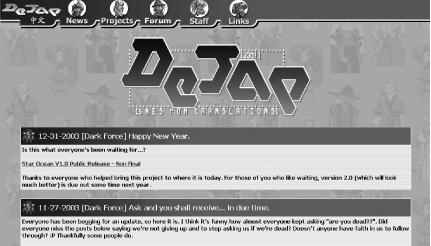
DeJap is one of the best-known individual translation groups; its impressive projects page (http://www.dejap.com/projects.php) shows a range of the most sought-after SNES translations (see Figure 6-1). The Square title Bahamut Lagoon, never available in the West, is one of the highlights. Elsewhere, Namco’s classic Tales Of Phantasia is another important translation, although the insanely complex Star Ocean is probably the most technically impressive work thus far.
- DemiForce Translations (http://www.demiforce.parodius.com/translations/)
This is another of the seminal translation groups, though it’s actually only one guy. He doesn’t have individual pages for his translations, preferring to link to individual Whirlpool detail pages. His particular highlights are a stylized translation of Final Fantasy I and II, as well as a standalone page for Radical Dreamers (http://radicaldreamers.sourceforge.net/), the largely unknown Chrono Trigger side story for SNES.
- Aeon Genesis (http://agtp.romhack.net/)
Aeon Genesis has released a whopping total of 40 translations for everything from the Sega Game Gear to the NES and SNES. Although several titles, such as Magical Drop (http://agtp.romhack.net/mdrop.html), have little text to translate, a lot of know-how and work have gone into all these translations. Five years and 40 releases after they started, they’re still going strong. Romancing SaGa 2, another Square title, is also in the works.
This should give you a good idea of the kind of resources available for playing Japanese games with translated English text, even if the title was never released in the West. The next step is to try your hand at translation; at least, change the title screen of a game to something obscene, the stock-in-trade of lame ROM translation hackers.