Table of Contents for
Kali Linux 2 – Assuring Security by Penetration Testing - Third Edition
 Kali Linux 2 – Assuring Security by Penetration Testing - Third Edition
Published by
Packt Publishing, 2016
Kali Linux 2 – Assuring Security by Penetration Testing - Third Edition
Published by
Packt Publishing, 2016
- Cover
- Table of Contents
- Kali Linux 2 – Assuring Security by Penetration Testing Third Edition
- Kali Linux 2 – Assuring Security by Penetration Testing Third Edition
- Credits
- Disclaimer
- About the Authors
- About the Reviewer
- www.PacktPub.com
- Preface
- What you need for this book
- Who this book is for
- Conventions
- Reader feedback
- Customer support
- 1. Beginning with Kali Linux
- Kali Linux tool categories
- Downloading Kali Linux
- Using Kali Linux
- Configuring the virtual machine
- Updating Kali Linux
- Network services in Kali Linux
- Installing a vulnerable server
- Installing additional weapons
- Summary
- 2. Penetration Testing Methodology
- Vulnerability assessment versus penetration testing
- Security testing methodologies
- General penetration testing framework
- Information gathering
- The ethics
- Summary
- 3. Target Scoping
- Preparing the test plan
- Profiling test boundaries
- Defining business objectives
- Project management and scheduling
- Summary
- 4. Information Gathering
- Using public resources
- Querying the domain registration information
- Analyzing the DNS records
- Getting network routing information
- Utilizing the search engine
- Metagoofil
- Accessing leaked information
- Summary
- 5. Target Discovery
- Identifying the target machine
- OS fingerprinting
- Summary
- 6. Enumerating Target
- Understanding the TCP/IP protocol
- Understanding the TCP and UDP message format
- The network scanner
- Unicornscan
- Zenmap
- Amap
- SMB enumeration
- SNMP enumeration
- VPN enumeration
- Summary
- 7. Vulnerability Mapping
- Vulnerability taxonomy
- Automated vulnerability scanning
- Network vulnerability scanning
- Web application analysis
- Fuzz analysis
- Database assessment tools
- Summary
- 8. Social Engineering
- Attack process
- Attack methods
- Social Engineering Toolkit
- Summary
- 9. Target Exploitation
- Vulnerability and exploit repositories
- Advanced exploitation toolkit
- MSFConsole
- MSFCLI
- Ninja 101 drills
- Writing exploit modules
- Summary
- 10. Privilege Escalation
- Password attack tools
- Network spoofing tools
- Network sniffers
- Summary
- 11. Maintaining Access
- Working with tunneling tools
- Creating web backdoors
- Summary
- 12. Wireless Penetration Testing
- Wireless network recon
- Wireless testing tools
- Post cracking
- Sniffing wireless traffic
- Summary
- 13. Kali Nethunter
- Installing Kali Nethunter
- Nethunter icons
- Nethunter tools
- Third-party applications
- Wireless attacks
- HID attacks
- Summary
- 14. Documentation and Reporting
- Types of reports
- The executive report
- The management report
- The technical report
- Network penetration testing report (sample contents)
- Preparing your presentation
- Post-testing procedures
- Summary
- A. Supplementary Tools
- Web application tools
- Network tool
- Summary
- B. Key Resources
- Paid incentive programs
- Reverse engineering resources
- Penetration testing learning resources
- Exploit development learning resources
- Penetration testing on a vulnerable environment
- Online web application challenges
- Virtual machines and ISO images
- Network ports
- Index
This section will cover the tools that can be used to check for the Simple Network Monitoring Protocol (SNMP). Even though the information from a SNMP device may not look important, as pen-testers, we have seen misconfigured SNMP devices, which allows us to read the configuration, get important information, and even have modify the configuration.
We suggest you also check the SNMP devices when you encounter a penetration testing job; you may be surprised with what you find.
The onesixtyone tool can be used as a SNMP scanner to find whether the SNMP string exists on a device. The difference with respect to other SNMP scanners is that this tool sends all the SNMP requests as fast as it can (10 milliseconds apart). Then it waits for the responses and logs them. If the device is available, it will send responses containing the SNMP string.
To access onesixtyone, go to the console and type onesixtyone.
By default, Metasploitable 2 does not have the SNMP daemon installed. To install it, just type the following command after you are connected to the Internet:
apt-get install snmpd
Then, you need to change the configuration file, /etc/default/snmpd:
sudo vi /etc/default/snmpd
In the SNMPDOPTIONS line, remove the localhost address (127.0.0.1) and restart SNMPD:
sudo /etc/init.d/snmpd restart
Beware that you need to isolate the Metasploitable 2 machine from the network connected outside. If not, you will get attacked easily.
Let's try onesixtyone to find the SNMP strings used by a device located at 192.168.1.1. The following is the appropriate command:
onesixtyone 172.16.43.156
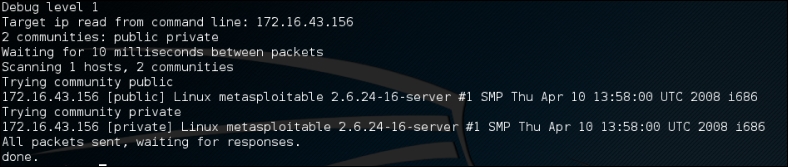
The following is the scanning result:

The SNMP strings found are public and private.
If we want the scanning to be more verbose, we can give the -d option:
onesixtyone -d 172.16.43.156
The result is as follows: