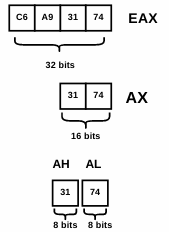
The x86 CPU has eight general purpose registers: eax, ebx, ecx, edx, esp, ebp, esi, and edi. These registers are 32 bits (4 bytes) in size. A program can access registers as 32-bit (4 bytes), 16-bit (2 bytes), or 8-bit (1 byte) values. The lower 16 bits (2 bytes) of each of these registers can be accessed as ax, bx, cx, dx, sp, bp, si, and di. The lower 8 bits (1 byte) of eax, ebx, ecx, and edx can be referenced as al, bl, cl, and dl. The higher set of 8 bits can be accessed as ah, bh, ch, and dh. In the following diagram, the eax register contains the 4-byte value 0xC6A93174. A program can access the lower 2 bytes (0x3174) by accessing the ax register, and it can access the lower byte (0x74) by accessing the al register, and the next byte (0x31) can be accessed by using the ah register: