A computer is a machine that processes information. All of the information in the computer is represented in bits. A bit is an individual unit that can take either of the two values 0 or 1. The collection of bits can represent a number, a character, or any other piece of information.
Fundamental data types:
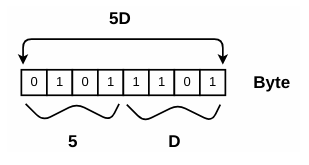
A group of 8 bits makes a byte. A single byte is represented as two hexadecimal digits, and each hexadecimal digit is 4 bits in size and called a nibble. For example, the binary number 01011101 translates to 5D in hexadecimal. The digit 5 (0101) and digit D (1101) are the nibbles:
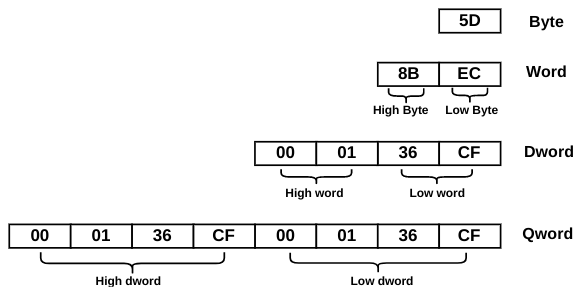
Apart from bytes, there are other data types, such as a word, which is 2 bytes (16 bits) in size, a double word (dword) is 4 bytes (32 bits), and a quadword (qword) is 8 bytes (64 bits) in size:
Data Interpretation:
A byte, or sequence of bytes, can be interpreted differently. For example, 5D can represent the binary number 01011101, or the decimal number 93, or the character ]. The byte 5D can also represent a machine instruction, pop ebp.
Similarly, the sequence of two bytes 8B EC (word) can represent short int 35820 or a machine instruction, mov ebp,esp.
The double word (dword) value 0x010F1000 can be interpreted as an integer value 17764352, or a memory address. It's all a matter of interpretation, and what a byte or sequence of bytes means depends on how it is used.