Table of Contents for
OpenLayers 3 : Beginner's Guide
 OpenLayers 3 : Beginner's Guide
Published by
Packt Publishing, 2015
OpenLayers 3 : Beginner's Guide
Published by
Packt Publishing, 2015
- Cover
- Table of Contents
- OpenLayers 3 Beginner's Guide
- OpenLayers 3 Beginner's Guide
- Credits
- About the Authors
- About the Reviewers
- www.PacktPub.com
- Preface
- What you need for this book
- Who this book is for
- Sections
- Time for action – heading
- Conventions
- Reader feedback
- Customer support
- 1. Getting Started with OpenLayers
- Advantages of using OpenLayers
- What, technically, is OpenLayers?
- Anatomy of a web mapping application
- Connecting to Google, Bing Maps, and other mapping APIs
- Time for action – downloading OpenLayers
- Time for action – creating your first map
- Where to go for help
- OpenLayers issues
- OpenLayers source code repository
- Getting live news from RSS and social networks
- Summary
- 2. Key Concepts in OpenLayers
- Time for action – creating a map
- Time for action – using the JavaScript console
- Time for action – overlaying information
- OpenLayers' super classes
- Key-Value Observing with the Object class
- Time for action – using bindTo
- Working with collections
- Summary
- 3. Charting the Map Class
- Time for action – creating a map
- Map renderers
- Time for action – rendering a masterpiece
- Map properties
- Time for action – target practice
- Map methods
- Time for action – creating animated maps
- Events
- Views
- Time for action – linking two views
- Summary
- 4. Interacting with Raster Data Source
- Layers in OpenLayers 3
- Common operations on layers
- Time for action – changing layer properties
- Tiled versus untiled layers
- Types of raster sources
- Tiled images' layers and their sources
- Time for action – creating a Stamen layer
- Time for action – creating a Bing Maps layer
- Time for action – creating tiles and adding Zoomify layer
- Image layers and their sources
- Using Spherical Mercator raster data with other layers
- Time For action – playing with various sources and layers together
- Time For action – applying Zoomify sample knowledge to a single raw image
- Summary
- 5. Using Vector Layers
- Time for action – creating a vector layer
- How the vector layer works
- The vector layer class
- Vector sources
- Time for action – using the cluster source
- Time for action – creating a loader function
- Time for action – working with the TileVector source
- Time for action – a drag and drop viewer for vector files
- Features and geometries
- Time for action – geometries in action
- Time for action – interacting with features
- Summary
- 6. Styling Vector Layers
- Time for action – basic styling
- The style class
- Time for action – using the icon style
- Have a go hero – using the circle style
- Multiple styles
- Time for action – using multiple styles
- Style functions
- Time for action – using properties to style features
- Interactive styles
- Time for action – creating interactive styles
- Summary
- 7. Wrapping Our Heads Around Projections
- Time for action – using different projection codes
- Time for action – determining coordinates
- OpenLayers projection class
- Transforming coordinates
- Time for action – coordinate transforms
- Time for action – setting up Proj4js.org
- Time for action – reprojecting extent
- Time for action – using custom projection with WMS sources
- Time for action – reprojecting geometries in vector layers
- Summary
- 8. Interacting with Your Map
- Time for action – converting your local or national authorities data into web mapping formats
- Time for action – testing the use cases for ol.interaction.Select
- Time for action – more options with ol.interaction.Select
- Introducing methods to get information from your map
- Time for action – understanding the forEachFeatureAtPixel method
- Time for action – understanding the getGetFeatureInfoUrl method
- Adding a pop-up on your map
- Time for action – introducing ol.Overlay with a static example
- Time for action – using ol.Overlay dynamically with layers information
- Time for action – using ol.interaction.Draw to share new information on the Web
- Time for action – using ol.interaction.Modify to update drawing
- Understanding interactions and their architecture
- Time for action – configuring default interactions
- Discovering the other interactions
- Time for action – using ol.interaction.DragRotateAndZoom
- Time for action – making rectangle export to GeoJSON with ol.interaction.DragBox
- Summary
- 9. Taking Control of Controls
- Adding controls to your map
- Time for action – starting with the default controls
- Controls overview
- Time for action – changing the default attribution styles
- Time for action – finding your mouse position
- Time for action – configuring ZoomToExtent and manipulate controls
- Creating a custom control
- Time for action – extending ol.control.Control to make your own control
- Summary
- 10. OpenLayers Goes Mobile
- Using a web server
- Time for action – go mobile!
- The Geolocation class
- Time for action – location, location, location
- The DeviceOrientation class
- Time for action – a sense of direction
- Debugging mobile web applications
- Debugging on iOS
- Debugging on Android
- Going offline
- Time for action – MANIFEST destiny
- Going native with web applications
- Time for action – track me
- Summary
- 11. Creating Web Map Apps
- Using geospatial data from Flickr
- Time for action – getting Flickr data
- A simple application
- Time for Action – adding data to your map
- Styling the features
- Time for action – creating a style function
- Creating a thumbnail style
- Time for action – switching to JSON data
- Time for action – creating a thumbnail style
- Turning our example into an application
- Time for action – adding the select interaction
- Time for action – handling selection events
- Time for action – displaying photo information
- Using real time data
- Time for action – getting dynamic data
- Wrapping up the application
- Time for action – adding dynamic tags to your map
- Deploying an application
- Creating custom builds
- Creating a combined build
- Time for action – creating a combined build
- Creating a separate build
- Time for action – creating a separate build
- Summary
- A. Object-oriented Programming – Introduction and Concepts
- Going further
- B. More details on Closure Tools and Code Optimization Techniques
- Introducing Closure Library, yet another JavaScript library
- Time for action – first steps with Closure Library
- Making custom build for optimizing performance
- Time for action – playing with Closure Compiler
- Applying your knowledge to the OpenLayers case
- Time for action - running official examples with the internal OpenLayers toolkit
- Time for action - building your custom OpenLayers library
- Syntax and styles
- Time for action – using Closure Linter to fix JavaScript
- Summary
- C. Squashing Bugs with Web Debuggers
- Time for action – opening Chrome Developer Tools
- Explaining Chrome Developer debugging controls
- Time for action – using DOM manipulation with OpenStreetMap map images
- Time for action – using breakpoints to explore your code
- Time for action – playing with zoom button and map copyrights
- Using the Console panel
- Time for action – executing code in the Console
- Time for action – creating object literals
- Time for action – interacting with a map
- Improving Chrome and Developer Tools with extensions
- Debugging in other browsers
- Summary
- D. Pop Quiz Answers
- Chapter 5, Using Vector Layers
- Chapter 7, Wrapping Our Heads Around Projections
- Chapter 8, Interacting with Your Map
- Chapter 9, Taking Control of Controls
- Chapter 10, OpenLayers Goes Mobile
- Appendix B, More details on Closure Tools and Code Optimization Techniques
- Appendix C, Squashing Bugs with Web Debuggers
- Index
We mentioned earlier that the Flickr feed API supports more than just the KML format. It also supports a variety of RSS versions and JSON. That sounds promising; let's see if we can do better with the JSON version. Refer to the following steps:
- First, replace the KML source,
flickrSource, with a generic vector source. Reload the page and make sure that everything still works. You should see the base map but no features (we'll add them shortly):var flickrSource = new ol.source.Vector();
- Next, we'll need to download the JSON version of our data by changing the format in the URL to
json. Load the following URL in your browser and save the result to a new file calledflickr_data.json: - Have a look at this file in your text editor. Note that it starts with
jsonFlickrFeed(on the first line, this means that it is intended to be loaded as JSONP).Note
JSONP, or JSON with Padding, is a technique for loading JSON data from a remote server that avoids the restrictions of the same-origin policy. See http://en.wikipedia.org/wiki/JSONP for a good description of why and how JSONP works. For now, it is sufficient to know that JSONP will invoke a callback function and pass the data to it.
The next few lines appear to be metadata about the response—a title, description, date, and so on. What comes next seems to be what we want—an array of objects that represent photos, complete with links to photos and geographic locations. Perfect!
- The data isn't in a format that OpenLayers understands; so, we'll have to load the data and turn it into features ourselves. We can use the jQuery
ajaxmethod to do this:$.ajax({ url: '../assets/data/flickr_data.json', dataType: 'jsonp', jsonpCallback: 'jsonFlickrFeed', success: successHandler }); - Now, we can add the
successHandlerfunction to process the data into features and add them to the map:function successHandler(data) { var transform = ol.proj.getTransform('EPSG:4326', 'EPSG:3857'); data.items.forEach(function(item) { var feature = new ol.Feature(item); feature.set('url', item.media.m); var coordinate = transform([parseFloat(item.longitude), parseFloat(item.latitude)]); var geometry = new ol.geom.Point(coordinate); feature.setGeometry(geometry); flickrSource.addFeature(feature); }); } - Reload and check the result. If we try the code from before in the console, we should see much more useful information:
var feature = flickrSource.getFeatures()[0];
feature.getProperties();
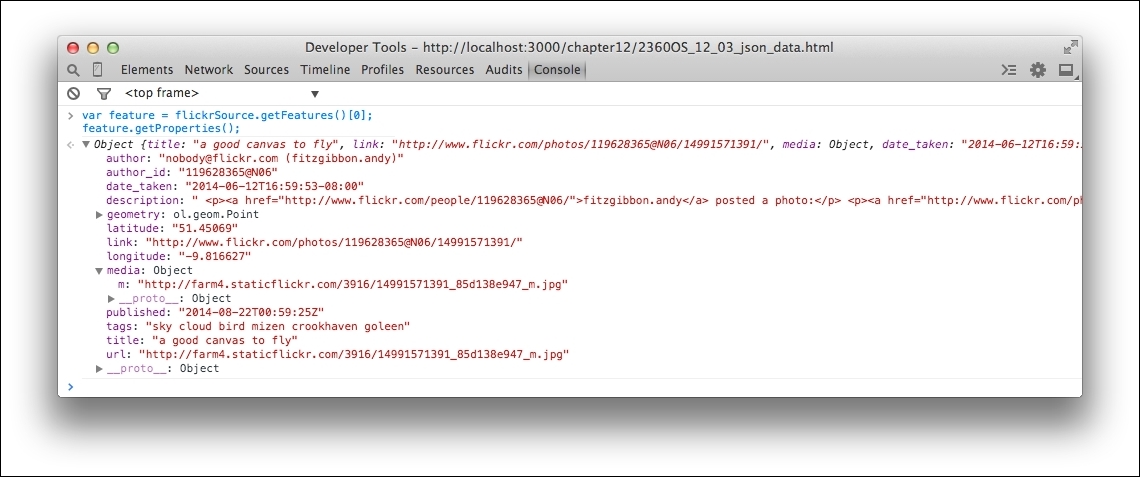
Allowing for different features in the new data file, the application should look exactly the same as before. The only difference is, we are now using JSON data instead of KML. Let's review how we changed from KML to JSON.
The JSON data is not in a format that is directly usable by OpenLayers; so, we need to do most of the work that a format-specific source would do for us. The first step was to remove the KML source and replace it with a generic vector source, into which we can insert the features as we get them. The next step is to load the data. We've chosen to use jQuery's ajax function to do this. The ajax function needs a URL to load from, a function to call when the data is loaded (successHandler) and a configuration to help it understand that the data is in the JSONP format:
dataType: 'jsonp'
And, that it uses a specific callback function name:
jsonpCallback: 'jsonFlickrFeed'
The final step is to interpret the data once it is loaded and create the features we need. We do this inside successHandler by first creating transform that will convert coordinates from latitude and longitude into the projection we are using for the map's view:
var transform = ol.proj.getTransform('EPSG:4326', 'EPSG:3857');Then, we loop over all the items and turn each one into a feature. Each item is an object literal containing all the information we need for positioning and styling the photo. We create a new feature object and pass it this information, so that we can access it later for styling purposes:
var feature = new ol.Feature(item);
From looking at the properties of each photo, we see that the URL to the photo is stored in the media attribute under a key called m. This will be inconvenient to work with later; so, we create a new property called url with the value we want:
feature.set('url', item.media.m);We need to create a new geometry object to represent the feature's location using the latitude and longitude of the photo (remembering to also transform the coordinates into the view's projection) and set it as the geometry of the feature:
var coordinate = transform([parseFloat(item.longitude), parseFloat(item.latitude)]);
var geometry = new ol.geom.Point(coordinate);
feature.setGeometry(geometry);
Finally, we added the feature to our vector source:
flickrSource.addFeature(feature);