Table of Contents for
PHP 7: Real World Application Development
 PHP 7: Real World Application Development
Published by
Packt Publishing, 2016
PHP 7: Real World Application Development
Published by
Packt Publishing, 2016
- Cover
- Table of Contents
- PHP 7: Real World Application Development
- PHP 7: Real World Application Development
- PHP 7: Real World Application Development
- Credits
- Preface
- What you need for this learning path
- Who this learning path is for
- Reader feedback
- Customer support
- 1. Module 1
- 1. Building a Foundation
- PHP 7 installation considerations
- Using the built-in PHP web server
- Defining a test MySQL database
- Installing PHPUnit
- Implementing class autoloading
- Hoovering a website
- Building a deep web scanner
- Creating a PHP 5 to PHP 7 code converter
- 2. Using PHP 7 High Performance Features
- Understanding the abstract syntax tree
- Understanding differences in parsing
- Understanding differences in foreach() handling
- Improving performance using PHP 7 enhancements
- Iterating through a massive file
- Uploading a spreadsheet into a database
- Recursive directory iterator
- 3. Working with PHP Functions
- Developing functions
- Hinting at data types
- Using return value data typing
- Using iterators
- Writing your own iterator using generators
- 4. Working with PHP Object-Oriented Programming
- Developing classes
- Extending classes
- Using static properties and methods
- Using namespaces
- Defining visibility
- Using interfaces
- Using traits
- Implementing anonymous classes
- 5. Interacting with a Database
- Using PDO to connect to a database
- Building an OOP SQL query builder
- Handling pagination
- Defining entities to match database tables
- Tying entity classes to RDBMS queries
- Embedding secondary lookups into query results
- Implementing jQuery DataTables PHP lookups
- 6. Building Scalable Websites
- Creating a generic form element generator
- Creating an HTML radio element generator
- Creating an HTML select element generator
- Implementing a form factory
- Chaining $_POST filters
- Chaining $_POST validators
- Tying validation to a form
- 7. Accessing Web Services
- Converting between PHP and XML
- Creating a simple REST client
- Creating a simple REST server
- Creating a simple SOAP client
- Creating a simple SOAP server
- 8. Working with Date/Time and International Aspects
- Using emoticons or emoji in a view script
- Converting complex characters
- Getting the locale from browser data
- Formatting numbers by locale
- Handling currency by locale
- Formatting date/time by locale
- Creating an HTML international calendar generator
- Building a recurring events generator
- Handling translation without gettext
- 9. Developing Middleware
- Authenticating with middleware
- Using middleware to implement access control
- Improving performance using the cache
- Implementing routing
- Making inter-framework system calls
- Using middleware to cross languages
- 10. Looking at Advanced Algorithms
- Using getters and setters
- Implementing a linked list
- Building a bubble sort
- Implementing a stack
- Building a binary search class
- Implementing a search engine
- Displaying a multi-dimensional array and accumulating totals
- 11. Implementing Software Design Patterns
- Creating an array to object hydrator
- Building an object to array hydrator
- Implementing a strategy pattern
- Defining a mapper
- Implementing object-relational mapping
- Implementing the Pub/Sub design pattern
- 12. Improving Web Security
- Filtering $_POST data
- Validating $_POST data
- Safeguarding the PHP session
- Securing forms with a token
- Building a secure password generator
- Safeguarding forms with a CAPTCHA
- Encrypting/decrypting without mcrypt
- 13. Best Practices, Testing, and Debugging
- Using Traits and Interfaces
- Universal exception handler
- Universal error handler
- Writing a simple test
- Writing a test suite
- Generating fake test data
- Customizing sessions using session_start parameters
- A. Defining PSR-7 Classes
- Implementing PSR-7 value object classes
- Developing a PSR-7 Request class
- Defining a PSR-7 Response class
- 2. Module 2
- 1. Setting Up the Environment
- Setting up Debian or Ubuntu
- Setting up CentOS
- Setting up Vagrant
- Summary
- 2. New Features in PHP 7
- New operators
- Uniform variable syntax
- Miscellaneous features and changes
- Summary
- 3. Improving PHP 7 Application Performance
- HTTP server optimization
- HTTP persistent connection
- Content Delivery Network (CDN)
- CSS and JavaScript optimization
- Full page caching
- Varnish
- The infrastructure
- Summary
- 4. Improving Database Performance
- Storage engines
- The Percona Server - a fork of MySQL
- MySQL performance monitoring tools
- Percona XtraDB Cluster (PXC)
- Redis – the key-value cache store
- Memcached key-value cache store
- Summary
- 5. Debugging and Profiling
- Profiling with Xdebug
- PHP DebugBar
- Summary
- 6. Stress/Load Testing PHP Applications
- ApacheBench (ab)
- Siege
- Load testing real-world applications
- Summary
- 7. Best Practices in PHP Programming
- Test-driven development (TDD)
- Design patterns
- Service-oriented architecture (SOA)
- Being object-oriented and reusable always
- PHP frameworks
- Version control system (VCS) and Git
- Deployment and Continuous Integration (CI)
- Summary
- A. Tools to Make Life Easy
- Git – A version control system
- Grunt watch
- Summary
- B. MVC and Frameworks
- Laravel
- Lumen
- Apigility
- Summary
- 3. Module 3
- 1. Ecosystem Overview
- Summary
- 2. GoF Design Patterns
- Structural patterns
- Behavioral patterns
- Summary
- 3. SOLID Design Principles
- Open/closed principle
- Liskov substitution principle
- Interface Segregation Principle
- Dependency inversion principle
- Summary
- 4. Requirement Specification for a Modular Web Shop App
- Wireframing
- Defining a technology stack
- Summary
- 5. Symfony at a Glance
- Creating a blank project
- Using Symfony console
- Controller
- Routing
- Templates
- Forms
- Configuring Symfony
- The bundle system
- Databases and Doctrine
- Testing
- Validation
- Summary
- 6. Building the Core Module
- Dependencies
- Implementation
- Unit testing
- Functional testing
- Summary
- 7. Building the Catalog Module
- Dependencies
- Implementation
- Unit testing
- Functional testing
- Summary
- 8. Building the Customer Module
- Dependencies
- Implementation
- Unit testing
- Functional testing
- Summary
- 9. Building the Payment Module
- Dependencies
- Implementation
- Unit testing
- Functional testing
- Summary
- 10. Building the Shipment Module
- Dependencies
- Implementation
- Unit testing
- Functional testing
- Summary
- 11. Building the Sales Module
- Dependencies
- Implementation
- Unit testing
- Functional testing
- Summary
- 12. Integrating and Distributing Modules
- Understanding GitHub
- Understanding Composer
- Understanding Packagist
- Summary
- Bibliography
- Index
We start off by creating a new module called Foggyline\CatalogBundle. We do so with the help of the console, by running the command as follows:
php bin/console generate:bundle --namespace=Foggyline/CatalogBundle
The command triggers an interactive process that asks us several questions along the way, as shown in the following screenshot:
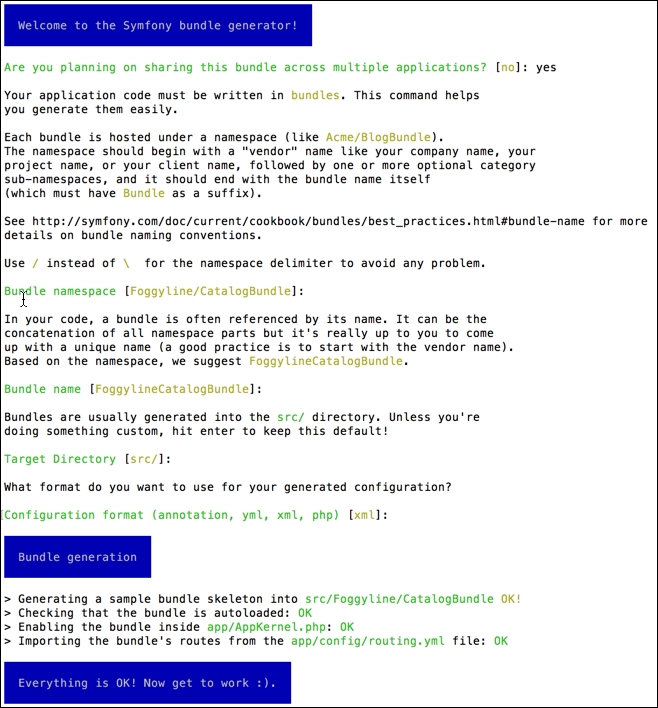
Once done, the following structure is generated for us:
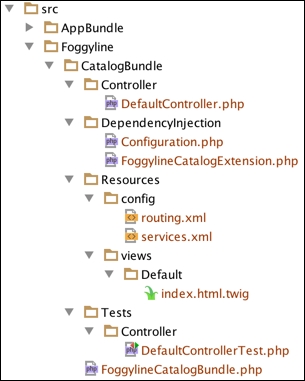
If we now take a look at the app/AppKernel.php file, we would see the following line under the registerBundles method:
new Foggyline\CatalogBundle\FoggylineCatalogBundle()
Similarly, the app/config/routing.yml has the following route definition added to it:
foggyline_catalog:
  resource: "@FoggylineCatalogBundle/Resources/config/routing.xml"
  prefix: /
Here we need to change prefix: / into prefix: /catalog/, so we don't collide with core module routes. Leaving it as prefix: / would simply overrun our core AppBundle and output Hello World! from the src/Foggyline/CatalogBundle/Resources/views/Default/index.html.twig template to the browser at this point. We want to keep things nice and separated. What this means is that the module does not define the root route for itself.
Let's go ahead and create a Category entity. We do so by using the console, as shown here:
php bin/console generate:doctrine:entity
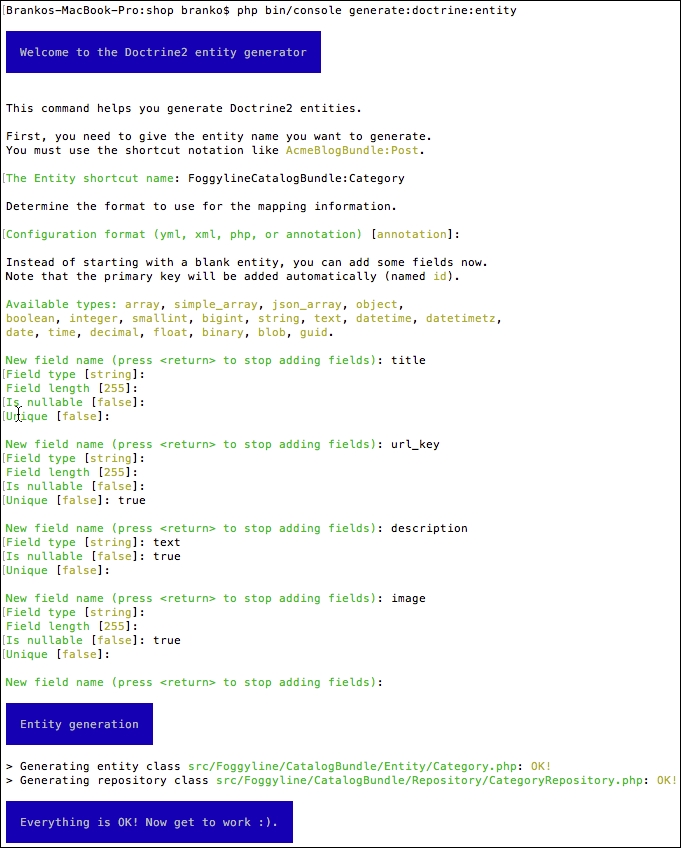
This creates the Entity/Category.php and Repository/CategoryRepository.php files within the src/Foggyline/CatalogBundle/ directory. After this, we need to update the database, so it pulls in the Category entity, as shown in the following command line instance:
php bin/console doctrine:schema:update --force
This results in a screen that looks similar to the following screenshot:

With entity in place, we are ready to generate its CRUD. We do so by using the following command:
php bin/console generate:doctrine:crud
This results with interactive output as shown here:
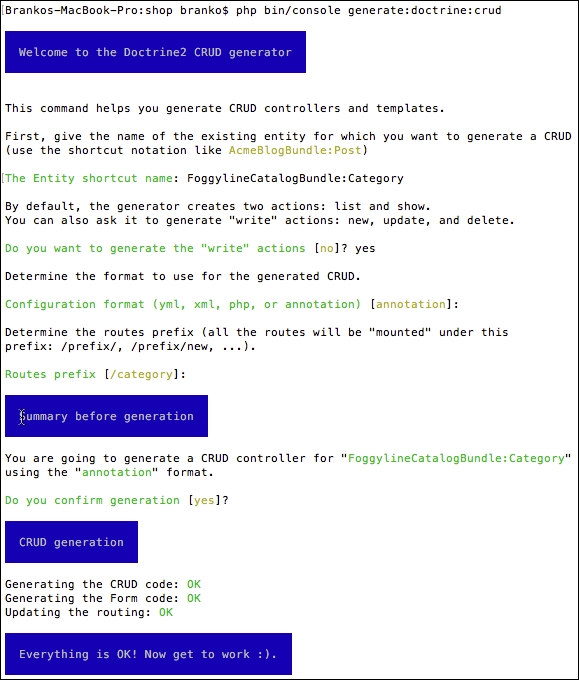
This results in src/Foggyline/CatalogBundle/Controller/CategoryController.php being created. It also adds an entry to our app/config/routing.yml file as follows:
foggyline_catalog_category:
  resource: "@FoggylineCatalogBundle/Controller/CategoryController.php"
  type:     annotation
Furthermore, the view files are created under the app/Resources/views/category/ directory, which is not what we might expect. We want them under our module src/Foggyline/CatalogBundle/Resources/views/Default/category/ directory, so we need to copy them over. Additionally, we need to modify all of the $this->render calls within our CategoryController by appending the FoggylineCatalogBundle:default: string to each of the template paths.
Next, we go ahead and create the Product entity by using the interactive generator as discussed earlier:
php bin/console generate:doctrine:entity
We follow the interactive generator, respecting the minimum of the following attributes: title, price, sku, url_key, description, qty, category, and image. Aside from price and qty, which are of types decimal and integer, all other attributes are of type string. Furthermore, sku and url_key are flagged as unique. This creates the Entity/Product.php and Repository/ProductRepository.php files within the src/Foggyline/CatalogBundle/ directory.
Similar to what we have done for the Category view templates, we need to do for the Product view templates. That is, copy them over from the app/Resources/views/product/ directory to src/Foggyline/CatalogBundle/Resources/views/Default/product/ and update all of the $this->render calls within our ProductController by appending the FoggylineCatalogBundle:default: string to each of the template paths.
At this point, we won't rush updating the schema, as we want to add proper relations to our code. Each product should be able to have a relation to a single Category entity. To achieve this, we need to edit Category.php and Product.php from within the src/Foggyline/CatalogBundle/Entity/ directory, as follows:
// src/Foggyline/CatalogBundle/Entity/Category.php

/**
 * @ORM\OneToMany(targetEntity="Product", mappedBy="category")
 */
private $products;

public function __construct()
{
  $this->products = new \Doctrine\Common\Collections\ArrayCollection();
}

// src/Foggyline/CatalogBundle/Entity/Product.php

/**
 * @ORM\ManyToOne(targetEntity="Category", inversedBy="products")
 * @ORM\JoinColumn(name="category_id", referencedColumnName="id")
 */
private $category;
We further need to edit the Category.php file by adding the __toString method implementation to it, as follows:
public function __toString()
{
    return $this->getTitle();
}
The reason we are doing so is that, later on, our Product-editing form would know what labels to list under the Category selection, otherwise the system would throw the following error:
Catchable Fatal Error: Object of class Foggyline\CatalogBundle\Entity\Category could not be converted to string
With the above changes in place, we can now run the schema update, as follows:
php bin/console doctrine:schema:update --force
If we now take a look at our database, the CREATE command syntax for our product table looks like the following:
CREATE TABLE `product` (
  `id` int(11) NOT NULL AUTO_INCREMENT,
  `category_id` int(11) DEFAULT NULL,
  `title` varchar(255) COLLATE utf8_unicode_ci NOT NULL,
  `price` decimal(10,2) NOT NULL,
  `sku` varchar(255) COLLATE utf8_unicode_ci NOT NULL,
  `url_key` varchar(255) COLLATE utf8_unicode_ci NOT NULL,
  `description` longtext COLLATE utf8_unicode_ci,
  `qty` int(11) NOT NULL,
  `image` varchar(255) COLLATE utf8_unicode_ci DEFAULT NULL,
  PRIMARY KEY (`id`),
  UNIQUE KEY `UNIQ_D34A04ADF9038C4` (`sku`),
  UNIQUE KEY `UNIQ_D34A04ADDFAB7B3B` (`url_key`),
  KEY `IDX_D34A04AD12469DE2` (`category_id`),
  CONSTRAINT `FK_D34A04AD12469DE2` FOREIGN KEY (`category_id`) REFERENCES `category` (`id`)
) ENGINE=InnoDB DEFAULT CHARSET=utf8 COLLATE=utf8_unicode_ci;
We can see two unique keys and one foreign key restraint defined, as per the entries provided to our interactive entity generator. Now we are ready to generate the CRUD for our Product entity. To do so, we run the generate:doctrine:crud command and follow the interactive generator as shown here:
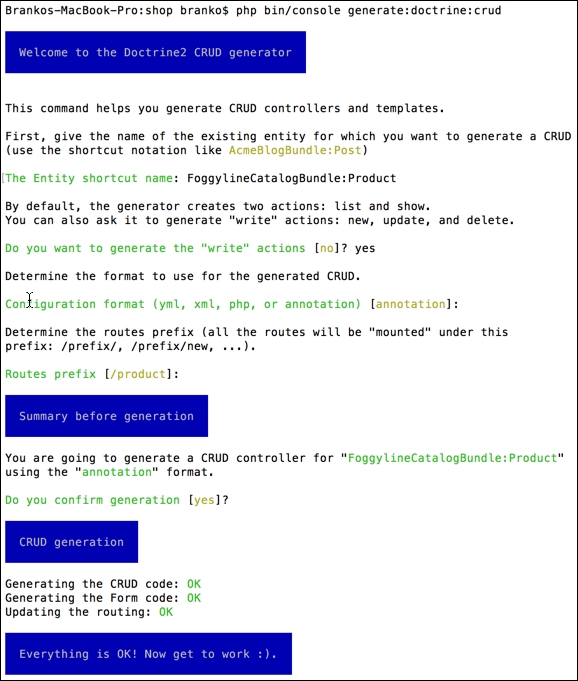
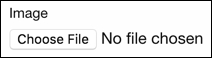
At this point, if we access either /category/new/ or /product/new/ URL, the image field is just a simple input text field, not the actual image upload we would like. To make it into an image upload field, we need to edit the $image property of Category.php and Product.php as follows:
//…
use Symfony\Component\Validator\Constraints as Assert;
//…
class [Category|Product]
{
  //…
  /**
  * @var string
  *
  * @ORM\Column(name="image", type="string", length=255, nullable=true)
  * @Assert\File(mimeTypes={ "image/png", "image/jpeg" }, mimeTypesMessage="Please upload the PNG or JPEG image file.")
  */
  private $image;
  //…
}
As soon as we do so, the input fields turn into the file upload fields, as shown here:
Next, we will go ahead and implement the upload functionality into the forms.
We do so by first defining the service that will handle the actual upload. Service is defined by adding the following entry into the src/Foggyline/CatalogBundle/Resources/config/services.xml file, under the services element:
<service id="foggyline_catalog.image_uploader" class="Foggyline\CatalogBundle\Service\ImageUploader">
  <argument>%foggyline_catalog_images_directory%</argument>
</service>
The %foggyline_catalog_images_directory% argument value is the name of a parameter the we will soon define.
We then create the src/Foggyline/CatalogBundle/Service/ImageUploader.php file with content as follows:
namespace Foggyline\CatalogBundle\Service;

use Symfony\Component\HttpFoundation\File\UploadedFile;

class ImageUploader
{
  private $targetDir;

  public function __construct($targetDir)
  {
    $this->targetDir = $targetDir;
  }

  public function upload(UploadedFile $file)
  {
    $fileName = md5(uniqid()) . '.' . $file->guessExtension();
    $file->move($this->targetDir, $fileName);
    return $fileName;
  }
}
We then create our own parameters.yml file within the src/Foggyline/CatalogBundle/Resources/config directory with content as follows:
parameters:
  foggyline_catalog_images_directory: "%kernel.root_dir%/../web/uploads/foggyline_catalog_images"
This is the parameter our service expects to find. It can easily be overridden with the same entry under app/config/parameters.yml if needed.
In order for our bundle to see the parameters.yml file, we still need to edit the FoggylineCatalogExtension.php file within the src/Foggyline/CatalogBundle/DependencyInjection/ directory, by adding the following loader to the end of the load method:
$loader = new Loader\YamlFileLoader($container, new FileLocator(__DIR__.'/../Resources/config'));
$loader->load('parameters.yml');
At this point, our Symfony module is able to read its parameters.yml, thus making it possible for the defined service to pickup the proper value for its argument. All that is left is to adjust the code for our new and edit forms, attaching the upload functionality to them. Since both forms are the same, the following is a Category example that equally applies to the Product form as well:
public function newAction(Request $request) {
  // ...

  if ($form->isSubmitted() && $form->isValid()) {
    /* @var $image \Symfony\Component\HttpFoundation\File\UploadedFile */
    if ($image = $category->getImage()) {
      $name = $this->get('foggyline_catalog.image_uploader')->upload($image);
      $category->setImage($name);
    }

    $em = $this->getDoctrine()->getManager();
    // ...
  }

  // ...
}

public function editAction(Request $request, Category $category) {
  $existingImage = $category->getImage();
  if ($existingImage) {
    $category->setImage(
      new File($this->getParameter('foggyline_catalog_images_directory') . '/' . $existingImage)
    );
  }

  $deleteForm = $this->createDeleteForm($category);
  // ...

  if ($editForm->isSubmitted() && $editForm->isValid()) {
    /* @var $image \Symfony\Component\HttpFoundation\File\UploadedFile */
    if ($image = $category->getImage()) {
      $name = $this->get('foggyline_catalog.image_uploader')->upload($image);
      $category->setImage($name);
    } elseif ($existingImage) {
      $category->setImage($existingImage);
    }

    $em = $this->getDoctrine()->getManager();
    // ...
  }

  // ...
}
Both the new and edit forms should now be able to handle file uploads.
Now let's go ahead and address the category menu and the on-sale items. Back when we were building the core module, we defined the global variables under the twig:global section of the app/config/config.yml file. These variables were pointing to services defined in the app/config/services.yml file. In order for us to change the content of the category menu and the on sale items, we need to override those services.
We start off by adding the following two service definitions under the src/Foggyline/CatalogBundle/Resources/config/services.xml file:
<service id="foggyline_catalog.category_menu" class="Foggyline\CatalogBundle\Service\Menu\Category">
  <argument type="service" id="doctrine.orm.entity_manager" />
  <argument type="service" id="router" />
</service>

<service id="foggyline_catalog.onsale" class="Foggyline\CatalogBundle\Service\Menu\OnSale">
  <argument type="service" id="doctrine.orm.entity_manager" />
  <argument type="service" id="router" />
</service>
Both of the services accept the Doctrine ORM entity manager and router service arguments, as we will need to use those internally.
We then create the actual Category and OnSale service classes within the src/Foggyline/CatalogBundle/Service/Menu/ directory as follows:
//Category.php

namespace Foggyline\CatalogBundle\Service\Menu;

class Category
{
  private $em;
  private $router;

  public function __construct(
    \Doctrine\ORM\EntityManager $entityManager,
    \Symfony\Bundle\FrameworkBundle\Routing\Router $router
  )
  {
    $this->em = $entityManager;
    $this->router = $router;
  }

  public function getItems()
  {
    $categories = array();
    $_categories = $this->em->getRepository('FoggylineCatalogBundle:Category')->findAll();

    foreach ($_categories as $_category) {
      /* @var $_category \Foggyline\CatalogBundle\Entity\Category */
      $categories[] = array(
        'path' => $this->router->generate('category_show', array('id' => $_category->getId())),
        'label' => $_category->getTitle(),
      );
    }

    return $categories;
  }
}
 //OnSale.php

namespace Foggyline\CatalogBundle\Service\Menu;

class OnSale
{
  private $em;
  private $router;

  public function __construct(\Doctrine\ORM\EntityManager $entityManager, $router)
  {
    $this->em = $entityManager;
    $this->router = $router;
  }

  public function getItems()
  {
    $products = array();
    $_products = $this->em->getRepository('FoggylineCatalogBundle:Product')->findBy(
        array('onsale' => true),
        null,
        5
    );

    foreach ($_products as $_product) {
      /* @var $_product \Foggyline\CatalogBundle\Entity\Product */
      $products[] = array(
        'path' => $this->router->generate('product_show', array('id' => $_product->getId())),
        'name' => $_product->getTitle(),
        'image' => $_product->getImage(),
        'price' => $_product->getPrice(),
        'id' => $_product->getId(),
      );
    }

    return $products;
  }
}
This alone won't trigger the override of the core module services. Within the src/Foggyline/CatalogBundle/DependencyInjection/Compiler/ directory we need to create an OverrideServiceCompilerPass class that implements the CompilerPassInterface. Within its process method, we can then change the definition of the service, as follows:
namespace Foggyline\CatalogBundle\DependencyInjection\Compiler;

use Symfony\Component\DependencyInjection\Compiler\CompilerPassInterface;
use Symfony\Component\DependencyInjection\ContainerBuilder;

class OverrideServiceCompilerPass implements CompilerPassInterface
{
  public function process(ContainerBuilder $container)
  {
    // Override the core module 'category_menu' service
    $container->removeDefinition('category_menu');
    $container->setDefinition('category_menu', $container->getDefinition('foggyline_catalog.category_menu'));

    // Override the core module 'onsale' service
    $container->removeDefinition('onsale');
    $container->setDefinition('onsale', $container->getDefinition('foggyline_catalog.onsale'));
  }
}
Finally, we need to edit the build method of the src/Foggyline/CatalogBundle/FoggylineCatalogBundle.php file in order to add this compiler pass as shown here:
public function build(ContainerBuilder $container)
{
  parent::build($container);
  $container->addCompilerPass(new \Foggyline\CatalogBundle\DependencyInjection\Compiler\OverrideServiceCompilerPass());
}
Now our Category and OnSale services should override the ones defined in the core module, thus providing the right values for the header Category menu and On Sale section of the homepage.
The auto-generated CRUD made a Category page for us with the layout as follows:
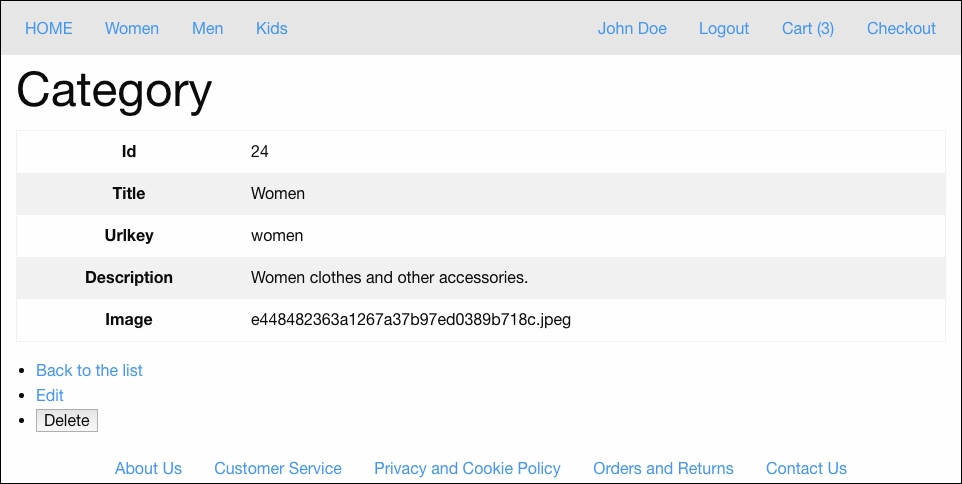
This is significantly different from the Category page defined under Chapter 4, Requirement Specification for Modular Web Shop App. We therefore need to make amends to our Category Show page, by modifying the show.html.twig file within the src/Foggyline/CatalogBundle/Resources/views/Default/category/ directory. We do so by replacing the entire content of body block with code as follows:
<div class="row">
  <div class="small-12 large-12 columns text-center">
    <h1>{{ category.title }}</h1>
    <p>{{ category.description }}</p>
  </div>
</div>

<div class="row">
  <img src="{{ asset('uploads/foggyline_catalog_images/' ~ category.image) }}"/>
</div>

{% set products = category.getProducts() %}
{% if products %}
<div class="row products_onsale text-center small-up-1 medium-up-3 large-up-5" data-equalizer data-equalize-by-row="true">
{% for product in products %}
<div class="column product">
  <img src="{{ asset('uploads/foggyline_catalog_images/' ~ product.image) }}"
    alt="missing image"/>
  <a href="{{ path('product_show', {'id': product.id}) }}">{{ product.title }}</a>

  <div>${{ product.price }}</div>
  <div><a class="small button" href="{{ path('product_show', {'id': product.id}) }}">View</a></div>
  </div>
  {% endfor %}
</div>
{% else %}
<div class="row">
  <p>There are no products assigned to this category.</p>
</div>
{% endif %}

{% if is_granted('ROLE_ADMIN') %}
<ul>
  <li>
    <a href="{{ path('category_edit', { 'id': category.id }) }}">Edit</a>
  </li>
  <li>
    {{ form_start(delete_form) }}
    <input type="submit" value="Delete">
    form_end(delete_form) }}
  </li>
</ul>
{% endif %}
The body is now sectioned into three areas. First, we are addressing the category title and description output. We are then fetching and looping through the list of products assigned to category, rendering each individual product. Finally, we are using the is_granted Twig extension to check if the current user role is ROLE_ADMIN, in which case we show the Edit and Delete links for the category.
The auto-generated CRUD made a Product page for us with the layout as follows:
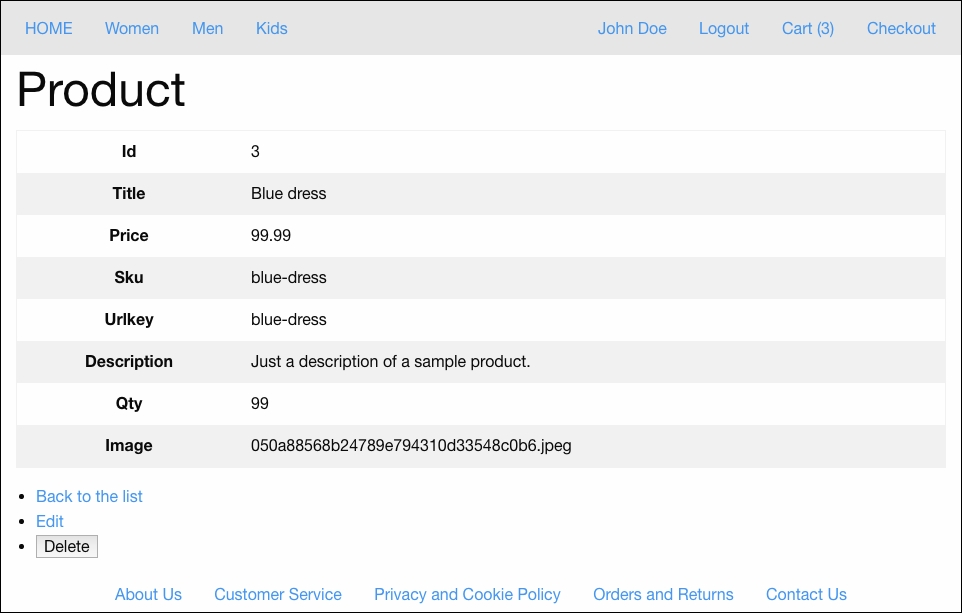
This differs from the Product page defined under Chapter 4, Requirement Specification for Modular Web Shop App. To rectify the problem, we need to make amends to our Product Show page, by modifying the show.html.twig file within the src/Foggyline/CatalogBundle/Resources/views/Default/product/ directory. We do so by replacing entire content of body block with code as follows:
<div class="row">
  <div class="small-12 large-6 columns">
    <img class="thumbnail" src="{{ asset('uploads/foggyline_catalog_images/' ~ product.image) }}"/>
  </div>
  <div class="small-12 large-6 columns">
    <h1>{{ product.title }}</h1>
    <div>SKU: {{ product.sku }}</div>
    {% if product.qty %}
    <div>IN STOCK</div>
    {% else %}
    <div>OUT OF STOCK</div>
    {% endif %}
    <div>$ {{ product.price }}</div>
    <form action="{{ add_to_cart_url.getAddToCartUrl
      (product.id) }}" method="get">
      <div class="input-group">
        <span class="input-group-label">Qty</span>
        <input class="input-group-field" type="number">
        <div class="input-group-button">
          <input type="submit" class="button" value="Add to Cart">
        </div>
      </div>
    </form>
  </div>
</div>

<div class="row">
  <p>{{ product.description }}</p>
</div>

{% if is_granted('ROLE_ADMIN') %}
<ul>
  <li>
    <a href="{{ path('product_edit', { 'id': product.id }) }}">Edit</a>
  </li>
  <li>
    {{ form_start(delete_form) }}
    <input type="submit" value="Delete">
    {{ form_end(delete_form) }}
  </li>
</ul>
{% endif %}
The body is now sectioned into two main areas. First, we are addressing the product image, title, stock status, and add to cart output. The add to cart form uses the add_to_cart_url service to provide the right link. This service is defined under the core module and, at this point, only provides a dummy link. Later on, when we get to the checkout module, we will implement an override for this service and inject the right add to cart link. We then output the description section. Finally, we use the is_granted Twig extension, like we did on the Category example, to determine if the user can access the Edit and Delete links for a product.