Table of Contents for
PHP 7: Real World Application Development
 PHP 7: Real World Application Development
Published by
Packt Publishing, 2016
PHP 7: Real World Application Development
Published by
Packt Publishing, 2016
- Cover
- Table of Contents
- PHP 7: Real World Application Development
- PHP 7: Real World Application Development
- PHP 7: Real World Application Development
- Credits
- Preface
- What you need for this learning path
- Who this learning path is for
- Reader feedback
- Customer support
- 1. Module 1
- 1. Building a Foundation
- PHP 7 installation considerations
- Using the built-in PHP web server
- Defining a test MySQL database
- Installing PHPUnit
- Implementing class autoloading
- Hoovering a website
- Building a deep web scanner
- Creating a PHP 5 to PHP 7 code converter
- 2. Using PHP 7 High Performance Features
- Understanding the abstract syntax tree
- Understanding differences in parsing
- Understanding differences in foreach() handling
- Improving performance using PHP 7 enhancements
- Iterating through a massive file
- Uploading a spreadsheet into a database
- Recursive directory iterator
- 3. Working with PHP Functions
- Developing functions
- Hinting at data types
- Using return value data typing
- Using iterators
- Writing your own iterator using generators
- 4. Working with PHP Object-Oriented Programming
- Developing classes
- Extending classes
- Using static properties and methods
- Using namespaces
- Defining visibility
- Using interfaces
- Using traits
- Implementing anonymous classes
- 5. Interacting with a Database
- Using PDO to connect to a database
- Building an OOP SQL query builder
- Handling pagination
- Defining entities to match database tables
- Tying entity classes to RDBMS queries
- Embedding secondary lookups into query results
- Implementing jQuery DataTables PHP lookups
- 6. Building Scalable Websites
- Creating a generic form element generator
- Creating an HTML radio element generator
- Creating an HTML select element generator
- Implementing a form factory
- Chaining $_POST filters
- Chaining $_POST validators
- Tying validation to a form
- 7. Accessing Web Services
- Converting between PHP and XML
- Creating a simple REST client
- Creating a simple REST server
- Creating a simple SOAP client
- Creating a simple SOAP server
- 8. Working with Date/Time and International Aspects
- Using emoticons or emoji in a view script
- Converting complex characters
- Getting the locale from browser data
- Formatting numbers by locale
- Handling currency by locale
- Formatting date/time by locale
- Creating an HTML international calendar generator
- Building a recurring events generator
- Handling translation without gettext
- 9. Developing Middleware
- Authenticating with middleware
- Using middleware to implement access control
- Improving performance using the cache
- Implementing routing
- Making inter-framework system calls
- Using middleware to cross languages
- 10. Looking at Advanced Algorithms
- Using getters and setters
- Implementing a linked list
- Building a bubble sort
- Implementing a stack
- Building a binary search class
- Implementing a search engine
- Displaying a multi-dimensional array and accumulating totals
- 11. Implementing Software Design Patterns
- Creating an array to object hydrator
- Building an object to array hydrator
- Implementing a strategy pattern
- Defining a mapper
- Implementing object-relational mapping
- Implementing the Pub/Sub design pattern
- 12. Improving Web Security
- Filtering $_POST data
- Validating $_POST data
- Safeguarding the PHP session
- Securing forms with a token
- Building a secure password generator
- Safeguarding forms with a CAPTCHA
- Encrypting/decrypting without mcrypt
- 13. Best Practices, Testing, and Debugging
- Using Traits and Interfaces
- Universal exception handler
- Universal error handler
- Writing a simple test
- Writing a test suite
- Generating fake test data
- Customizing sessions using session_start parameters
- A. Defining PSR-7 Classes
- Implementing PSR-7 value object classes
- Developing a PSR-7 Request class
- Defining a PSR-7 Response class
- 2. Module 2
- 1. Setting Up the Environment
- Setting up Debian or Ubuntu
- Setting up CentOS
- Setting up Vagrant
- Summary
- 2. New Features in PHP 7
- New operators
- Uniform variable syntax
- Miscellaneous features and changes
- Summary
- 3. Improving PHP 7 Application Performance
- HTTP server optimization
- HTTP persistent connection
- Content Delivery Network (CDN)
- CSS and JavaScript optimization
- Full page caching
- Varnish
- The infrastructure
- Summary
- 4. Improving Database Performance
- Storage engines
- The Percona Server - a fork of MySQL
- MySQL performance monitoring tools
- Percona XtraDB Cluster (PXC)
- Redis – the key-value cache store
- Memcached key-value cache store
- Summary
- 5. Debugging and Profiling
- Profiling with Xdebug
- PHP DebugBar
- Summary
- 6. Stress/Load Testing PHP Applications
- ApacheBench (ab)
- Siege
- Load testing real-world applications
- Summary
- 7. Best Practices in PHP Programming
- Test-driven development (TDD)
- Design patterns
- Service-oriented architecture (SOA)
- Being object-oriented and reusable always
- PHP frameworks
- Version control system (VCS) and Git
- Deployment and Continuous Integration (CI)
- Summary
- A. Tools to Make Life Easy
- Git – A version control system
- Grunt watch
- Summary
- B. MVC and Frameworks
- Laravel
- Lumen
- Apigility
- Summary
- 3. Module 3
- 1. Ecosystem Overview
- Summary
- 2. GoF Design Patterns
- Structural patterns
- Behavioral patterns
- Summary
- 3. SOLID Design Principles
- Open/closed principle
- Liskov substitution principle
- Interface Segregation Principle
- Dependency inversion principle
- Summary
- 4. Requirement Specification for a Modular Web Shop App
- Wireframing
- Defining a technology stack
- Summary
- 5. Symfony at a Glance
- Creating a blank project
- Using Symfony console
- Controller
- Routing
- Templates
- Forms
- Configuring Symfony
- The bundle system
- Databases and Doctrine
- Testing
- Validation
- Summary
- 6. Building the Core Module
- Dependencies
- Implementation
- Unit testing
- Functional testing
- Summary
- 7. Building the Catalog Module
- Dependencies
- Implementation
- Unit testing
- Functional testing
- Summary
- 8. Building the Customer Module
- Dependencies
- Implementation
- Unit testing
- Functional testing
- Summary
- 9. Building the Payment Module
- Dependencies
- Implementation
- Unit testing
- Functional testing
- Summary
- 10. Building the Shipment Module
- Dependencies
- Implementation
- Unit testing
- Functional testing
- Summary
- 11. Building the Sales Module
- Dependencies
- Implementation
- Unit testing
- Functional testing
- Summary
- 12. Integrating and Distributing Modules
- Understanding GitHub
- Understanding Composer
- Understanding Packagist
- Summary
- Bibliography
- Index
When a form is first rendered, there is little value in having a form class (such as Application\Form\Factory, described in the previous recipe) tied to a class that can perform filtering or validation (such as the Application\Filter\* described in the previous recipe). Once the form data has been submitted, however, interest grows. If the form data fails validation, the values can be filtered, and then re-displayed. Validation error messages can be tied to form elements, and rendered next to form fields.
- First of all, be sure to implement the classes defined in the Implementing a Form Factory, Chaining $_POST Filters, and Chaining $_POST Validators recipes.
- We will now turn our attention to the
Application\Form\Factoryclass, and add properties and setters that allow us to attach instances ofApplication\Filter\FilterandApplication\Filter\Validator. We also need define$data, which will be used to retain the filtered and/or validated data:const DATA_NOT_FOUND = 'Data not found. Run setData()'; const FILTER_NOT_FOUND = 'Filter not found. Run setFilter()'; const VALIDATOR_NOT_FOUND = 'Validator not found. Run setValidator()'; protected $filter; protected $validator; protected $data; public function setFilter(Filter $filter) { $this->filter = $filter; } public function setValidator(Validator $validator) { $this->validator = $validator; } public function setData($data) { $this->data = $data; } - Next, we define a
validate()method that calls theprocess()method of the embeddedApplication\Filter\Validatorinstance. We check to see if$dataand$validatorexist. If not, the appropriate exceptions are thrown with instructions on which method needs to be run first:public function validate() { if (!$this->data) throw new RuntimeException(self::DATA_NOT_FOUND); if (!$this->validator) throw new RuntimeException(self::VALIDATOR_NOT_FOUND); - After calling the
process()method, we associate validation result messages with form element messages. Note that theprocess()method returns a boolean value that represents the overall validation status of the data set. When the form is re-displayed following failed validation, error messages will appear next to each element:$valid = $this->validator->process($this->data); foreach ($this->elements as $element) { if (isset($this->validator->getResults() [$element->getName()])) { $element->setErrors($this->validator->getResults() [$element->getName()]->messages); } } return $valid; } - In a similar manner, we define a
filter()method that calls theprocess()method of the embeddedApplication\Filter\Filterinstance. As with thevalidate()method described in step 3, we need to check for the existence of$dataand$filter. If either is missing, we throw aRuntimeExceptionwith the appropriate message:public function filter() { if (!$this->data) throw new RuntimeException(self::DATA_NOT_FOUND); if (!$this->filter) throw new RuntimeException(self::FILTER_NOT_FOUND); - We then run the
process()method, which produces an array ofResultobjects where the$itemproperty represents the end result of the filter chain. We then loop through the results, and, if the corresponding$elementkey matches, set thevalueattribute to the filtered value. We also add any messages resulting from the filtering process. When the form is then re-displayed, all value attributes will display filtered results:$this->filter->process($this->data); foreach ($this->filter->getResults() as $key => $result) { if (isset($this->elements[$key])) { $this->elements[$key] ->setSingleAttribute('value', $result->item); if (isset($result->messages) && count($result->messages)) { foreach ($result->messages as $message) { $this->elements[$key]->addSingleError($message); } } } } }
You can start by making the changes to Application\Form\Factory as described above. For a test target you can use the prospects database table shown in the How it works... section of the Chaining $_POST filters recipe. The various column settings should give you an idea of which form elements, filters, and validators to define.
As an example, you can define a chap_06_tying_filters_to_form_definitions.php file, which will contain definitions for form wrappers, elements, and filter assignments. Here are some examples:
<?php
use Application\Form\Generic;

define('VALIDATE_SUCCESS', 'SUCCESS: form submitted ok!');
define('VALIDATE_FAILURE', 'ERROR: validation errors detected');

$wrappers = [
  Generic::INPUT  => ['type' => 'td', 'class' => 'content'],
  Generic::LABEL  => ['type' => 'th', 'class' => 'label'],
  Generic::ERRORS => ['type' => 'td', 'class' => 'error']
];

$elements = [
  'first_name' => [
     'class'     => 'Application\Form\Generic',
     'type'      => Generic::TYPE_TEXT,
     'label'     => 'First Name',
     'wrappers'  => $wrappers,
     'attributes'=> ['maxLength'=>128,'required'=>'']
  ],
  'last_name'   => [
    'class'     => 'Application\Form\Generic',
    'type'      => Generic::TYPE_TEXT,
    'label'     => 'Last Name',
    'wrappers'  => $wrappers,
    'attributes'=> ['maxLength'=>128,'required'=>'']
  ],
    // etc.
];

// overall form config
$formConfig = [
  'name'       => 'prospectsForm',
  'attributes' => [
'method'=>'post',
'action'=>'chap_06_tying_filters_to_form.php'
],
  'row_wrapper'  => ['type' => 'tr', 'class' => 'row'],
  'form_wrapper' => [
    'type'=>'table',
    'class'=>'table',
    'id'=>'prospectsTable',
    'class'=>'display','cellspacing'=>'0'
  ],
  'form_tag_inside_wrapper' => FALSE,
];

$assignments = [
  'first_name'    => [ ['key' => 'length',
  'params'        => ['min' => 1, 'max' => 128]],
                     ['key' => 'alnum',
  'params'        => ['allowWhiteSpace' => TRUE]],
                     ['key' => 'required','params' => []] ],
  'last_name'     => [ ['key' => 'length',
  'params'        => ['min' => 1, 'max' => 128]],
                     ['key' => 'alnum',
  'params'        => ['allowWhiteSpace' => TRUE]],
                     ['key' => 'required','params' => []] ],
  'address'       => [ ['key' => 'length',
  'params'        => ['max' => 256]] ],
  'city'          => [ ['key' => 'length',
  'params'        => ['min' => 1, 'max' => 64]] ],
  'state_province'=> [ ['key' => 'length',
  'params'        => ['min' => 1, 'max' => 32]] ],
  'postal_code'   => [ ['key' => 'length',
  'params'        => ['min' => 1, 'max' => 16] ],
                     ['key' => 'alnum',
  'params'        => ['allowWhiteSpace' => TRUE]],
                     ['key' => 'required','params' => []] ],
  'phone'         => [ ['key' => 'phone',   'params' => []] ],
  'country'       => [ ['key' => 'in_array',
  'params'        => $countries ],
                     ['key' => 'required','params' => []] ],
  'email'         => [ ['key' => 'email',   'params' => [] ],
                     ['key' => 'length',
  'params'        => ['max' => 250] ],
                     ['key' => 'required','params' => [] ] ],
  'budget'        => [ ['key' => 'float',   'params' => []] ]
];
You can use the already existing chap_06_post_data_config_callbacks.php and chap_06_post_data_config_messages.php files described in the previous recipes. Finally, define a chap_06_tying_filters_to_form.php file that sets up autoloading and includes these three configuration files:
<?php
require __DIR__ . '/../Application/Autoload/Loader.php';
Application\Autoload\Loader::init(__DIR__ . '/..');
include __DIR__ . '/chap_06_post_data_config_messages.php';
include __DIR__ . '/chap_06_post_data_config_callbacks.php';
include __DIR__ . '/chap_06_tying_filters_to_form_definitions.php';
Next, you can create instances of the form factory, filter, and validator classes:
use Application\Form\Factory;
use Application\Filter\ { Validator, Filter };
$form = Factory::generate($elements);
$form->setFilter(new Filter($callbacks['filters'], $assignments['filters']));
$form->setValidator(new Validator($callbacks['validators'], $assignments['validators']));
You can then check to see if there is any $_POST data. If so, perform validation and filtering:
$message = '';
if (isset($_POST['submit'])) {
  $form->setData($_POST);
  if ($form->validate()) {
    $message = VALIDATE_SUCCESS;
  } else {
    $message = VALIDATE_FAILURE;
  }
  $form->filter();
}
?>
The view logic is extremely simple: just render the form. Any validation messages and values for the various elements will be assigned as part of validation and filtering:
<?= $form->render($form, $formConfig); ?>
Here is an example using bad form data:
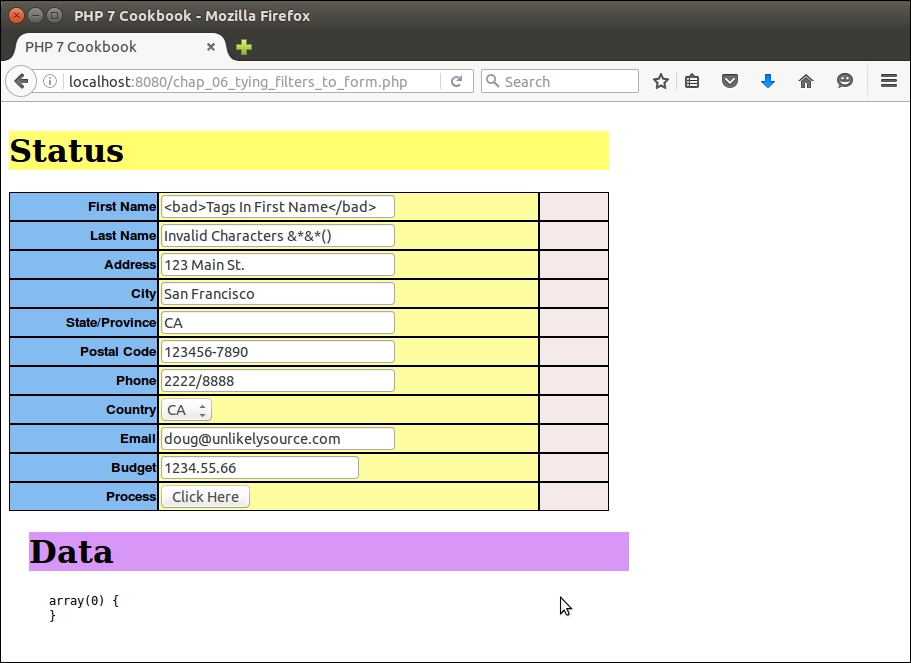
Notice the filtering and validation messages. Also notice the bad tags: