Table of Contents for
PHP 7: Real World Application Development
 PHP 7: Real World Application Development
Published by
Packt Publishing, 2016
PHP 7: Real World Application Development
Published by
Packt Publishing, 2016
- Cover
- Table of Contents
- PHP 7: Real World Application Development
- PHP 7: Real World Application Development
- PHP 7: Real World Application Development
- Credits
- Preface
- What you need for this learning path
- Who this learning path is for
- Reader feedback
- Customer support
- 1. Module 1
- 1. Building a Foundation
- PHP 7 installation considerations
- Using the built-in PHP web server
- Defining a test MySQL database
- Installing PHPUnit
- Implementing class autoloading
- Hoovering a website
- Building a deep web scanner
- Creating a PHP 5 to PHP 7 code converter
- 2. Using PHP 7 High Performance Features
- Understanding the abstract syntax tree
- Understanding differences in parsing
- Understanding differences in foreach() handling
- Improving performance using PHP 7 enhancements
- Iterating through a massive file
- Uploading a spreadsheet into a database
- Recursive directory iterator
- 3. Working with PHP Functions
- Developing functions
- Hinting at data types
- Using return value data typing
- Using iterators
- Writing your own iterator using generators
- 4. Working with PHP Object-Oriented Programming
- Developing classes
- Extending classes
- Using static properties and methods
- Using namespaces
- Defining visibility
- Using interfaces
- Using traits
- Implementing anonymous classes
- 5. Interacting with a Database
- Using PDO to connect to a database
- Building an OOP SQL query builder
- Handling pagination
- Defining entities to match database tables
- Tying entity classes to RDBMS queries
- Embedding secondary lookups into query results
- Implementing jQuery DataTables PHP lookups
- 6. Building Scalable Websites
- Creating a generic form element generator
- Creating an HTML radio element generator
- Creating an HTML select element generator
- Implementing a form factory
- Chaining $_POST filters
- Chaining $_POST validators
- Tying validation to a form
- 7. Accessing Web Services
- Converting between PHP and XML
- Creating a simple REST client
- Creating a simple REST server
- Creating a simple SOAP client
- Creating a simple SOAP server
- 8. Working with Date/Time and International Aspects
- Using emoticons or emoji in a view script
- Converting complex characters
- Getting the locale from browser data
- Formatting numbers by locale
- Handling currency by locale
- Formatting date/time by locale
- Creating an HTML international calendar generator
- Building a recurring events generator
- Handling translation without gettext
- 9. Developing Middleware
- Authenticating with middleware
- Using middleware to implement access control
- Improving performance using the cache
- Implementing routing
- Making inter-framework system calls
- Using middleware to cross languages
- 10. Looking at Advanced Algorithms
- Using getters and setters
- Implementing a linked list
- Building a bubble sort
- Implementing a stack
- Building a binary search class
- Implementing a search engine
- Displaying a multi-dimensional array and accumulating totals
- 11. Implementing Software Design Patterns
- Creating an array to object hydrator
- Building an object to array hydrator
- Implementing a strategy pattern
- Defining a mapper
- Implementing object-relational mapping
- Implementing the Pub/Sub design pattern
- 12. Improving Web Security
- Filtering $_POST data
- Validating $_POST data
- Safeguarding the PHP session
- Securing forms with a token
- Building a secure password generator
- Safeguarding forms with a CAPTCHA
- Encrypting/decrypting without mcrypt
- 13. Best Practices, Testing, and Debugging
- Using Traits and Interfaces
- Universal exception handler
- Universal error handler
- Writing a simple test
- Writing a test suite
- Generating fake test data
- Customizing sessions using session_start parameters
- A. Defining PSR-7 Classes
- Implementing PSR-7 value object classes
- Developing a PSR-7 Request class
- Defining a PSR-7 Response class
- 2. Module 2
- 1. Setting Up the Environment
- Setting up Debian or Ubuntu
- Setting up CentOS
- Setting up Vagrant
- Summary
- 2. New Features in PHP 7
- New operators
- Uniform variable syntax
- Miscellaneous features and changes
- Summary
- 3. Improving PHP 7 Application Performance
- HTTP server optimization
- HTTP persistent connection
- Content Delivery Network (CDN)
- CSS and JavaScript optimization
- Full page caching
- Varnish
- The infrastructure
- Summary
- 4. Improving Database Performance
- Storage engines
- The Percona Server - a fork of MySQL
- MySQL performance monitoring tools
- Percona XtraDB Cluster (PXC)
- Redis – the key-value cache store
- Memcached key-value cache store
- Summary
- 5. Debugging and Profiling
- Profiling with Xdebug
- PHP DebugBar
- Summary
- 6. Stress/Load Testing PHP Applications
- ApacheBench (ab)
- Siege
- Load testing real-world applications
- Summary
- 7. Best Practices in PHP Programming
- Test-driven development (TDD)
- Design patterns
- Service-oriented architecture (SOA)
- Being object-oriented and reusable always
- PHP frameworks
- Version control system (VCS) and Git
- Deployment and Continuous Integration (CI)
- Summary
- A. Tools to Make Life Easy
- Git – A version control system
- Grunt watch
- Summary
- B. MVC and Frameworks
- Laravel
- Lumen
- Apigility
- Summary
- 3. Module 3
- 1. Ecosystem Overview
- Summary
- 2. GoF Design Patterns
- Structural patterns
- Behavioral patterns
- Summary
- 3. SOLID Design Principles
- Open/closed principle
- Liskov substitution principle
- Interface Segregation Principle
- Dependency inversion principle
- Summary
- 4. Requirement Specification for a Modular Web Shop App
- Wireframing
- Defining a technology stack
- Summary
- 5. Symfony at a Glance
- Creating a blank project
- Using Symfony console
- Controller
- Routing
- Templates
- Forms
- Configuring Symfony
- The bundle system
- Databases and Doctrine
- Testing
- Validation
- Summary
- 6. Building the Core Module
- Dependencies
- Implementation
- Unit testing
- Functional testing
- Summary
- 7. Building the Catalog Module
- Dependencies
- Implementation
- Unit testing
- Functional testing
- Summary
- 8. Building the Customer Module
- Dependencies
- Implementation
- Unit testing
- Functional testing
- Summary
- 9. Building the Payment Module
- Dependencies
- Implementation
- Unit testing
- Functional testing
- Summary
- 10. Building the Shipment Module
- Dependencies
- Implementation
- Unit testing
- Functional testing
- Summary
- 11. Building the Sales Module
- Dependencies
- Implementation
- Unit testing
- Functional testing
- Summary
- 12. Integrating and Distributing Modules
- Understanding GitHub
- Understanding Composer
- Understanding Packagist
- Summary
- Bibliography
- Index
One of the key characteristics of PSR-7 middleware is the use of Request and Response classes. When applied, this enables different blocks of software to perform together without sharing any specific knowledge between them. In this context, a request class should encompass all aspects of the original user request, including such items as browser settings, the original URL requested, parameters passed, and so forth.
- First, be sure to define classes to represent the
Uri,Stream, andUploadedFilevalue objects, as described in the previous recipe. - Now we are ready to define the core
Application\MiddleWare\Messageclass. This class consumesStreamandUriand implementsPsr\Http\Message\MessageInterface. We first define properties for the key value objects, including those representing the message body (that is, aStreamInterfaceinstance), version, and HTTP headers:namespace Application\MiddleWare; use Psr\Http\Message\ { MessageInterface, StreamInterface, UriInterface }; class Message implements MessageInterface { protected $body; protected $version; protected $httpHeaders = array(); - Next, we have the
getBody()method that represents aStreamInterfaceinstance. A companion method,withBody(), returns the currentMessageinstance and allows us to overwrite the current value ofbody:public function getBody() { if (!$this->body) { $this->body = new Stream(self::DEFAULT_BODY_STREAM); } return $this->body; } public function withBody(StreamInterface $body) { if (!$body->isReadable()) { throw new InvalidArgumentException(self::ERROR_BODY_UNREADABLE); } $this->body = $body; return $this; } - PSR-7 recommends that headers should be viewed as case-insensitive. Accordingly, we define a
findHeader()method (not directly defined byMessageInterface) that locates a header usingstripos():protected function findHeader($name) { $found = FALSE; foreach (array_keys($this->getHeaders()) as $header) { if (stripos($header, $name) !== FALSE) { $found = $header; break; } } return $found; } - The next method, not defined by PSR-7, is designed to populate the
$httpHeadersproperty. This property is assumed to be an associative array where the key is the header, and the value is the string representing the header value. If there is more than one value, additional values separated by commas are appended to the string. There is an excellentapache_request_headers()PHP function from the Apache extension that produces headers if they are not already available in$httpHeaders:protected function getHttpHeaders() { if (!$this->httpHeaders) { if (function_exists('apache_request_headers')) { $this->httpHeaders = apache_request_headers(); } else { $this->httpHeaders = $this->altApacheReqHeaders(); } } return $this->httpHeaders; } - If
apache_request_headers()is not available (that is, the Apache extension is not enabled), we provide an alternative,altApacheReqHeaders():protected function altApacheReqHeaders() { $headers = array(); foreach ($_SERVER as $key => $value) { if (stripos($key, 'HTTP_') !== FALSE) { $headerKey = str_ireplace('HTTP_', '', $key); $headers[$this->explodeHeader($headerKey)] = $value; } elseif (stripos($key, 'CONTENT_') !== FALSE) { $headers[$this->explodeHeader($key)] = $value; } } return $headers; } protected function explodeHeader($header) { $headerParts = explode('_', $header); $headerKey = ucwords(implode(' ', strtolower($headerParts))); return str_replace(' ', '-', $headerKey); } - Implementing
getHeaders()(required in PSR-7) is now a trivial loop through the$httpHeadersproperty produced by thegetHttpHeaders()method discussed in step 4:public function getHeaders() { foreach ($this->getHttpHeaders() as $key => $value) { header($key . ': ' . $value); } } - Again, we provide a series of
withmethods designed to overwrite or replace headers. Since there can be many headers, we also have a method that adds to the existing set of headers. ThewithoutHeader()method is used to remove a header instance. Notice the consistent use offindHeader(), mentioned in the previous step, to allow for case-insensitive handling of headers:public function withHeader($name, $value) { $found = $this->findHeader($name); if ($found) { $this->httpHeaders[$found] = $value; } else { $this->httpHeaders[$name] = $value; } return $this; } public function withAddedHeader($name, $value) { $found = $this->findHeader($name); if ($found) { $this->httpHeaders[$found] .= $value; } else { $this->httpHeaders[$name] = $value; } return $this; } public function withoutHeader($name) { $found = $this->findHeader($name); if ($found) { unset($this->httpHeaders[$found]); } return $this; } - We then provide a series of useful header-related methods to confirm a header exists, retrieve a single header line, and retrieve a header in array form, as per PSR-7:
public function hasHeader($name) { return boolval($this->findHeader($name)); } public function getHeaderLine($name) { $found = $this->findHeader($name); if ($found) { return $this->httpHeaders[$found]; } else { return ''; } } public function getHeader($name) { $line = $this->getHeaderLine($name); if ($line) { return explode(',', $line); } else { return array(); } } - Finally, to round off header handling, we present
getHeadersAsStringthat produces a single header string with the headers separated by\r\nfor direct use with PHP stream contexts:public function getHeadersAsString() { $output = ''; $headers = $this->getHeaders(); if ($headers && is_array($headers)) { foreach ($headers as $key => $value) { if ($output) { $output .= "\r\n" . $key . ': ' . $value; } else { $output .= $key . ': ' . $value; } } } return $output; } - Still within the
Messageclass, we now turn our attention to version handling. According to PSR-7, the return value for the protocol version (that is, HTTP/1.1) should only be the numerical part. For this reason, we also provideonlyVersion()that strips off any non-digit character, allowing periods:public function getProtocolVersion() { if (!$this->version) { $this->version = $this->onlyVersion($_SERVER['SERVER_PROTOCOL']); } return $this->version; } public function withProtocolVersion($version) { $this->version = $this->onlyVersion($version); return $this; } protected function onlyVersion($version) { if (!empty($version)) { return preg_replace('/[^0-9\.]/', '', $version); } else { return NULL; } } } - Finally, almost as an anticlimax, we are ready to define our
Requestclass. It must be noted here, however, that we need to consider both out-bound as well as in-bound requests. That is to say, we need a class to represent an outgoing request a client will make to a server, as well as a request received from a client by a server. Accordingly, we provideApplication\MiddleWare\Request(requests a client will make to a server), andApplication\MiddleWare\ServerRequest(requests received from a client by a server). The good news is that most of our work has already been done: notice that ourRequestclass extendsMessage. We also provide properties to represent the URI and HTTP method:namespace Application\MiddleWare; use InvalidArgumentException; use Psr\Http\Message\ { RequestInterface, StreamInterface, UriInterface }; class Request extends Message implements RequestInterface { protected $uri; protected $method; // HTTP method protected $uriObj; // Psr\Http\Message\UriInterface instance - All properties in the constructor default to
NULL, but we leave open the possibility of defining the appropriate arguments right away. We use the inheritedonlyVersion()method to sanitize the version. We also definecheckMethod()to make sure any method supplied is on our list of supported HTTP methods, defined as a constant array inConstants:public function __construct($uri = NULL, $method = NULL, StreamInterface $body = NULL, $headers = NULL, $version = NULL) { $this->uri = $uri; $this->body = $body; $this->method = $this->checkMethod($method); $this->httpHeaders = $headers; $this->version = $this->onlyVersion($version); } protected function checkMethod($method) { if (!$method === NULL) { if (!in_array(strtolower($method), Constants::HTTP_METHODS)) { throw new InvalidArgumentException(Constants::ERROR_HTTP_METHOD); } } return $method; } - We are going to interpret the request target as the originally requested URI in the form of a string. Bear in mind that our
Uriclass has methods that will parse this into its component parts, hence our provision of the$uriObjproperty. In the case ofwithRequestTarget(), notice that we rungetUri()that performs the aforementioned parsing process:public function getRequestTarget() { return $this->uri ?? Constants::DEFAULT_REQUEST_TARGET; } public function withRequestTarget($requestTarget) { $this->uri = $requestTarget; $this->getUri(); return $this; } - Our
getandwithmethods, which represent the HTTP method, reveal no surprises. We usecheckMethod(), used in the constructor as well, to ensure the method matches those we plan to support:public function getMethod() { return $this->method; } public function withMethod($method) { $this->method = $this->checkMethod($method); return $this; } - Finally, we have a
getandwithmethod for the URI. As mentioned in step 14, we retain the original request string in the$uriproperty and the newly parsedUriinstance in$uriObj. Note the extra flag to preserve any existingHostheader:public function getUri() { if (!$this->uriObj) { $this->uriObj = new Uri($this->uri); } return $this->uriObj; } public function withUri(UriInterface $uri, $preserveHost = false) { if ($preserveHost) { $found = $this->findHeader(Constants::HEADER_HOST); if (!$found && $uri->getHost()) { $this->httpHeaders[Constants::HEADER_HOST] = $uri->getHost(); } } elseif ($uri->getHost()) { $this->httpHeaders[Constants::HEADER_HOST] = $uri->getHost(); } $this->uri = $uri->__toString(); return $this; } } - The
ServerRequestclass extendsRequestand provides additional functionality to retrieve information of interest to a server handling an incoming request. We start by defining properties that will represent incoming data read from the various PHP$_ super-globals(that is,$_SERVER,$_POST, and so on):namespace Application\MiddleWare; use Psr\Http\Message\ { ServerRequestInterface, UploadedFileInterface } ; class ServerRequest extends Request implements ServerRequestInterface { protected $serverParams; protected $cookies; protected $queryParams; protected $contentType; protected $parsedBody; protected $attributes; protected $method; protected $uploadedFileInfo; protected $uploadedFileObjs; - We then define a series of getters to pull super-global information. We do not show everything, to conserve space:
public function getServerParams() { if (!$this->serverParams) { $this->serverParams = $_SERVER; } return $this->serverParams; } // getCookieParams() reads $_COOKIE // getQueryParams() reads $_GET // getUploadedFileInfo() reads $_FILES public function getRequestMethod() { $method = $this->getServerParams()['REQUEST_METHOD'] ?? ''; $this->method = strtolower($method); return $this->method; } public function getContentType() { if (!$this->contentType) { $this->contentType = $this->getServerParams()['CONTENT_TYPE'] ?? ''; $this->contentType = strtolower($this->contentType); } return $this->contentType; } - As uploaded files are supposed to be represented as independent
UploadedFileobjects (presented in the previous recipe), we also define a method that takes$uploadedFileInfoand createsUploadedFileobjects:public function getUploadedFiles() { if (!$this->uploadedFileObjs) { foreach ($this->getUploadedFileInfo() as $field => $value) { $this->uploadedFileObjs[$field] = new UploadedFile($field, $value); } } return $this->uploadedFileObjs; } - As with the other classes defined previously, we provide
withmethods that add or overwrite properties and return the new instance:public function withCookieParams(array $cookies) { array_merge($this->getCookieParams(), $cookies); return $this; } public function withQueryParams(array $query) { array_merge($this->getQueryParams(), $query); return $this; } public function withUploadedFiles(array $uploadedFiles) { if (!count($uploadedFiles)) { throw new InvalidArgumentException(Constant::ERROR_NO_UPLOADED_FILES); } foreach ($uploadedFiles as $fileObj) { if (!$fileObj instanceof UploadedFileInterface) { throw new InvalidArgumentException(Constant::ERROR_INVALID_UPLOADED); } } $this->uploadedFileObjs = $uploadedFiles; } - One important aspect of PSR-7 messages is that the body should also be available in a parsed manner, that is to say, a sort of structured representation rather than just a raw stream. Accordingly, we define
getParsedBody()and its accompanyingwithmethod. The PSR-7 recommendations are quite specific when it comes to form posting. Note the series ofifstatements that check theContent-Typeheader as well as the method:public function getParsedBody() { if (!$this->parsedBody) { if (($this->getContentType() == Constants::CONTENT_TYPE_FORM_ENCODED || $this->getContentType() == Constants::CONTENT_TYPE_MULTI_FORM) && $this->getRequestMethod() == Constants::METHOD_POST) { $this->parsedBody = $_POST; } elseif ($this->getContentType() == Constants::CONTENT_TYPE_JSON || $this->getContentType() == Constants::CONTENT_TYPE_HAL_JSON) { ini_set("allow_url_fopen", true); $this->parsedBody = json_decode(file_get_contents('php://input')); } elseif (!empty($_REQUEST)) { $this->parsedBody = $_REQUEST; } else { ini_set("allow_url_fopen", true); $this->parsedBody = file_get_contents('php://input'); } } return $this->parsedBody; } public function withParsedBody($data) { $this->parsedBody = $data; return $this; } - We also allow for attributes that are not precisely defined in PSR-7. Rather, we leave this open so that the developer can provide whatever is appropriate for the application. Notice the use of
withoutAttributes()that allows you to remove attributes at will:public function getAttributes() { return $this->attributes; } public function getAttribute($name, $default = NULL) { return $this->attributes[$name] ?? $default; } public function withAttribute($name, $value) { $this->attributes[$name] = $value; return $this; } public function withoutAttribute($name) { if (isset($this->attributes[$name])) { unset($this->attributes[$name]); } return $this; } } - Finally, in order to load the different properties from an in-bound request, we define
initialize(), which is not in PSR-7, but is extremely convenient:public function initialize() { $this->getServerParams(); $this->getCookieParams(); $this->getQueryParams(); $this->getUploadedFiles; $this->getRequestMethod(); $this->getContentType(); $this->getParsedBody(); return $this; }
First, be sure to complete the preceding recipe, as the Message and Request classes consume Uri, Stream, and UploadedFile value objects. After that, go ahead and define the classes summarized in the following table:
|
Class |
Steps they are discussed in |
|---|---|
|
|
2 to 9 |
|
|
10 to 14 |
|
|
15 to 20 |
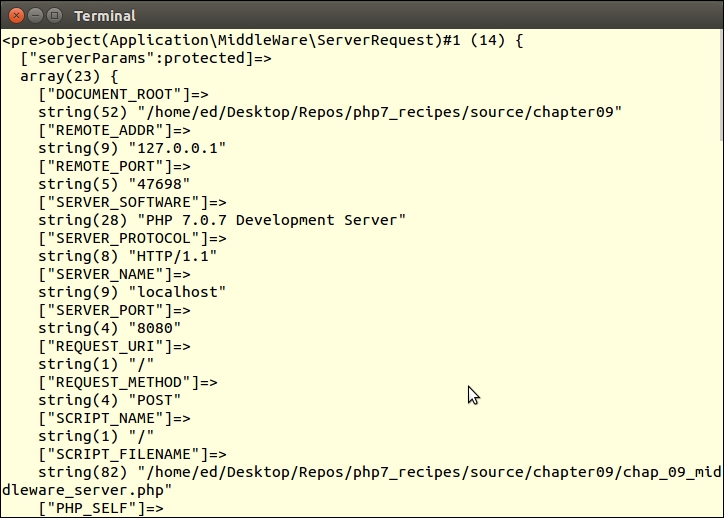
After that, you can define a server program, chap_09_middleware_server.php, which sets up autoloading and uses the appropriate classes. This script will pull the incoming request into a ServerRequest instance, initialize it, and then use var_dump() to show what information was received:
<?php
require __DIR__ . '/../Application/Autoload/Loader.php';
Application\Autoload\Loader::init(__DIR__ . '/..');
use Application\MiddleWare\ServerRequest;

$request = new ServerRequest();
$request->initialize();
echo '<pre>', var_dump($request), '</pre>';
To run the server program, first change to the /path/to/source/for/this/chapter folder. You can then run the following command:
php -S localhost:8080 chap_09_middleware_server.php'
As for the client, first create a calling program, chap_09_middleware_request.php, that sets up autoloading, uses the appropriate classes, and defines the target server and a local text file:
<?php
define('READ_FILE', __DIR__ . '/gettysburg.txt');
define('TEST_SERVER', 'http://localhost:8080');
require __DIR__ . '/../Application/Autoload/Loader.php';
Application\Autoload\Loader::init(__DIR__ . '/..');
use Application\MiddleWare\ { Request, Stream, Constants };
Next, you can create a Stream instance using the text as a source. This will become the body of a new Request, which, in this case, mirrors what might be expected for a form posting:
$body = new Stream(READ_FILE);
You can then directly build a Request instance, supplying parameters as appropriate:
$request = new Request(
    TEST_SERVER,
    Constants::METHOD_POST,
    $body,
    [Constants::HEADER_CONTENT_TYPE => Constants::CONTENT_TYPE_FORM_ENCODED,Constants::HEADER_CONTENT_LENGTH => $body->getSize()]
);
Alternatively, you can use the fluent interface syntax to produce exactly the same results:
$uriObj = new Uri(TEST_SERVER);
$request = new Request();
$request->withRequestTarget(TEST_SERVER)
        ->withMethod(Constants::METHOD_POST)
        ->withBody($body)
        ->withHeader(Constants::HEADER_CONTENT_TYPE, Constants::CONTENT_TYPE_FORM_ENCODED)
        ->withAddedHeader(Constants::HEADER_CONTENT_LENGTH, $body->getSize());
You can then set up a cURL resource to simulate a form posting, where the data parameter is the contents of the text file. You can follow that with curl_init(), curl_exec(), and so on, echoing the results:
$data = http_build_query(['data' => $request->getBody()->getContents()]);
$defaults = array(
    CURLOPT_URL => $request->getUri()->getUriString(),
    CURLOPT_POST => true,
    CURLOPT_POSTFIELDS => $data,
);
$ch = curl_init();
curl_setopt_array($ch, $defaults);
$response = curl_exec($ch);
curl_close($ch);
Here is how the direct output might appear:
- An excellent article that shows example usage written by Matthew Weir O'Phinney, the editor of PSR-7 (also the lead architect for Zend Framework 1, 2, and 3), is available here: https://mwop.net/blog/2015-01-26-psr-7-by-example.html