Table of Contents for
PHP 7: Real World Application Development
 PHP 7: Real World Application Development
Published by
Packt Publishing, 2016
PHP 7: Real World Application Development
Published by
Packt Publishing, 2016
- Cover
- Table of Contents
- PHP 7: Real World Application Development
- PHP 7: Real World Application Development
- PHP 7: Real World Application Development
- Credits
- Preface
- What you need for this learning path
- Who this learning path is for
- Reader feedback
- Customer support
- 1. Module 1
- 1. Building a Foundation
- PHP 7 installation considerations
- Using the built-in PHP web server
- Defining a test MySQL database
- Installing PHPUnit
- Implementing class autoloading
- Hoovering a website
- Building a deep web scanner
- Creating a PHP 5 to PHP 7 code converter
- 2. Using PHP 7 High Performance Features
- Understanding the abstract syntax tree
- Understanding differences in parsing
- Understanding differences in foreach() handling
- Improving performance using PHP 7 enhancements
- Iterating through a massive file
- Uploading a spreadsheet into a database
- Recursive directory iterator
- 3. Working with PHP Functions
- Developing functions
- Hinting at data types
- Using return value data typing
- Using iterators
- Writing your own iterator using generators
- 4. Working with PHP Object-Oriented Programming
- Developing classes
- Extending classes
- Using static properties and methods
- Using namespaces
- Defining visibility
- Using interfaces
- Using traits
- Implementing anonymous classes
- 5. Interacting with a Database
- Using PDO to connect to a database
- Building an OOP SQL query builder
- Handling pagination
- Defining entities to match database tables
- Tying entity classes to RDBMS queries
- Embedding secondary lookups into query results
- Implementing jQuery DataTables PHP lookups
- 6. Building Scalable Websites
- Creating a generic form element generator
- Creating an HTML radio element generator
- Creating an HTML select element generator
- Implementing a form factory
- Chaining $_POST filters
- Chaining $_POST validators
- Tying validation to a form
- 7. Accessing Web Services
- Converting between PHP and XML
- Creating a simple REST client
- Creating a simple REST server
- Creating a simple SOAP client
- Creating a simple SOAP server
- 8. Working with Date/Time and International Aspects
- Using emoticons or emoji in a view script
- Converting complex characters
- Getting the locale from browser data
- Formatting numbers by locale
- Handling currency by locale
- Formatting date/time by locale
- Creating an HTML international calendar generator
- Building a recurring events generator
- Handling translation without gettext
- 9. Developing Middleware
- Authenticating with middleware
- Using middleware to implement access control
- Improving performance using the cache
- Implementing routing
- Making inter-framework system calls
- Using middleware to cross languages
- 10. Looking at Advanced Algorithms
- Using getters and setters
- Implementing a linked list
- Building a bubble sort
- Implementing a stack
- Building a binary search class
- Implementing a search engine
- Displaying a multi-dimensional array and accumulating totals
- 11. Implementing Software Design Patterns
- Creating an array to object hydrator
- Building an object to array hydrator
- Implementing a strategy pattern
- Defining a mapper
- Implementing object-relational mapping
- Implementing the Pub/Sub design pattern
- 12. Improving Web Security
- Filtering $_POST data
- Validating $_POST data
- Safeguarding the PHP session
- Securing forms with a token
- Building a secure password generator
- Safeguarding forms with a CAPTCHA
- Encrypting/decrypting without mcrypt
- 13. Best Practices, Testing, and Debugging
- Using Traits and Interfaces
- Universal exception handler
- Universal error handler
- Writing a simple test
- Writing a test suite
- Generating fake test data
- Customizing sessions using session_start parameters
- A. Defining PSR-7 Classes
- Implementing PSR-7 value object classes
- Developing a PSR-7 Request class
- Defining a PSR-7 Response class
- 2. Module 2
- 1. Setting Up the Environment
- Setting up Debian or Ubuntu
- Setting up CentOS
- Setting up Vagrant
- Summary
- 2. New Features in PHP 7
- New operators
- Uniform variable syntax
- Miscellaneous features and changes
- Summary
- 3. Improving PHP 7 Application Performance
- HTTP server optimization
- HTTP persistent connection
- Content Delivery Network (CDN)
- CSS and JavaScript optimization
- Full page caching
- Varnish
- The infrastructure
- Summary
- 4. Improving Database Performance
- Storage engines
- The Percona Server - a fork of MySQL
- MySQL performance monitoring tools
- Percona XtraDB Cluster (PXC)
- Redis – the key-value cache store
- Memcached key-value cache store
- Summary
- 5. Debugging and Profiling
- Profiling with Xdebug
- PHP DebugBar
- Summary
- 6. Stress/Load Testing PHP Applications
- ApacheBench (ab)
- Siege
- Load testing real-world applications
- Summary
- 7. Best Practices in PHP Programming
- Test-driven development (TDD)
- Design patterns
- Service-oriented architecture (SOA)
- Being object-oriented and reusable always
- PHP frameworks
- Version control system (VCS) and Git
- Deployment and Continuous Integration (CI)
- Summary
- A. Tools to Make Life Easy
- Git – A version control system
- Grunt watch
- Summary
- B. MVC and Frameworks
- Laravel
- Lumen
- Apigility
- Summary
- 3. Module 3
- 1. Ecosystem Overview
- Summary
- 2. GoF Design Patterns
- Structural patterns
- Behavioral patterns
- Summary
- 3. SOLID Design Principles
- Open/closed principle
- Liskov substitution principle
- Interface Segregation Principle
- Dependency inversion principle
- Summary
- 4. Requirement Specification for a Modular Web Shop App
- Wireframing
- Defining a technology stack
- Summary
- 5. Symfony at a Glance
- Creating a blank project
- Using Symfony console
- Controller
- Routing
- Templates
- Forms
- Configuring Symfony
- The bundle system
- Databases and Doctrine
- Testing
- Validation
- Summary
- 6. Building the Core Module
- Dependencies
- Implementation
- Unit testing
- Functional testing
- Summary
- 7. Building the Catalog Module
- Dependencies
- Implementation
- Unit testing
- Functional testing
- Summary
- 8. Building the Customer Module
- Dependencies
- Implementation
- Unit testing
- Functional testing
- Summary
- 9. Building the Payment Module
- Dependencies
- Implementation
- Unit testing
- Functional testing
- Summary
- 10. Building the Shipment Module
- Dependencies
- Implementation
- Unit testing
- Functional testing
- Summary
- 11. Building the Sales Module
- Dependencies
- Implementation
- Unit testing
- Functional testing
- Summary
- 12. Integrating and Distributing Modules
- Understanding GitHub
- Understanding Composer
- Understanding Packagist
- Summary
- Bibliography
- Index
One trend that developers are taking advantage of is the use of anonymous functions. One classic problem, when dealing with anonymous functions, is to write them in such a way that any object can be bound to $this and the function will still work. The approach used in PHP 5 code is to use bindTo(). In PHP 7, a new method, call(), was added, which offers similar functionality, but vastly improved performance.
To take advantage of call(), execute an anonymous function in a lengthy loop. In this example, we will demonstrate an anonymous function, that scans through a log file, identifying IP addresses sorted by how frequently they appear:
- First, we define a
Application\Web\Access class. In the constructor, we accept a filename as an argument. The log file is opened as anSplFileObjectand assigned to$this->log:Namespace Application\Web; use Exception; use SplFileObject; class Access { const ERROR_UNABLE = 'ERROR: unable to open file'; protected $log; public $frequency = array(); public function __construct($filename) { if (!file_exists($filename)) { $message = __METHOD__ . ' : ' . self::ERROR_UNABLE . PHP_EOL; $message .= strip_tags($filename) . PHP_EOL; throw new Exception($message); } $this->log = new SplFileObject($filename, 'r'); } - Next, we define a generator that iterates through the file, line by line:
public function fileIteratorByLine() { $count = 0; while (!$this->log->eof()) { yield $this->log->fgets(); $count++; } return $count; } - Finally, we define a method that looks for, and extracts as a sub-match, an IP address:
public function getIp($line)
{
  preg_match('/(\d{1,3}\.\d{1,3}\.\d{1,3}\.\d{1,3})/', $line, $match);
  return $match[1] ?? '';
  }
}
First of all, we define a calling program, chap_02_performance_using_php7_enchancement_call.php, that takes advantage of the autoloading class defined in Chapter 1 , Building a Foundation, to obtain an instance of Application\Web\Access:
define('LOG_FILES', '/var/log/apache2/*access*.log');
require __DIR__ . '/../Application/Autoload/Loader.php';
Application\Autoload\Loader::init(__DIR__ . '/..');
Next we define the anonymous function, which processes one line in the log file. If an IP address is detected, it becomes a key in the $frequency array, and the current value for this key is incremented:
// define functions
$freq = function ($line) {
  $ip = $this->getIp($line);
  if ($ip) {
    echo '.';
    $this->frequency[$ip] =
    (isset($this->frequency[$ip])) ? $this->frequency[$ip] + 1 : 1;
  }
};
We then loop through the iteration of lines in each log file found, processing IP addresses:
foreach (glob(LOG_FILES) as $filename) {
  echo PHP_EOL . $filename . PHP_EOL;
  // access class
  $access = new Application\Web\Access($filename);
  foreach ($access->fileIteratorByLine() as $line) {
    $freq->call($access, $line);
  }
}Finally, we reverse-sort the array, but maintain the keys. The output is produced in a simple foreach() loop:
arsort($access->frequency);
foreach ($access->frequency as $key => $value) {
  printf('%16s : %6d' . PHP_EOL, $key, $value);
}
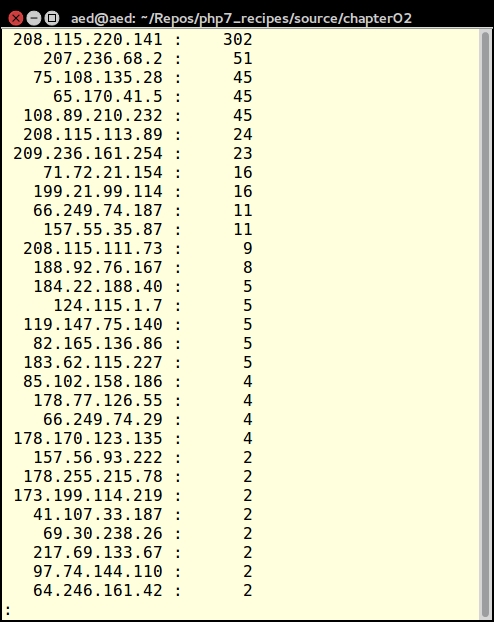
The output will vary depending on which access.log you process. Here is a sample:
Many of the PHP 7 performance improvements have nothing to do with new features and functions. Rather, they take the form of internal improvements, which are invisible until you start running your programs. Here is a short list of improvements that fall into this category: