Table of Contents for
PHP 7: Real World Application Development
 PHP 7: Real World Application Development
Published by
Packt Publishing, 2016
PHP 7: Real World Application Development
Published by
Packt Publishing, 2016
- Cover
- Table of Contents
- PHP 7: Real World Application Development
- PHP 7: Real World Application Development
- PHP 7: Real World Application Development
- Credits
- Preface
- What you need for this learning path
- Who this learning path is for
- Reader feedback
- Customer support
- 1. Module 1
- 1. Building a Foundation
- PHP 7 installation considerations
- Using the built-in PHP web server
- Defining a test MySQL database
- Installing PHPUnit
- Implementing class autoloading
- Hoovering a website
- Building a deep web scanner
- Creating a PHP 5 to PHP 7 code converter
- 2. Using PHP 7 High Performance Features
- Understanding the abstract syntax tree
- Understanding differences in parsing
- Understanding differences in foreach() handling
- Improving performance using PHP 7 enhancements
- Iterating through a massive file
- Uploading a spreadsheet into a database
- Recursive directory iterator
- 3. Working with PHP Functions
- Developing functions
- Hinting at data types
- Using return value data typing
- Using iterators
- Writing your own iterator using generators
- 4. Working with PHP Object-Oriented Programming
- Developing classes
- Extending classes
- Using static properties and methods
- Using namespaces
- Defining visibility
- Using interfaces
- Using traits
- Implementing anonymous classes
- 5. Interacting with a Database
- Using PDO to connect to a database
- Building an OOP SQL query builder
- Handling pagination
- Defining entities to match database tables
- Tying entity classes to RDBMS queries
- Embedding secondary lookups into query results
- Implementing jQuery DataTables PHP lookups
- 6. Building Scalable Websites
- Creating a generic form element generator
- Creating an HTML radio element generator
- Creating an HTML select element generator
- Implementing a form factory
- Chaining $_POST filters
- Chaining $_POST validators
- Tying validation to a form
- 7. Accessing Web Services
- Converting between PHP and XML
- Creating a simple REST client
- Creating a simple REST server
- Creating a simple SOAP client
- Creating a simple SOAP server
- 8. Working with Date/Time and International Aspects
- Using emoticons or emoji in a view script
- Converting complex characters
- Getting the locale from browser data
- Formatting numbers by locale
- Handling currency by locale
- Formatting date/time by locale
- Creating an HTML international calendar generator
- Building a recurring events generator
- Handling translation without gettext
- 9. Developing Middleware
- Authenticating with middleware
- Using middleware to implement access control
- Improving performance using the cache
- Implementing routing
- Making inter-framework system calls
- Using middleware to cross languages
- 10. Looking at Advanced Algorithms
- Using getters and setters
- Implementing a linked list
- Building a bubble sort
- Implementing a stack
- Building a binary search class
- Implementing a search engine
- Displaying a multi-dimensional array and accumulating totals
- 11. Implementing Software Design Patterns
- Creating an array to object hydrator
- Building an object to array hydrator
- Implementing a strategy pattern
- Defining a mapper
- Implementing object-relational mapping
- Implementing the Pub/Sub design pattern
- 12. Improving Web Security
- Filtering $_POST data
- Validating $_POST data
- Safeguarding the PHP session
- Securing forms with a token
- Building a secure password generator
- Safeguarding forms with a CAPTCHA
- Encrypting/decrypting without mcrypt
- 13. Best Practices, Testing, and Debugging
- Using Traits and Interfaces
- Universal exception handler
- Universal error handler
- Writing a simple test
- Writing a test suite
- Generating fake test data
- Customizing sessions using session_start parameters
- A. Defining PSR-7 Classes
- Implementing PSR-7 value object classes
- Developing a PSR-7 Request class
- Defining a PSR-7 Response class
- 2. Module 2
- 1. Setting Up the Environment
- Setting up Debian or Ubuntu
- Setting up CentOS
- Setting up Vagrant
- Summary
- 2. New Features in PHP 7
- New operators
- Uniform variable syntax
- Miscellaneous features and changes
- Summary
- 3. Improving PHP 7 Application Performance
- HTTP server optimization
- HTTP persistent connection
- Content Delivery Network (CDN)
- CSS and JavaScript optimization
- Full page caching
- Varnish
- The infrastructure
- Summary
- 4. Improving Database Performance
- Storage engines
- The Percona Server - a fork of MySQL
- MySQL performance monitoring tools
- Percona XtraDB Cluster (PXC)
- Redis – the key-value cache store
- Memcached key-value cache store
- Summary
- 5. Debugging and Profiling
- Profiling with Xdebug
- PHP DebugBar
- Summary
- 6. Stress/Load Testing PHP Applications
- ApacheBench (ab)
- Siege
- Load testing real-world applications
- Summary
- 7. Best Practices in PHP Programming
- Test-driven development (TDD)
- Design patterns
- Service-oriented architecture (SOA)
- Being object-oriented and reusable always
- PHP frameworks
- Version control system (VCS) and Git
- Deployment and Continuous Integration (CI)
- Summary
- A. Tools to Make Life Easy
- Git – A version control system
- Grunt watch
- Summary
- B. MVC and Frameworks
- Laravel
- Lumen
- Apigility
- Summary
- 3. Module 3
- 1. Ecosystem Overview
- Summary
- 2. GoF Design Patterns
- Structural patterns
- Behavioral patterns
- Summary
- 3. SOLID Design Principles
- Open/closed principle
- Liskov substitution principle
- Interface Segregation Principle
- Dependency inversion principle
- Summary
- 4. Requirement Specification for a Modular Web Shop App
- Wireframing
- Defining a technology stack
- Summary
- 5. Symfony at a Glance
- Creating a blank project
- Using Symfony console
- Controller
- Routing
- Templates
- Forms
- Configuring Symfony
- The bundle system
- Databases and Doctrine
- Testing
- Validation
- Summary
- 6. Building the Core Module
- Dependencies
- Implementation
- Unit testing
- Functional testing
- Summary
- 7. Building the Catalog Module
- Dependencies
- Implementation
- Unit testing
- Functional testing
- Summary
- 8. Building the Customer Module
- Dependencies
- Implementation
- Unit testing
- Functional testing
- Summary
- 9. Building the Payment Module
- Dependencies
- Implementation
- Unit testing
- Functional testing
- Summary
- 10. Building the Shipment Module
- Dependencies
- Implementation
- Unit testing
- Functional testing
- Summary
- 11. Building the Sales Module
- Dependencies
- Implementation
- Unit testing
- Functional testing
- Summary
- 12. Integrating and Distributing Modules
- Understanding GitHub
- Understanding Composer
- Understanding Packagist
- Summary
- Bibliography
- Index
As the name implies, middleware sits in the middle of a sequence of function or method calls. Accordingly, middleware is well suited for the task of "gate keeper". You can easily implement an Access Control List (ACL) mechanism with a middleware class that reads the ACL, and allows or denies access to the next function or method call in the sequence.
- Probably the most difficult part of the process is determining which factors to include in the ACL. For the purposes of illustration, let's say that our users are all assigned a
leveland astatus. In this illustration, the level is defined as follows:'levels' => [0, 'BEG', 'INT', 'ADV']
- The status could indicate how far they are in the membership signup process. For example, a status of
0could indicate they've initiated the membership signup process, but have not yet been confirmed. A status of1could indicate their e-mail address is confirmed, but they have not paid the monthly fee, and so on. - Next, we need to define the resources we plan to control. In this case, we will assume there is a need to control access to a series of web pages on the site. Accordingly, we need to define an array of such resources. In the ACL, we can then refer to the key:
'pages' => [0 => 'sorry', 'logout' => 'logout', 'login' => 'auth', 1 => 'page1', 2 => 'page2', 3 => 'page3', 4 => 'page4', 5 => 'page5', 6 => 'page6', 7 => 'page7', 8 => 'page8', 9 => 'page9'] - Finally, the most important piece of configuration is to make assignments to pages according to
levelandstatus. The generic template used in the configuration array might look like this:status => ['inherits' => <key>, 'pages' => [level => [pages allowed], etc.]]
- Now we are in a position to define the
Aclclass. As before, we use a few classes, and define constants and properties appropriate for access control:namespace Application\Acl; use InvalidArgumentException; use Psr\Http\Message\RequestInterface; use Application\MiddleWare\ { Constants, Response, TextStream }; class Acl { const DEFAULT_STATUS = ''; const DEFAULT_LEVEL = 0; const DEFAULT_PAGE = 0; const ERROR_ACL = 'ERROR: authorization error'; const ERROR_APP = 'ERROR: requested page not listed'; const ERROR_DEF = 'ERROR: must assign keys "levels", "pages" and "allowed"'; protected $default; protected $levels; protected $pages; protected $allowed; - In the
__construct()method, we break up the assignments array into$pages, the resources to be controlled,$levels, and$allowed, which are the actual assignments. If the array does not include one of these three sub-components, an exception is thrown:public function __construct(array $assignments) { $this->default = $assignments['default'] ?? self::DEFAULT_PAGE; $this->pages = $assignments['pages'] ?? FALSE; $this->levels = $assignments['levels'] ?? FALSE; $this->allowed = $assignments['allowed'] ?? FALSE; if (!($this->pages && $this->levels && $this->allowed)) { throw new InvalidArgumentException(self::ERROR_DEF); } } - You may have noticed that we allow inheritance. In
$allowed, theinheritskey can be set to another key within the array. If so, we need to merge its values with the values currently under examination. We iterate through$allowedin reverse, merging any inherited values each time through the loop. This method, incidentally, also only isolates rules that apply to a certainstatusandlevel:protected function mergeInherited($status, $level) { $allowed = $this->allowed[$status]['pages'][$level] ?? array(); for ($x = $status; $x > 0; $x--) { $inherits = $this->allowed[$x]['inherits']; if ($inherits) { $subArray = $this->allowed[$inherits]['pages'][$level] ?? array(); $allowed = array_merge($allowed, $subArray); } } return $allowed; } - When processing authorization, we initialize a few variables, and then extract the page requested from the original request URI. If the page parameter doesn't exist, we set a
400code:public function isAuthorized(RequestInterface $request) { $code = 401; // unauthorized $text['page'] = $this->pages[$this->default]; $text['authorized'] = FALSE; $page = $request->getUri()->getQueryParams()['page'] ?? FALSE; if ($page === FALSE) { $code = 400; // bad request - Otherwise, we decode the request body contents, and acquire the
statusandlevel. We are then in a position to callmergeInherited(), which returns an array of pages accessible to thisstatusandlevel:} else { $params = json_decode( $request->getBody()->getContents()); $status = $params->status ?? self::DEFAULT_LEVEL; $level = $params->level ?? '*'; $allowed = $this->mergeInherited($status, $level); - If the requested page is in the
$allowedarray, we set the status code to a happy200, and return an authorized setting along with the web page that corresponds to the page code requested:if (in_array($page, $allowed)) { $code = 200; // OK $text['authorized'] = TRUE; $text['page'] = $this->pages[$page]; } else { $code = 401; } } - We then return the response, JSON-encoded, and we are done:
$body = new TextStream(json_encode($text));
return (new Response())->withStatus($code)
->withBody($body);
}

}
After that, you will need to define Application\Acl\Acl, which is discussed in this recipe. Now move to the /path/to/source/for/this/chapter folder and create two directories: public and
pages. In pages, create a series of PHP files, such as page1.php, page2.php, and so on. Here is an example of how one of these pages might look:
<?php // page 1 ?>
<h1>Page 1</h1>
<hr>
<p>Lorem ipsum dolor sit amet, consectetur adipiscing elit. etc.</p>
You can also define a menu.php page, which could be included in the output:
<?php // menu ?>
<a href="?page=1">Page 1</a>
<a href="?page=2">Page 2</a>
<a href="?page=3">Page 3</a>
// etc.
The logout.php page should destroy the session:
<?php
  $_SESSION['info'] = FALSE;
  session_destroy();
?>
<a href="/">BACK</a>
The auth.php page will display a login screen (as described in the previous recipe):
<?= $auth->getLoginForm($action) ?>
You can then create a configuration file that allows access to web pages depending on level and status. For the sake of illustration, call it chap_09_middleware_acl_config.php and return an array that might look like this:
<?php
$min = [0, 'logout'];
return [
  'default' => 0,     // default page
  'levels' => [0, 'BEG', 'INT', 'ADV'],
  'pages'  => [0 => 'sorry',
  'logout' => 'logout',
  'login' => 'auth',
               1 => 'page1', 2 => 'page2', 3 => 'page3',
               4 => 'page4', 5 => 'page5', 6 => 'page6',
               7 => 'page7', 8 => 'page8', 9 => 'page9'],
  'allowed' => [
               0 => ['inherits' => FALSE,
                     'pages' => [ '*' => $min, 'BEG' => $min,
                     'INT' => $min,'ADV' => $min]],
               1 => ['inherits' => FALSE,
                     'pages' => ['*' => ['logout'],
                    'BEG' => [1, 'logout'],
                    'INT' => [1,2, 'logout'],
                    'ADV' => [1,2,3, 'logout']]],
               2 => ['inherits' => 1,
                     'pages' => ['BEG' => [4],
                     'INT' => [4,5],
                     'ADV' => [4,5,6]]],
               3 => ['inherits' => 2,
                     'pages' => ['BEG' => [7],
                     'INT' => [7,8],
                     'ADV' => [7,8,9]]]
    ]
];
Finally, in the public folder, define index.php, which sets up autoloading, and ultimately calls up both the Authenticate and Acl classes. As with other recipes, define configuration files, set up autoloading, and use certain classes. Also, don't forget to start the session:
<?php
session_start();
session_regenerate_id();
define('DB_CONFIG_FILE', __DIR__ . '/../../config/db.config.php');
define('DB_TABLE', 'customer_09');
define('PAGE_DIR', __DIR__ . '/../pages');
define('SESSION_KEY', 'auth');
require __DIR__ . '/../../Application/Autoload/Loader.php';
Application\Autoload\Loader::init(__DIR__ . '/../..');

use Application\Database\Connection;
use Application\Acl\ { Authenticate, Acl };
use Application\MiddleWare\ { ServerRequest, Request, Constants, TextStream };
Tip
Best practice
It is a best practice to protect your sessions. An easy way to help protect a session is to use session_regenerate_id(), which invalidates the existing PHP session identifier and generates a new one. Thus, if an attacker were to obtain the session identifier through illegal means, the window of time in which any given session identifier is valid is kept to a minimum.
You can now pull in the ACL configuration, and create instances for Authenticate as well as Acl:
$config = require __DIR__ . '/../chap_09_middleware_acl_config.php';
$acl    = new Acl($config);
$conn   = new Connection(include DB_CONFIG_FILE);
$dbAuth = new DbTable($conn, DB_TABLE);
$auth   = new Authenticate($dbAuth, SESSION_KEY);
Next, define incoming and outbound request instances:
$incoming = new ServerRequest();
$incoming->initialize();
$outbound = new Request();
If the incoming request method was post, process the authentication calling the login() method:
if (strtolower($incoming->getMethod()) == Constants::METHOD_POST) {
    $body = new TextStream(json_encode(
    $incoming->getParsedBody()));
    $response = $auth->login($outbound->withBody($body));
}
If the session key defined for authentication is populated, that means the user has been successfully authenticated. If not, we program an anonymous function, called later, which includes the authentication login page:
$info = $_SESSION[SESSION_KEY] ?? FALSE;
if (!$info) {
    $execute = function () use ($auth) {
      include PAGE_DIR . '/auth.php';
    };
Otherwise, you can proceed with the ACL check. You first need to find, from the original query, which web page the user wants to visit, however:
} else {
    $query = $incoming->getServerParams()['QUERY_STRING'] ?? '';
You can then reprogram the $outbound request to include this information:
$outbound->withBody(new TextStream(json_encode($info)));
$outbound->getUri()->withQuery($query);
Next, you'll be in a position to check authorization, supplying the outbound request as an argument:
$response = $acl->isAuthorized($outbound);
You can then examine the return response for the authorized parameter, and program an anonymous function to include the return page parameter if OK, and the sorry page otherwise:
$params   = json_decode($response->getBody()->getContents());
$isAllowed = $params->authorized ?? FALSE;
if ($isAllowed) {
    $execute = function () use ($response, $params) {
      include PAGE_DIR .'/' . $params->page . '.php';
      echo '<pre>', var_dump($response), '</pre>';
      echo '<pre>', var_dump($_SESSION[SESSION_KEY]);
      echo '</pre>';
    };
} else {
    $execute = function () use ($response) {
      include PAGE_DIR .'/sorry.php';
      echo '<pre>', var_dump($response), '</pre>';
      echo '<pre>', var_dump($_SESSION[SESSION_KEY]);
      echo '</pre>';
    };
}
}
Now all you need to do is to set the form action and wrap the anonymous function in HTML:
$action = $incoming->getServerParams()['PHP_SELF'];
?>
<!DOCTYPE html>
<head>
  <title>PHP 7 Cookbook</title>
  <meta http-equiv="content-type" content="text/html;charset=utf-8" />
</head>
<body>
  <?php $execute(); ?>
</body>
</html>
To test it, you can use the built-in PHP web server, but you will need to use the -t flag to indicate that the document root is public:
cd /path/to/source/for/this/chapter
php -S localhost:8080 -t public
From a browser, you can access the http://localhost:8080/ URL.
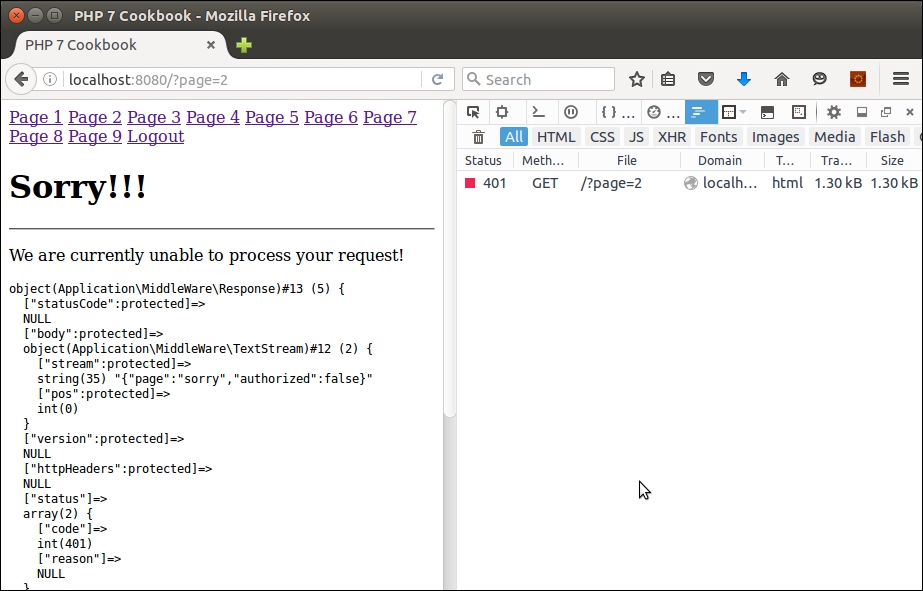
If you try to access any page, you will simply be redirected back to the login page. As per the configuration, a user with status = 1, and level = BEG can only access page 1 and log out. If, when logged in as this user, you try to access page 2, here is the output:
This example relies on $_SESSION as the sole means of user authentication once they have logged in. For good examples of how you can protect PHP sessions, please see Chapter 12, Improving Web Security, specifically the recipe entitled Safeguarding the PHP session.