Table of Contents for
Linux Shell Scripting Bootcamp
 Linux Shell Scripting Bootcamp
Published by
Packt Publishing, 2017
Linux Shell Scripting Bootcamp
Published by
Packt Publishing, 2017
- Cover
- Table of Contents
- Linux Shell Scripting Bootcamp
- Linux Shell Scripting Bootcamp
- Credits
- About the Author
- Acknowledgement
- About the Reviewer
- www.PacktPub.com
- Customer Feedback
- Preface
- What you need for this book
- Who this book is for
- Conventions
- Reader feedback
- Customer support
- 1. Getting Started with Shell Scripting
- Demonstrating the use of scripts
- Summary
- 2. Working with Variables
- Validating parameters using conditional statements
- Comparison operators for strings
- Environment variables
- Summary
- 3. Using Loops and the sleep Command
- Screen manipulation
- Indenting your code
- Using the for statement
- Leaving a loop early
- The sleep command
- Watching a process
- Creating numbered backup files
- Summary
- 4. Creating and Calling Subroutines
- File redirection
- Command piping
- Subroutines
- Using parameters
- Making a current backup of your work
- Summary
- 5. Creating Interactive Scripts
- Summary
- 6. Automating Tasks with Scripts
- Summary
- 7. Working with Files
- Reading files
- Reading and writing files
- Reading and writing files interactively
- File checksums
- File encryption
- Summary
- 8. Working with wget and curl
- wget and recursion
- wget options
- curl
- Summary
- 9. Debugging Scripts
- Automatic backups
- More syntax errors
- Logic errors
- Using set to debug scripts
- Summary
- 10. Scripting Best Practices
- ssh and scp
- Find and use a good text editor
- Environment variables and aliases
- ssh prompt
- Testing an archive
- Progress indicator
- Creating new commands from a template
- Alerting the user
- Summary
- Index
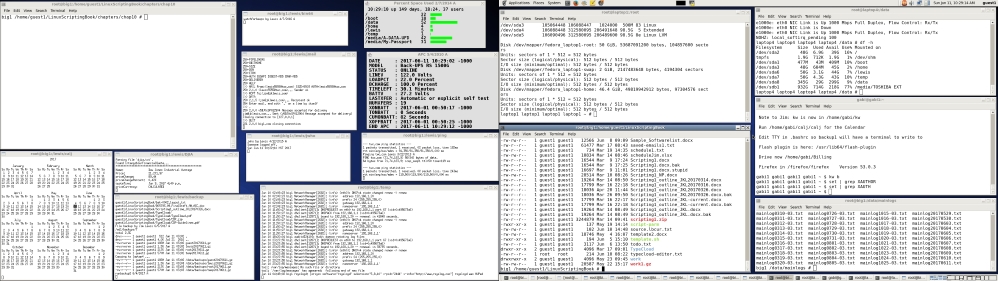
When I run a Linux system I tend to have at least 30 terminal windows open. Some of these are logged into the other machines in my house. As of this writing I am logged into laptop1, laptop4, and gabi1 (my girlfriend's laptop running Fedora 20). I found a while back that if the prompt were different on these terminals it was harder for me to get mixed up and type the right command but on the wrong computer. Needless to say that could be a disaster. For a while I would change the prompt manually but that got old very quickly. One day I found almost by accident a really cool solution to this problem. I have used this technique on Red Hat Enterprise Linux, Fedora, and CentOS and so it should work on your system as well (with maybe a little bit of tweaking).
These lines are in the $HOME/.bashrc file on all my systems:
# Modified 1/17/2014
set | grep XAUTHORITY
rc=$?
if [ $rc -eq 0 ] ; then
 PS1="\h \w # "
else
 PS1="\h \h \h \h \w # "
fi
So what this does is use the set command to grep for the string XAUTHORITY. That string is only in the environment on the local machine. So when you open a terminal locally on big1 it uses the normal prompt. However, if you ssh to another system the string is not there and so it uses the long expanded prompt.
Here is a screenshot of my system showing how this looks: