Table of Contents for
Mastering phpMyAdmin 3.4 for Effective MySQL Management
 Mastering phpMyAdmin 3.4 for Effective MySQL Management
Published by
Packt Publishing, 2012
Mastering phpMyAdmin 3.4 for Effective MySQL Management
Published by
Packt Publishing, 2012
- Cover
- Mastering phpMyAdmin 3.4 for Effective MySQL Management
- Mastering phpMyAdmin 3.4 for Effective MySQL Management
- Credits
- About the Author
- About the Reviewers
- www.PacktPub.com
- Preface
- What you need for this book
- Who this book is for
- Conventions
- Reader feedback
- Customer support
- 1. Getting Started with phpMyAdmin
- What is phpMyAdmin?
- Installing phpMyAdmin
- Configuring phpMyAdmin
- Installing phpMyAdmin configuration storage
- Upgrading phpMyAdmin
- Summary
- 2. Configuring Authentication and Security
- Securing phpMyAdmin
- Summary
- 3. Over Viewing the Interface
- Customizing general settings
- Character sets and collations
- Navigation panel
- Main panel
- User preferences
- Query window
- Summary
- 4. Creating and Browsing Tables
- Creating our first table
- Inserting data manually
- Browse mode
- Profiling queries
- Creating an additional table
- Summary
- 5. Changing Data and Structure
- Changing table structure
- Summary
- 6. Exporting Structure and Data (Backup)
- Exporting a database
- Exporting a table
- Exporting selectively
- Exporting multiple databases
- Saving the export file on the server
- Memory limits
- Summary
- 7. Importing Structure and Data
- Importing SQL files
- Importing CSV files
- Importing other formats
- Reading files from a web server upload directory
- Displaying an upload progress bar
- Summary
- 8. Searching Data
- Performing a complete database search
- Stopping an errant query
- Summary
- 9. Performing Table and Database Operations
- Changing table attributes
- Emptying or deleting a table
- Renaming, moving, and copying tables
- Performing other table operations
- Multi-table operations
- Database operations
- Summary
- 10. Benefiting from the Relational System
- Defining relations with the relation view
- Defining relations with the Designer
- Benefiting from the defined relations
- Column commenting
- Summary
- 11. Entering SQL Statements
- The Query window
- Multi-statement queries
- Pretty printing (syntax highlighting)
- The SQL Validator
- Summary
- 12. Generating Multi-table Queries
- Exploring column criteria
- Generating automatic joins (internal relations)
- Executing the query
- The visual builder
- Summary
- 13. Synchronizing Data and Supporting Replication
- Supporting MySQL replication
- Summary
- 14. Using Query Bookmarks
- Creating bookmarks
- Recalling bookmarks from the bookmarks list
- Passing a parameter to a bookmark
- Summary
- 15. Documenting the System
- Generating relational schemas
- Summary
- 16. Transforming Data using MIME
- Enabling transformations
- Examples of transformations
- Summary
- 17. Supporting Features Added in MySQL 5
- Supporting routines—stored procedures and functions
- Executing code with triggers
- Using information_schema
- Partitioning
- Exploring the event scheduler
- Summary
- 18. Tracking Changes
- Prerequisites
- Principles
- Initiating tracking for one table
- Testing the tracking mechanism
- Determining tracking status
- Structure snapshot
- Exporting a version
- Creating a new version
- Deleting tracking information
- Summary
- 19. Administrating the MySQL Server
- Database information
- Server information
- Summary
- A. Troubleshooting and Support
- Seeking support
- Contributing to the project
Both administrators and ordinary users can benefit from monitoring the server and obtaining information about its general configuration and behavior. The Status, Variables, and Processes menu tabs can be used to get information about the MySQL server, or to act upon specific processes.
The server status statistics reflect the MySQL server's total activity, including (but not limited to) the activity generated by queries sent from phpMyAdmin.
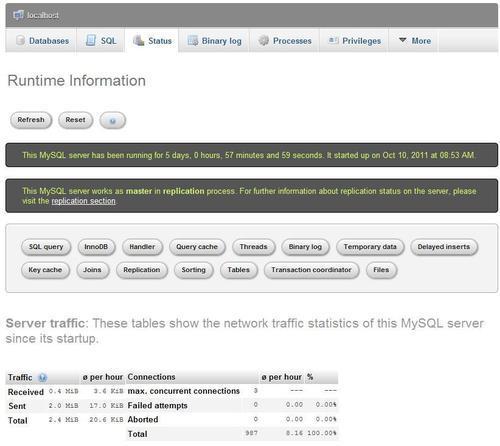
Clicking on the Status menu tab produces runtime information about the server. The page has several sections. First, we get information about the elapsed running time and the startup time. Then we get the total and average values, for traffic and connections (where the ø indicates average), as shown in the following screenshot:
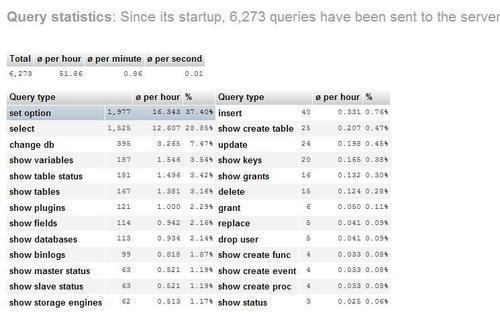
Next, the statistics about the queries are displayed (shown in part in the screenshot). The average number of queries per hour, minute, and second give a good indication of the server load.
The query statistics are followed by statistics about each MySQL statement executed, including:
- The absolute number of times each statement has been executed
- The hourly average of execution
- The percentage of execution for this statement compared to all statements
The presentation order is by descending percentage of utilization; in the following screenshot, we see that the set option statement is the one which is most received by this server with 37.40%:
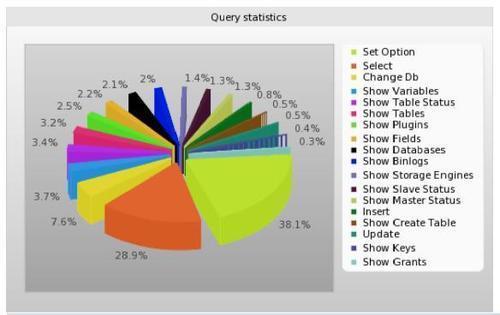
After Query statistics, a Show query chart link, when clicked, produces a chart displaying the popular query types on this server, as shown in the following screenshot:
Depending on the MySQL version, many other sections containing server information are also displayed.
The Variables page displays various settings for the MySQL server, which can be defined in, say, the my.cnf MySQL configuration file. These values can't be changed from within phpMyAdmin.
The Processes page is available to both superusers and normal users. A normal user would see only the processes belonging to him or her, whereas a superuser sees all of the processes.
This page lists all active processes on the server. There is a Kill link that allows us to terminate a specific process, as shown in the following screenshot:
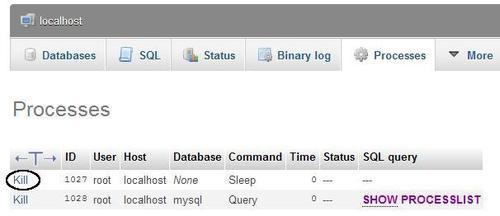
This example has only two running processes, including the one created by the SHOW PROCESSLIST command itself. This process is not killable because it's no longer running when we get to see the page. On a busy server, we would see more processes running.
Information about the various storage engines is available in a two-level format. First, the Engines tab displays an overview of the possible engines for the current MySQL version. The names of the engines that are enabled on this server are clickable.
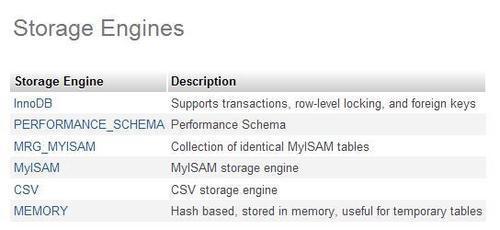
Secondly, a click on one engine name brings up a detailed panel about its settings. Hovering the mouse over the numbers in superscript reveals even more information about a particular setting.
The Charsets menu tab on the home page opens the Server view for the Charsets page, which lists the character sets and collations supported by the MySQL server. The default collation for each character set is shown with a different background color (using the row-marking color defined in $cfg['BrowseMarkerColor']).
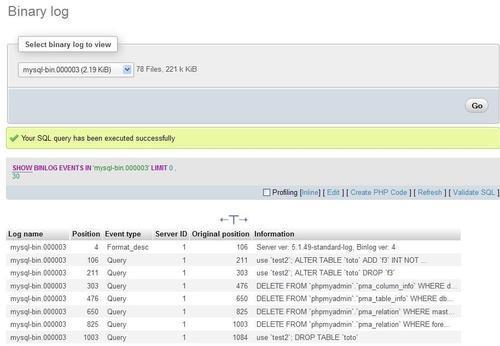
If MySQL's binary logging is active on our server, the menu in the Server view changes so that a Binary log tab appears. This tab gives access to an interface, through the SHOW BINLOG EVENTS command. This command produces the list of SQL statements that have updated data on our servers. This list could be huge, and currently phpMyAdmin does not limit its display with a pagination technique. Hence, we could hit the browser's memory limit, which depends on the particular browser we are using.
In the following screenshot, we choose the binary log that we want to examine (unless the server has only one binary log), and the statements are then displayed: