Table of Contents for
Mastering phpMyAdmin 3.4 for Effective MySQL Management
 Mastering phpMyAdmin 3.4 for Effective MySQL Management
Published by
Packt Publishing, 2012
Mastering phpMyAdmin 3.4 for Effective MySQL Management
Published by
Packt Publishing, 2012
- Cover
- Mastering phpMyAdmin 3.4 for Effective MySQL Management
- Mastering phpMyAdmin 3.4 for Effective MySQL Management
- Credits
- About the Author
- About the Reviewers
- www.PacktPub.com
- Preface
- What you need for this book
- Who this book is for
- Conventions
- Reader feedback
- Customer support
- 1. Getting Started with phpMyAdmin
- What is phpMyAdmin?
- Installing phpMyAdmin
- Configuring phpMyAdmin
- Installing phpMyAdmin configuration storage
- Upgrading phpMyAdmin
- Summary
- 2. Configuring Authentication and Security
- Securing phpMyAdmin
- Summary
- 3. Over Viewing the Interface
- Customizing general settings
- Character sets and collations
- Navigation panel
- Main panel
- User preferences
- Query window
- Summary
- 4. Creating and Browsing Tables
- Creating our first table
- Inserting data manually
- Browse mode
- Profiling queries
- Creating an additional table
- Summary
- 5. Changing Data and Structure
- Changing table structure
- Summary
- 6. Exporting Structure and Data (Backup)
- Exporting a database
- Exporting a table
- Exporting selectively
- Exporting multiple databases
- Saving the export file on the server
- Memory limits
- Summary
- 7. Importing Structure and Data
- Importing SQL files
- Importing CSV files
- Importing other formats
- Reading files from a web server upload directory
- Displaying an upload progress bar
- Summary
- 8. Searching Data
- Performing a complete database search
- Stopping an errant query
- Summary
- 9. Performing Table and Database Operations
- Changing table attributes
- Emptying or deleting a table
- Renaming, moving, and copying tables
- Performing other table operations
- Multi-table operations
- Database operations
- Summary
- 10. Benefiting from the Relational System
- Defining relations with the relation view
- Defining relations with the Designer
- Benefiting from the defined relations
- Column commenting
- Summary
- 11. Entering SQL Statements
- The Query window
- Multi-statement queries
- Pretty printing (syntax highlighting)
- The SQL Validator
- Summary
- 12. Generating Multi-table Queries
- Exploring column criteria
- Generating automatic joins (internal relations)
- Executing the query
- The visual builder
- Summary
- 13. Synchronizing Data and Supporting Replication
- Supporting MySQL replication
- Summary
- 14. Using Query Bookmarks
- Creating bookmarks
- Recalling bookmarks from the bookmarks list
- Passing a parameter to a bookmark
- Summary
- 15. Documenting the System
- Generating relational schemas
- Summary
- 16. Transforming Data using MIME
- Enabling transformations
- Examples of transformations
- Summary
- 17. Supporting Features Added in MySQL 5
- Supporting routines—stored procedures and functions
- Executing code with triggers
- Using information_schema
- Partitioning
- Exploring the event scheduler
- Summary
- 18. Tracking Changes
- Prerequisites
- Principles
- Initiating tracking for one table
- Testing the tracking mechanism
- Determining tracking status
- Structure snapshot
- Exporting a version
- Creating a new version
- Deleting tracking information
- Summary
- 19. Administrating the MySQL Server
- Database information
- Server information
- Summary
- A. Troubleshooting and Support
- Seeking support
- Contributing to the project
The Event Scheduler (http://dev.mysql.com/doc/refman/5.1/en/events.html), another new feature of MySQL 5.1, permits the creation of tasks that will run automatically according to a schedule. The schedule is quite flexible and permits, for example, a statement to be run every ten seconds, starting from midnight of May 18, 2011. These can be one-time events or recurring ones.
We should first verify whether the scheduler is active on our server. If not, we need to activate it. Otherwise, nothing will happen! We will start by entering the following statement in the query box:
SHOW VARIABLES LIKE 'event%';
Next, we look in the results for a variable named event_scheduler. If this variable is set to OFF, we need to ask the system administrator (or someone with the SUPER privilege) to execute the following statement:
SET GLOBAL event_scheduler = ON;
Every user who wants to create or drop an event needs the EVENT privilege, either globally or on the database on which he or she plans to add the event. Please refer to Chapter 19 for details about granting such privileges.
The current phpMyAdmin version does not have an interface on which we could choose the various parts of the CREATE EVENT statement. Therefore, the only method left is to use the SQL query box to enter the statement and to understand its syntax! Here, we will use a totally fictitious example:
CREATE EVENT add_page_count
ON SCHEDULE
EVERY 1 MINUTE
DO
UPDATE author set total_page_count = total_page_count + 1
WHERE id = 1;
You can now get some amusement by browsing the author table once in a while, and see the counter incrementing for author 1.
Events are related to a single database, which is why you see an Events slider on the Structure page for the marc_book database. Activating it reveals the following panel:
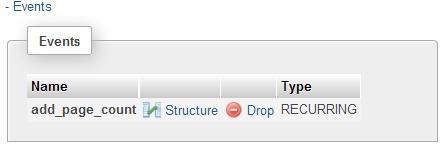
Indeed, this is a recurring event. We can use the first icon to edit the event (which will have the effect of deleting and recreating the event), and the second icon to remove it.
It's possible to generate event-related statements at the end of an SQL database export file by selecting the Add CREATE PROCEDURE / FUNCTION / EVENT option. Please remember that some events may have an expiration time. Hence, they may have vanished between the time you create them and the time you attempt to export them, unless the ON COMPLETION PRESERVE clause was used when creating the event.