
Table of Contents for
Seven NoSQL Databases in a Week

Version ebook / Retour

Cover image for bash Cookbook, 2nd Edition Seven NoSQL Databases in a Week by Xun Wu Published by Packt Publishing, 2018
  1. Seven NoSQL Databases in a Week
  2. Title Page
  3. Copyright and Credits
  4. Seven NoSQL Databases in a Week
  5. Dedication
  6. Packt Upsell
  7. Why subscribe?
  8. PacktPub.com
  9. Contributors
  10. About the authors
  11. Packt is searching for authors like you
  12. Table of Contents
  13. Preface
  14. Who this book is for
  15. What this book covers
  16. To get the most out of this book
  17. Download the example code files
  18. Download the color images
  19. Conventions used
  20. Get in touch
  21. Reviews
  22. Introduction to NoSQL Databases
  23. Consistency versus availability
  24. ACID guarantees
  25. Hash versus range partition
  26. In-place updates versus appends
  27. Row versus column versus column-family storage models
  28. Strongly versus loosely enforced schemas
  29. Summary
  30. MongoDB
  31. Installing of MongoDB
  32. MongoDB data types
  33. The MongoDB database
  34. MongoDB collections
  35. MongoDB documents
  36. The create operation
  37. The read operation
  38. Applying filters on fields
  39. Applying conditional and logical operators on the filter parameter
  40. The update operation
  41. The delete operation
  42. Data models in MongoDB
  43. The references document data model
  44. The embedded data model
  45. Introduction to MongoDB indexing
  46. The default _id index
  47. Replication
  48. Replication in MongoDB
  49. Automatic failover in replication
  50. Read operations
  51. Sharding
  52. Sharded clusters
  53. Advantages of sharding
  54. Storing large data in MongoDB
  55. Summary
  56. Neo4j
  57. What is Neo4j?
  58. How does Neo4j work?
  59. Features of Neo4j
  60. Clustering
  61. Neo4j Browser
  62. Cache sharding
  63. Help for beginners
  64. Evaluating your use case
  65. Social networks
  66. Matchmaking
  67. Network management
  68. Analytics
  69. Recommendation engines
  70. Neo4j anti-patterns
  71. Applying relational modeling techniques in Neo4j
  72. Using Neo4j for the first time on something mission-critical
  73. Storing entities and relationships within entities
  74. Improper use of relationship types
  75. Storing binary large object data
  76. Indexing everything
  77. Neo4j hardware selection, installation, and configuration
  78. Random access memory
  79. CPU
  80. Disk
  81. Operating system
  82. Network/firewall
  83. Installation
  84. Installing JVM
  85. Configuration
  86. High-availability clustering
  87. Causal clustering
  88. Using Neo4j
  89. Neo4j Browser
  90. Cypher
  91. Python
  92. Java
  93. Taking a backup with Neo4j
  94. Backup/restore with Neo4j Enterprise
  95. Backup/restore with Neo4j Community
  96. Differences between the Neo4j Community and Enterprise Editions
  97. Tips for success
  98. Summary
  99. References 
  100. Redis
  101. Introduction to Redis
  102. What are the key features of Redis?
  103. Performance
  104. Tunable data durability
  105. Publish/Subscribe
  106. Useful data types
  107. Expiring data over time
  108. Counters
  109. Server-side Lua scripting
  110. Appropriate use cases for Redis
  111. Data fits into RAM
  112. Data durability is not a concern
  113. Data at scale
  114. Simple data model
  115. Features of Redis matching part of your use case
  116. Data modeling and application design with Redis
  117. Taking advantage of Redis' data structures
  118. Queues
  119. Sets
  120. Notifications
  121. Counters
  122. Caching
  123. Redis anti-patterns
  124. Dataset cannot fit into RAM
  125. Modeling relational data
  126. Improper connection management
  127. Security
  128. Using the KEYS command
  129. Unnecessary trips over the network
  130. Not disabling THP
  131. Redis setup, installation, and configuration
  132. Virtualization versus on-the-metal
  133. RAM
  134. CPU
  135. Disk
  136. Operating system
  137. Network/firewall
  138. Installation
  139. Configuration files
  140. Using Redis
  141. redis-cli
  142. Lua
  143. Python
  144. Java
  145. Taking a backup with Redis
  146. Restoring from a backup
  147. Tips for success
  148. Summary
  149. References
  150. Cassandra
  151. Introduction to Cassandra
  152. What problems does Cassandra solve?
  153. What are the key features of Cassandra?
  154. No single point of failure
  155. Tunable consistency
  156. Data center awareness
  157. Linear scalability
  158. Built on the JVM
  159. Appropriate use cases for Cassandra
  160. Overview of the internals
  161. Data modeling in Cassandra
  162. Partition keys
  163. Clustering keys
  164. Putting it all together
  165. Optimal use cases
  166. Cassandra anti-patterns
  167. Frequently updated data
  168. Frequently deleted data
  169. Queues or queue-like data
  170. Solutions requiring query flexibility
  171. Solutions requiring full table scans
  172. Incorrect use of BATCH statements
  173. Using Byte Ordered Partitioner
  174. Using a load balancer in front of Cassandra nodes
  175. Using a framework driver
  176. Cassandra hardware selection, installation, and configuration
  177. RAM
  178. CPU
  179. Disk
  180. Operating system
  181. Network/firewall
  182. Installation using apt-get
  183. Tarball installation
  184. JVM installation
  185. Node configuration
  186. Running Cassandra
  187. Adding a new node to the cluster
  188. Using Cassandra
  189. Nodetool
  190. CQLSH
  191. Python
  192. Java
  193. Taking a backup with Cassandra
  194. Restoring from a snapshot
  195. Tips for success
  196. Run Cassandra on Linux
  197. Open ports 7199, 7000, 7001, and 9042
  198. Enable security
  199. Use solid state drives (SSDs) if possible
  200. Configure only one or two seed nodes per data center
  201. Schedule weekly repairs
  202. Do not force a major compaction
  203. Remember that every mutation is a write
  204. The data model is key
  205. Consider a support contract
  206. Cassandra is not a general purpose database
  207. Summary
  208. References
  209. HBase
  210. Architecture
  211. Components in the HBase stack
  212. Zookeeper
  213. HDFS
  214. HBase master
  215. HBase RegionServers
  216. Reads and writes
  217. The HBase write path
  218. HBase writes – design motivation
  219. The HBase read path
  220. HBase compactions
  221. System trade-offs
  222. Logical and physical data models
  223. Interacting with HBase – the HBase shell
  224. Interacting with HBase – the HBase Client API
  225. Interacting with secure HBase clusters
  226. Advanced topics
  227. HBase high availability
  228. Replicated reads
  229. HBase in multiple regions
  230. HBase coprocessors
  231. SQL over HBase
  232. Summary
  233. DynamoDB
  234. The difference between SQL and DynamoDB
  235. Setting up DynamoDB
  236. Setting up locally
  237. Setting up using AWS
  238. The difference between downloadable DynamoDB and DynamoDB web services
  239. DynamoDB data types and terminology
  240. Tables, items, and attributes
  241. Primary key
  242. Secondary indexes
  243. Streams
  244. Queries
  245. Scan
  246. Data types
  247. Data models and CRUD operations in DynamoDB
  248. Limitations of DynamoDB
  249. Best practices
  250. Summary
  251. InfluxDB
  252. Introduction to InfluxDB
  253. Key concepts and terms of InfluxDB
  254. Data model and storage engine
  255. Storage engine
  256. Installation and configuration
  257. Installing InfluxDB
  258. Configuring InfluxDB
  259. Production deployment considerations
  260. Query language and API
  261. Query language
  262. Query pagination
  263. Query performance optimizations
  264. Interaction via Rest API
  265. InfluxDB API client
  266. InfluxDB with Java client
  267. InfluxDB with a Python client
  268. InfluxDB with Go client
  269. InfluxDB ecosystem
  270. Telegraf
  271. Telegraf data management
  272. Kapacitor
  273. InfluxDB operations
  274. Backup and restore
  275. Backups
  276. Restore
  277. Clustering and HA
  278. Retention policy
  279. Monitoring
  280. Summary
  281. Other Books You May Enjoy
  282. Leave a review - let other readers know what you think

The default _id index

MongoDB creates the default _id index when creating a document. The _id index prevents users from inserting two documents with the same _id value. You cannot drop an index on an _id field.

The following syntax is used to create an index in MongoDB:

>db.collection.createIndex(<key and index type specification>, <options>);

The preceding method creates an index only if an index with the same specification does not exist. MongoDB indexes use the B-tree data structure.

The following are the different types of indexes:

  • Single field: In addition to the _id field index, MongoDB allows the creation of an index on any single field in ascending or descending order. For a single field index, the order of the index does not matter as MongoDB can traverse indexes in any order. The following is an example of creating an index on the single field where we are creating an index on the firstName field of the user_profiles collection:

The query gives acknowledgment after creating the index:
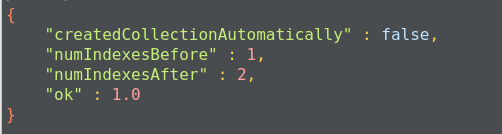
This will create an ascending index on the firstName field. To create a descending index, we have to provide -1 instead of 1.

  • Compound index: MongoDB also supports user-defined indexes on multiple fields. The order of fields defined while creating an index has a significant effect. For example, a compound index defined as {firstName:1, age:-1} will sort data by firstName first and then each firstName with age.
  • Multikey index: MongoDB uses multi-key indexes to index the content in the array. If you index the field that contains the array values, MongoDB creates an index for each field in the object of an array. These indexes allow queries to select the document by matching the element or set of elements of the array. MongoDB automatically decides whether to create multi-key indexes or not.
  • Text indexes: MongoDB provides text indexes that support the searching of string contents in the MongoDB collection. To create text indexes, we have to use the db.collection.createIndex() method, but we need to pass a text string literal in the query:

You can also create text indexes on multiple fields, for example:

Once the index is created, we get an acknowledgment:
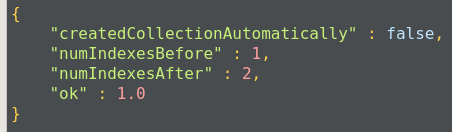
Compound indexes can be used with text indexes to define an ascending or descending order of the index.

  • Hashed index: To support hash-based sharding, MongoDB supports hashed indexes. In this approach, indexes store the hash value and query, and the select operation checks the hashed indexes. Hashed indexes can support only equality-based operations. They are limited in their performance of range-based operations.

Indexes have the following properties:

  • Unique indexes: Indexes should maintain uniqueness. This makes MongoDB drop the duplicate value from indexes.
  • Partial Indexes: Partial indexes apply the index on documents of a collection that match a specified condition. By applying an index on the subset of documents in the collection, partial indexes have a lower storage requirement as well as a reduced performance cost.
  • Sparse index: In the sparse index, MongoDB includes only those documents in the index in which the index field is present, other documents are discarded. We can combine unique indexes with a sparse index to reject documents that have duplicate values but ignore documents that have an indexed key.
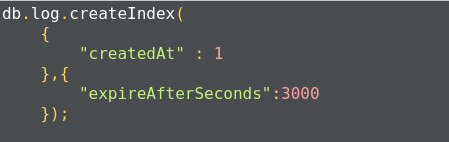
  • TTL index: TTL indexes are a special type of indexes where MongoDB will automatically remove the document from the collection after a certain amount of time. Such indexes are ideal to remove machine-generated data, logs, and session information that we need for a finite duration. The following TTL index will automatically delete data from the log table after 3000 seconds:
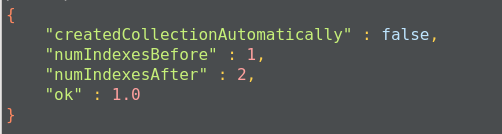
Once the index is created, we get an acknowledgment message:
The limitations of indexes:

  • A single collection can have up to 64 indexes only.
  • The qualified index name is <database-name>.<collection-name>.$<index-name> and cannot have more than 128 characters. By default, the index name is a combination of index type and field name. You can specify an index name while using the createIndex() method to ensure that the fully-qualified name does not exceed the limit.
  • There can be no more than 31 fields in the compound index.
  • The query cannot use both text and geospatial indexes. You cannot combine the $text operator, which requires text indexes, with some other query operator required for special indexes. For example, you cannot combine the $text operator with the $near operator.
  • Fields with 2d sphere indexes can only hold geometry data. 2d sphere indexes are specially provided for geometric data operations. For example, to perform operations on co-ordinate, we have to provide data as points on a planer co-ordinate system, [x, y]. For non-geometries, the data query operation will fail.

The limitation on data:

  • The maximum number of documents in a capped collection must be less than 2^32. We should define it by the max parameter while creating it. If you do not specify, the capped collection can have any number of documents, which will slow down the queries.
  • The MMAPv1 storage engine will allow 16,000 data files per database, which means it provides the maximum size of 32 TB.
    We can set the storage.mmapv1.smallfile parameter to reduce the size of the database to 8 TB only.
  • Replica sets can have up to 50 members.
  • Shard keys cannot exceed 512 bytes.