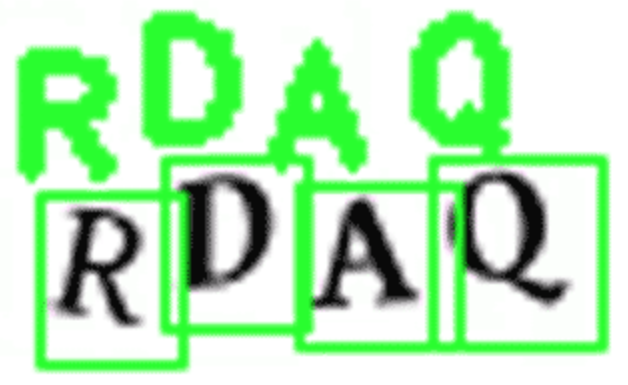
Finally, we test the model such that we have built a machine learning solution that is able to crack the CAPTCHA:
from keras.models import load_model
from helpers import resize_to_fit
from imutils import paths
import numpy as np
import imutils
import cv2
import pickle
We load up the model labels and the neural network to test whether the model is able to read from the test set:
MODEL = "captcha.hdf5"
MODEL_LABELS = "labels.dat"
CAPTCHA_IMAGE = "generated_captcha_images"

with open(MODEL_LABELS, "rb") as f:
 labb = pickle.load(f)

model = load_model(MODEL)
We get some CAPTCHA images from different authentication sites to see whether the model is working:
captcha_image_files = list(paths.list_images(CAPTCHA_IMAGE))
captcha_image_files = np.random.choice(captcha_image_files, size=(10,), replace=False)

for image_file in captcha_image_files:
 # grayscale
 image = cv2.imread(image_file)
 image = cv2.cvtColor(image, cv2.COLOR_BGR2GRAY)

#extra padding
 image = cv2.copyMakeBorder(image, 20, 20, 20, 20, cv2.BORDER_REPLICATE)

# threshold
 thresh = cv2.threshold(image, 0, 255, cv2.THRESH_BINARY_INV | cv2.THRESH_OTSU)[1]

#contours
 contours = cv2.findContours(thresh.copy(), cv2.RETR_EXTERNAL, cv2.CHAIN_APPROX_SIMPLE)

#different OpenCV versions
 contours = contours[0] if imutils.is_cv2() else contours[1]

letter_image_regions = []
We loop through each of the four contours and extract the letter:
for contour in contours:
 (x, y, w, h) = cv2.boundingRect(contour)

if w / h > 1.25:

half_width = int(w / 2)
 letter_image_regions.append((x, y, half_width, h))
 letter_image_regions.append((x + half_width, y, half_width, h))
 else:

letter_image_regions.append((x, y, w, h))
We sort the detected letter images from left to right. We make a list of predicted letters:
letter_image_regions = sorted(letter_image_regions, key=lambda x: x[0])

output = cv2.merge([image] * 3)
 predictions = []

for letter_bounding_box in letter_image_regions:

 x, y, w, h = letter_bounding_box

letter_image = image[y - 2:y + h + 2, x - 2:x + w + 2]

letter_image = resize_to_fit(letter_image, 20, 20)

letter_image = np.expand_dims(letter_image, axis=2)
 letter_image = np.expand_dims(letter_image, axis=0)

prediction = model.predict(letter_image)

letter = labb.inverse_transform(prediction)[0]
 predictions.append(letter)
We finally match the images that we predicted with the actual letters in the image with the list created from the predicted images:
cv2.rectangle(output, (x - 2, y - 2), (x + w + 4, y + h + 4), (0, 255, 0), 1)
 cv2.putText(output, letter, (x - 5, y - 5), cv2.FONT_HERSHEY_SIMPLEX, 0.55, (0, 255, 0), 2)

captcha_text = "".join(predictions)
 print("CAPTCHA text is: {}".format(captcha_text))

cv2.imshow("Output", output)
 cv2.waitKey()
This is the output: