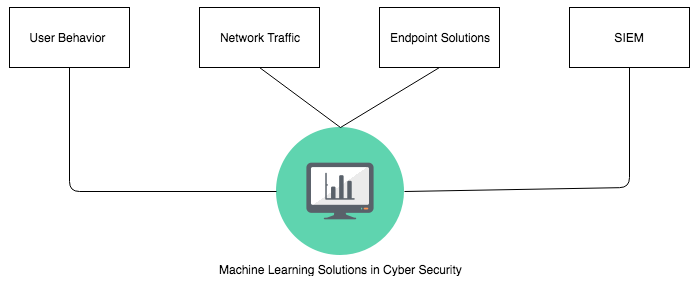
Today signature-based systems are being gradually replaced by intelligent cybersecurity agents. Machine learning products are aggressive in identifying new malware, zero day attacks, and advanced persistent threats. Insight from the immense amount of log data is being aggregated by log correlation methods. Endpoint solutions have been super active in identifying peripheral attacks. New machine learning driven cybersecurity products have been proactive in strengthening container systems like virtual machines. The following diagram gives a brief overview of some machine learning solutions in cybersecurity:
In general, machine learning products are created to predict attacks before they occur, but given the sophisticated nature of these attacks, preventive measures often fail. In such cases, machine learning often helps to remediate in other ways, like recognizing the attack at its initial stages and preventing it from spreading across the entire organization.
Many cybersecurity companies are relying on advanced analytics, such as user behavior analytics and predictive analytics, to identify advanced persistent threats early on in the threat life cycle. These methods have been successful in preventing data leakage of personally identifiable information (PII) and insider threats. But prescriptive analytics is another advanced machine learning solution worth mentioning in the cybersecurity perspective. Unlike predictive analytics, which predicts threat by comparing current threat logs with historic threat logs, prescriptive analytics is a more reactive process. Prescriptive analytics deals with situations where a cyber attack is already in play. It analyzes data at this stage to suggest what reactive measure could best fit the situation to keep the loss of information to a minimum.
Machine learning, however, has a down side in cybersecurity. Since alerts generated need to be tested by human SOC analysts, generating too many false alerts could cause alert fatigue. To prevent this issue of false positives, cybersecurity solutions also get insights from SIEM signals. The signals from SIEM systems are compared with the advanced analytics signals so that the system does not produce duplicate signals. Thus machine learning solutions in the field of cybersecurity products learn from the environment to keep false signals to a minimum.