
TensorFlow is written in C++ and comprises two languages in the frontend. They are C++ and Python. Since most developers code in Python, the Python frontend is more developed than the C++ one. However, the C++ frontend's low-level API is good for running embedded systems.
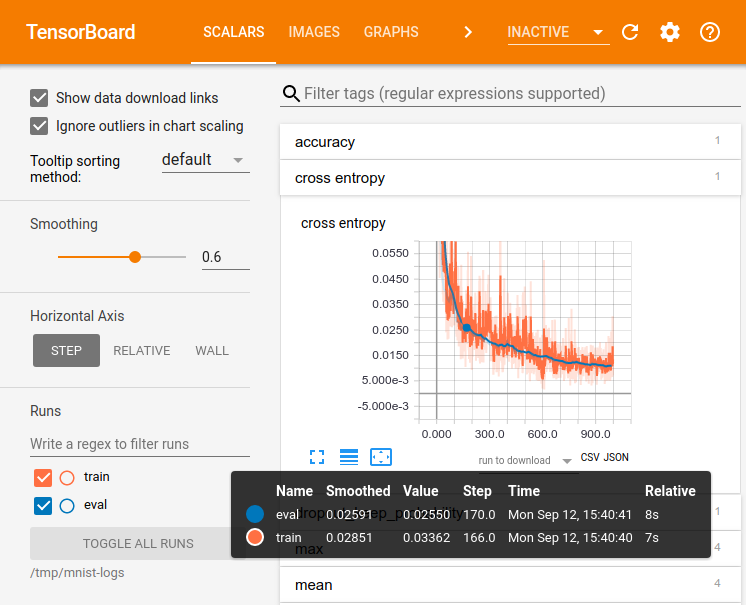
TensorFlow was designed for probabilistic systems and gives flexibility to users to run models with ease, and across a variety of platforms. With TensorFlow, it is extremely easy to optimize various machine learning algorithms without having to set gradients at the beginning of the code, which is quite difficult. TensorFlow comes packed with TensorBoard, which helps visualize the flow with graphs and loss functions. The following screenshot shows the TensorFlow website:
TensorFlow, with all these capabilities, makes it super easy to deploy and build for industry use cases that solve real-life artificial intelligence problems. Since it allows distributed computing, it is usually used to handle massive amounts of data. Unlike other packages, TensorFlow allows us to port the same code for both distributed and localized use, without compromising scalability. Deployment to Google Cloud Platform or Amazon Web Services is achieved with ease.
TensorFlow is packed with primitives that define functions on tensors and implicitly compute derivatives. Tensors here are multilinear maps that connect vector spaces to real numbers. Thus, we can call them multidimensional arrays of numbers, making scalars, vectors, and matrices all tensors. TensorFlow is therefore in many ways similar to NumPy packages providing N-d Libraries. They are dissimilar, however, because NumPy does not have tensors and does not provide GPU capabilities.
There are several other lesser-known packages that perform almost the same in terms to capabilities as TensorFlow. They are as follows:
- Torch
- Caffe
- Theano (Keras and Lasagne)
- CuDNN
- Mxnet