
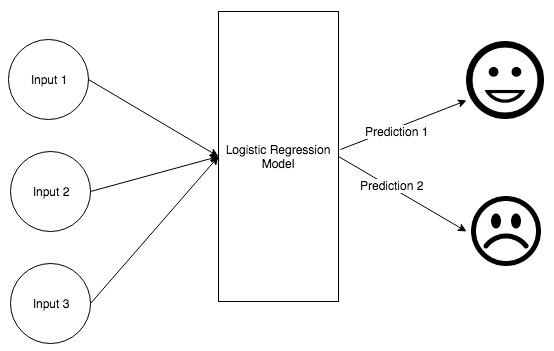
The logistic regression model is a regression model that can be used to categorize data using a logistic function. These mostly consist of a dependent binary variable that is used to estimate the outcome of the logistic model, as shown in the following diagram:
To start with our use case, we first import the respective packages using the following code:
import pandas as pd
import numpy as np
import random
import pickle

from sklearn.model_selection import train_test_split
from sklearn.feature_extraction.text import TfidfVectorizer
from sklearn.linear_model import LogisticRegression
The URL needs to undergo a degree of cleansing before we use it. We tokenize it by removing the slashes, dots, and coms, as shown in the following code. We do this because the input data needs to be converted to the binary format for logistic regression:
def url_cleanse(web_url):
 web_url = web_url.lower()

 urltoken = []
 dot_slash = []
 slash = str(web_url).split('/')
 for i in slash:
 r1 = str(i).split('-')

 token_slash = []
 for j in range(0,len(r1)):
 r2 = str(r1[j]).split('.')

 token_slash = token_slash + r2
 dot_slash = dot_slash + r1 + token_slash

 urltoken = list(set(dot_slash))
 if 'com' in urltoken:
 urltoken.remove('com')

 return urltoken
We then ingest the data and convert it to the relevant dataframes using the following code:
input_url = '~/data.csv'
data_csv = pd.read_csv(input_url,',',error_bad_lines=False)
data_df = pd.DataFrame(data_csv)
url_df = np.array(data_df)
random.shuffle(data_df)
y = [d[1] for d in data_df]
inputurls = [d[0] for d in data_df]
We now need to generate the term frequency–inverse document frequency (TF-IDF) from the URLs.