Table of Contents for
Node.js 8 the Right Way
 Node.js 8 the Right Way
Published by
Pragmatic Bookshelf, 2018
Node.js 8 the Right Way
Published by
Pragmatic Bookshelf, 2018
- Title Page
- Node.js 8 the Right Way
- Node.js 8 the Right Way
- Node.js 8 the Right Way
- Node.js 8 the Right Way
- Acknowledgments
- Preface
- Why Node.js the Right Way?
- What’s in This Book
- What This Book Is Not
- Code Examples and Conventions
- Online Resources
- Part I. Getting Up to Speed on Node.js 8
- 1. Getting Started
- Thinking Beyond the web
- Node.js’s Niche
- How Node.js Applications Work
- Aspects of Node.js Development
- Installing Node.js
- 2. Wrangling the File System
- Programming for the Node.js Event Loop
- Spawning a Child Process
- Capturing Data from an EventEmitter
- Reading and Writing Files Asynchronously
- The Two Phases of a Node.js Program
- Wrapping Up
- 3. Networking with Sockets
- Listening for Socket Connections
- Implementing a Messaging Protocol
- Creating Socket Client Connections
- Testing Network Application Functionality
- Extending Core Classes in Custom Modules
- Developing Unit Tests with Mocha
- Wrapping Up
- 4. Connecting Robust Microservices
- Installing ØMQ
- Publishing and Subscribing to Messages
- Responding to Requests
- Routing and Dealing Messages
- Clustering Node.js Processes
- Pushing and Pulling Messages
- Wrapping Up
- Node.js 8 the Right Way
- Part II. Working with Data
- 5. Transforming Data and Testing Continuously
- Procuring External Data
- Behavior-Driven Development with Mocha and Chai
- Extracting Data from XML with Cheerio
- Processing Data Files Sequentially
- Debugging Tests with Chrome DevTools
- Wrapping Up
- 6. Commanding Databases
- Introducing Elasticsearch
- Creating a Command-Line Program in Node.js with Commander
- Using request to Fetch JSON over HTTP
- Shaping JSON with jq
- Inserting Elasticsearch Documents in Bulk
- Implementing an Elasticsearch Query Command
- Wrapping Up
- Node.js 8 the Right Way
- Part III. Creating an Application from the Ground Up
- 7. Developing RESTful Web Services
- Advantages of Express
- Serving APIs with Express
- Writing Modular Express Services
- Keeping Services Running with nodemon
- Adding Search APIs
- Simplifying Code Flows with Promises
- Manipulating Documents RESTfully
- Emulating Synchronous Style with async and await
- Providing an Async Handler Function to Express
- Wrapping Up
- 8. Creating a Beautiful User Experience
- Getting Started with webpack
- Generating Your First webpack Bundle
- Sprucing Up Your UI with Bootstrap
- Bringing in Bootstrap JavaScript and jQuery
- Transpiling with TypeScript
- Templating HTML with Handlebars
- Implementing hashChange Navigation
- Listing Objects in a View
- Saving Data with a Form
- Wrapping Up
- 9. Fortifying Your Application
- Setting Up the Initial Project
- Managing User Sessions in Express
- Adding Authentication UI Elements
- Setting Up Passport
- Authenticating with Facebook, Twitter, and Google
- Composing an Express Router
- Bringing in the Book Bundle UI
- Serving in Production
- Wrapping Up
- Node.js 8 the Right Way
- 10. BONUS: Developing Flows with Node-RED
- Setting Up Node-RED
- Securing Node-RED
- Developing a Node-RED Flow
- Creating HTTP APIs with Node-RED
- Handling Errors in Node-RED Flows
- Wrapping Up
- A1. Setting Up Angular
- A2. Setting Up React
- Node.js 8 the Right Way
Generating Your First webpack Bundle
At this point, you have the basic outline of a project that will build a front end using webpack, but currently it doesn’t actually build anything. In this section, we’ll get the project to the point where it generates an index.html file and produces a distributable JavaScript bundle to go along with it.
First, to generate the HTML we’ll need the html-webpack-plugin module. Install it with npm.
| | $ npm install --save-dev --save-exact html-webpack-plugin@2.30.1 |
Next, open your webpack.config.js and update it to contain the following content:
| | 'use strict'; |
| | const path = require('path'); |
| | const distDir = path.resolve(__dirname, 'dist'); |
| | |
| | const HtmlWebpackPlugin = require('html-webpack-plugin'); |
| | |
| | module.exports = { |
| | entry: './entry.js', |
| | output: { |
| | filename: 'bundle.js', |
| | path: distDir, |
| | }, |
| | devServer: { |
| | contentBase: distDir, |
| | port: 60800, |
| | }, |
| | plugins: [ |
| | new HtmlWebpackPlugin({ |
| | title: 'Better Book Bundle Builder', |
| | }), |
| | ], |
| | }; |
At the top of the file, we pull in the built-in path module and use it to resolve the path to the dist directory. This is roughly equivalent to __dirname + ’/dist’, but uses the correct path separator for the current operating system and returns a fully resolved absolute path. We pull in the HtmlWebpackPlugin class from the included module, which we’ll use in the plugins portion of the webpack config.
Next, notice that we’ve added an output object to the webpack config. This specifies the target output directory and the filename that the bundled JavaScript output should have. By convention, we call the bundled JavaScript file bundle.js.
Note that webpack-dev-server does not write to this output directory. Instead, it serves content like the bundle.js file directly from memory on request. Running the webpack command directly, rather than webpack-dev-server, would write content to the output directory.
The devServer object contains configuration parameters specific to the webpack-dev-server. Here we use the same dist directory to be the contentBase of the running dev server, and override the default TCP port.
Lastly, we add a plugins object to add webpack plugins to the build. In the array of plugins, we construct a new HtmlWebpackPlugin instance and configure its title. This will show up in the generated HTML file’s <title> tag.
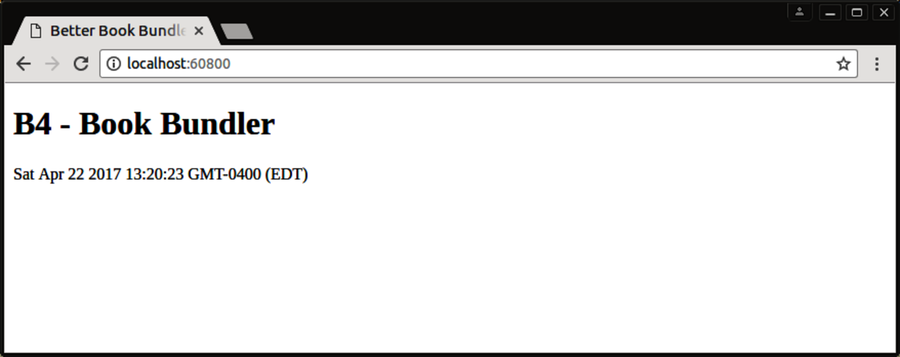
At this point the webpack config is ready, but in order to see anything other than a blank page, we should expand the currently empty entry.js file. Open that file and add the following:
| | 'use strict'; |
| | document.body.innerHTML = ` |
| | <h1>B4 - Book Bundler</h1> |
| | <p>${new Date()}</p> |
| | `; |
All this does is insert a big header and the current date and time into the page, but it’s enough to get going. Once you save the file, head to a terminal and start up the webpack dev server via npm start. If it’s still running from before, use Ctrl-C to kill it first.
With the dev server running, open localhost:60800 in your browser. It should look something like the following.
Great! Everything appears to be going smoothly so far. Next we’ll bring in Bootstrap to make the page more beautiful.