Table of Contents for
Node.js 8 the Right Way
 Node.js 8 the Right Way
Published by
Pragmatic Bookshelf, 2018
Node.js 8 the Right Way
Published by
Pragmatic Bookshelf, 2018
- Title Page
- Node.js 8 the Right Way
- Node.js 8 the Right Way
- Node.js 8 the Right Way
- Node.js 8 the Right Way
- Acknowledgments
- Preface
- Why Node.js the Right Way?
- What’s in This Book
- What This Book Is Not
- Code Examples and Conventions
- Online Resources
- Part I. Getting Up to Speed on Node.js 8
- 1. Getting Started
- Thinking Beyond the web
- Node.js’s Niche
- How Node.js Applications Work
- Aspects of Node.js Development
- Installing Node.js
- 2. Wrangling the File System
- Programming for the Node.js Event Loop
- Spawning a Child Process
- Capturing Data from an EventEmitter
- Reading and Writing Files Asynchronously
- The Two Phases of a Node.js Program
- Wrapping Up
- 3. Networking with Sockets
- Listening for Socket Connections
- Implementing a Messaging Protocol
- Creating Socket Client Connections
- Testing Network Application Functionality
- Extending Core Classes in Custom Modules
- Developing Unit Tests with Mocha
- Wrapping Up
- 4. Connecting Robust Microservices
- Installing ØMQ
- Publishing and Subscribing to Messages
- Responding to Requests
- Routing and Dealing Messages
- Clustering Node.js Processes
- Pushing and Pulling Messages
- Wrapping Up
- Node.js 8 the Right Way
- Part II. Working with Data
- 5. Transforming Data and Testing Continuously
- Procuring External Data
- Behavior-Driven Development with Mocha and Chai
- Extracting Data from XML with Cheerio
- Processing Data Files Sequentially
- Debugging Tests with Chrome DevTools
- Wrapping Up
- 6. Commanding Databases
- Introducing Elasticsearch
- Creating a Command-Line Program in Node.js with Commander
- Using request to Fetch JSON over HTTP
- Shaping JSON with jq
- Inserting Elasticsearch Documents in Bulk
- Implementing an Elasticsearch Query Command
- Wrapping Up
- Node.js 8 the Right Way
- Part III. Creating an Application from the Ground Up
- 7. Developing RESTful Web Services
- Advantages of Express
- Serving APIs with Express
- Writing Modular Express Services
- Keeping Services Running with nodemon
- Adding Search APIs
- Simplifying Code Flows with Promises
- Manipulating Documents RESTfully
- Emulating Synchronous Style with async and await
- Providing an Async Handler Function to Express
- Wrapping Up
- 8. Creating a Beautiful User Experience
- Getting Started with webpack
- Generating Your First webpack Bundle
- Sprucing Up Your UI with Bootstrap
- Bringing in Bootstrap JavaScript and jQuery
- Transpiling with TypeScript
- Templating HTML with Handlebars
- Implementing hashChange Navigation
- Listing Objects in a View
- Saving Data with a Form
- Wrapping Up
- 9. Fortifying Your Application
- Setting Up the Initial Project
- Managing User Sessions in Express
- Adding Authentication UI Elements
- Setting Up Passport
- Authenticating with Facebook, Twitter, and Google
- Composing an Express Router
- Bringing in the Book Bundle UI
- Serving in Production
- Wrapping Up
- Node.js 8 the Right Way
- 10. BONUS: Developing Flows with Node-RED
- Setting Up Node-RED
- Securing Node-RED
- Developing a Node-RED Flow
- Creating HTTP APIs with Node-RED
- Handling Errors in Node-RED Flows
- Wrapping Up
- A1. Setting Up Angular
- A2. Setting Up React
- Node.js 8 the Right Way
Testing Network Application Functionality
Functional tests assure us that our code does what we expect it to do. In this section, we’ll develop a test for our networked file-watching server and client programs. We’ll create a mock server that conforms to our LDJ protocol while exposing flaws in the client.
After we write the test, we’ll fix the client code so that it passes. This will bring up many Node.js concepts, including extending core classes, creating and using custom modules, and developing on top of EventEmitters. But first we need to understand a problem lurking in our client/server programs as currently written.
Understanding the Message-Boundary Problem
When you develop networked programs in Node.js, they’ll often communicate by passing messages. In the best case, a message will arrive all at once. But sometimes messages will arrive in pieces, split into distinct data events. To develop networked applications, you’ll need to deal with these splits when they happen.
The LDJ protocol we developed earlier separates messages with newline characters. Each newline character is the boundary between two messages. Here’s an example of a series of messages, with newline characters specifically called out:
| | {"type":"watching","file":"target.txt"}\n |
| | {"type":"changed","timestamp":1450694370094}\n |
| | {"type":"changed","timestamp":1450694375099}\n |
Recall the service we’ve been developing so far in this chapter. Whenever a change happens, it encodes and sends a message to the connection, including the trailing newline. Each line of output corresponds to a single data event in the connected client. Or, to put it another way, the data event boundaries exactly match up with the message boundaries.
Our client program currently relies on this behavior. It parses each message by sending the contents of the data buffer directly into JSON.parse:
| | client.on('data', data => { |
| | const message = JSON.parse(data); |
But consider what would happen if a message were split down the middle, and arrived as two separate data events. Such a split could happen in the wild, especially for large messages. The following figure shows an example of a split message.
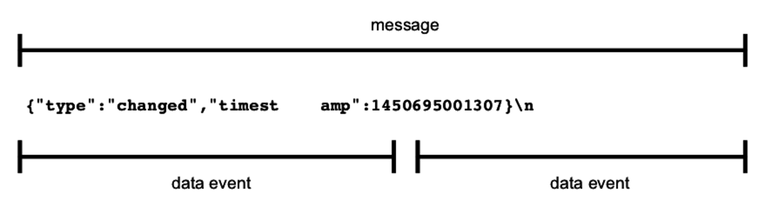
Let’s create a test service that sends a split message like this one and find out how the client responds.
Implementing a Test Service
Writing robust Node.js applications means gracefully handling network problems like split inputs, broken connections, and bad data. Here we’ll implement a test service that purposefully splits a message into multiple chunks.
Open your editor and enter this:
| | 'use strict'; |
| | const server = require('net').createServer(connection => { |
| | console.log('Subscriber connected.'); |
| | |
| | // Two message chunks that together make a whole message. |
| | const firstChunk = '{"type":"changed","timesta'; |
| | const secondChunk = 'mp":1450694370094}\n'; |
| | |
| | // Send the first chunk immediately. |
| | connection.write(firstChunk); |
| | |
| | // After a short delay, send the other chunk. |
| | const timer = setTimeout(() => { |
| | connection.write(secondChunk); |
| | connection.end(); |
| | }, 100); |
| | |
| | // Clear timer when the connection ends. |
| | connection.on('end', () => { |
| | clearTimeout(timer); |
| | console.log('Subscriber disconnected.'); |
| | }); |
| | }); |
| | |
| | server.listen(60300, function() { |
| | console.log('Test server listening for subscribers...'); |
| | }); |
Save this file as test-json-service.js and run it:
| | $ node test-json-service.js |
| | Test server listening for subscribers... |
This test service differs from our previous net-watcher-json-service.js in a few ways. Rather than setting up a filesystem watcher, as we did for the real service, here we just send the first predetermined chunk immediately.
Then we set up a timer to send the second chunk after a short delay. The JavaScript function setTimeout takes two parameters: a function to invoke and an amount of time in milliseconds. After the specified amount of time, the function will be called.
Finally, whenever the connection ends, we use clearTimeout to unschedule the callback. Unscheduling the callback is necessary because once a connection is closed, any calls to connection.write will trigger error events.
At last, let’s find out what happens when we connect with the client program:
| | $ node net-watcher-json-client.js |
| | undefined:1 |
| | {"type":"changed","timesta |
| | ^ |
| | |
| | SyntaxError: Unexpected token t |
| | at Object.parse (native) |
| | at Socket.<anonymous> (./net-watcher-json-client.js:6:22) |
| | at emitOne (events.js:77:13) |
| | at Socket.emit (events.js:169:7) |
| | at readableAddChunk (_stream_readable.js:146:16) |
| | at Socket.Readable.push (_stream_readable.js:110:10) |
| | at TCP.onread (net.js:523:20) |
The error Unexpected token t tells us that the message was not complete and valid JSON. Our client attempted to send half a message to JSON.parse, which expects only whole, properly formatted JSON strings as input.
At this point, we’ve successfully simulated the case of a split message coming from the server. Now let’s fix the client to work with it.