
Ripple acts as a real-time gross settlement and remittance network built by Ripple company and founded in 2012. It allows payments between parties in seconds. It operates with its own coin, known as Ripple (XRP), and also supports non-XRP payments. Ripple has proposed a new decentralized global network of banks and payment providers, known as RippleNet. This network uses Ripple's transaction settlement technology at its core. RippleNet is proposed to be independent of banks and payment providers, setting a standardized network for real-time payment settlement.
Ripple networks consist of various nodes that perform each of their own defined tasks. The first nodes that facilitate the system are called user nodes. The user nodes use Ripple for payment and transactions, such as to make and receive payments. The second type of node in Ripple is the validator node. These nodes are part of a consensus mechanism in the Ripple network. Nodes in the unique node list (UNL) are part of the Ripple network and trusted for the consensus mechanism. Anyone can become a validator node or a user node. The following diagram displays the flow of transactions that take place in the Ripple network. The transaction begins in the collection phase and then proceeds to move through the consensus phase. The final phase, which is the ledger closing phase, creates the block of the certain transaction for the next set of transactions to be received:
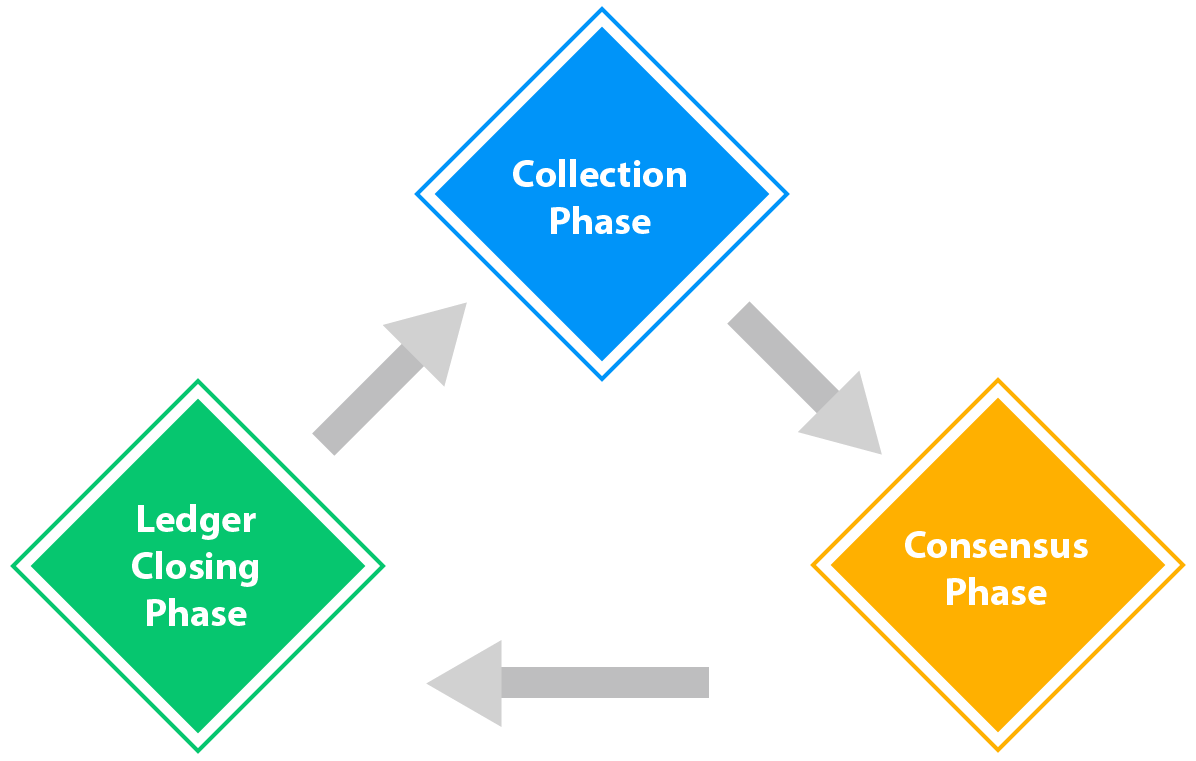
For the consensus mechanism, Ripple uses the Ripple Protocol Consensus Algorithm (RPCA). RPCA works neither on Proof of Work (PoW) nor Proof of Stake (PoS) systems; instead, its consensus mechanism works on a correctness-based system. The consensus process works on a voting system by seeking acceptance from the validator nodes in an iterative manner so that a required number of votes is received. Once the required number of votes is received, the changes are validated and the ledger is closed. Once the change in the ledger is accepted and the ledger is closed, an alert is sent to the network.
A Ripple network consists of various elements, which together make the transactions in Ripple successful:
- Validator: This element is the participant in the consensus protocol.
- Ledger: This contains elements such as the ledger number, account settings, transactions, timestamp, and ledger validation flag.
- Open ledger: This is the ledger on which the voting takes place. An open ledger contains the proposed transactions.
- Unique node list: This is the list of nodes that a validating server uses to seek votes and move the consensus ahead.
- Proposer: This element proposes new transactions that are to be made part of the consensus process.