
The state in Ethereum is made up of objects, each known as an account. Each account in Ethereum contains a 20-byte address. Each state transition is a direct transaction of value and information between various accounts. Each operation performed between or on the accounts is known as a state transition. The state transition in Ethereum is done using the Ethereum state transition function.
The state change in Ethereum blockchain starts from the genesis block of the blockchain, as shown in this diagram:
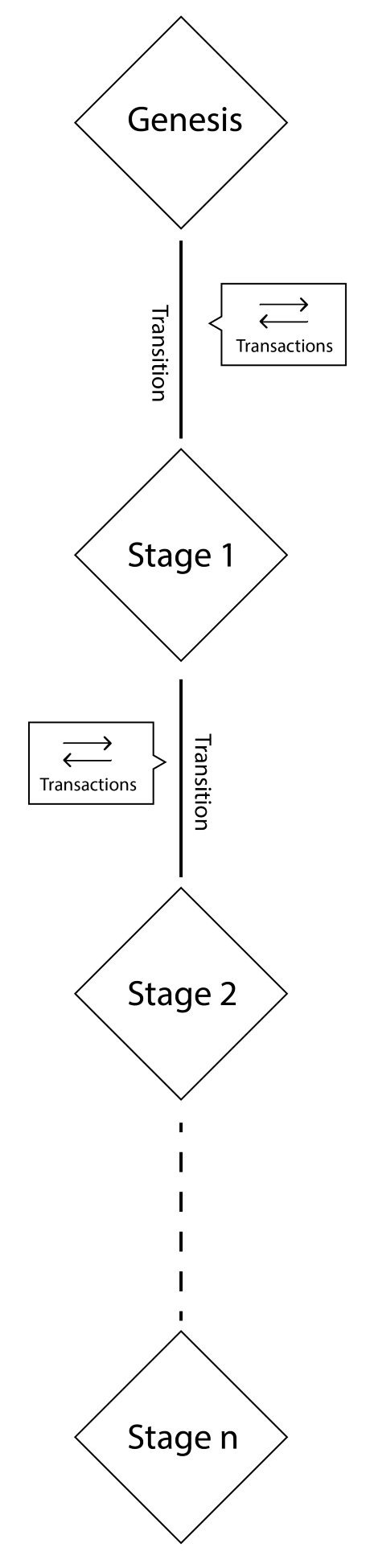
Each block contains a series of transactions, and each block is chained to its previous block. To transition from one state to the next, the transaction has to be valid. The transaction is further validated using consensus techniques, which we have already discussed in previous chapters.
To avoid stale blocks in Ethereum, GHOST (Greedy Heaviest Observed Subtree) protocol was introduced. This was introduced to avoid random forking by any nodes and inapt verification by other nodes. Stale blocks are created when two nodes find a block at the same time. Each node sends the block in the blockchain to be verified. This isn't the case with Bitcoin, since, in Bitcoin, block time is 10 minutes and the propagation of a block to approximately 50% of the network takes roughly 12 seconds. The GHOST protocol includes stale blocks also known as uncles, and these are included in the calculation of the chain.
As discussed in the previous chapters, there are two types of accounts in Ethereum blockchain. Namely, Contract Accounts (CA) and Externally Owned Accounts (EOAs). The contract accounts are the ones that have code associated with them along with a private key. EOA has an ether balance; it is able to send transactions and has no associated code, whereas CA has an ether balance and associated code. The contract account and the externally owned accounts have features of their own, and a new token can only be initiated by the contract account.