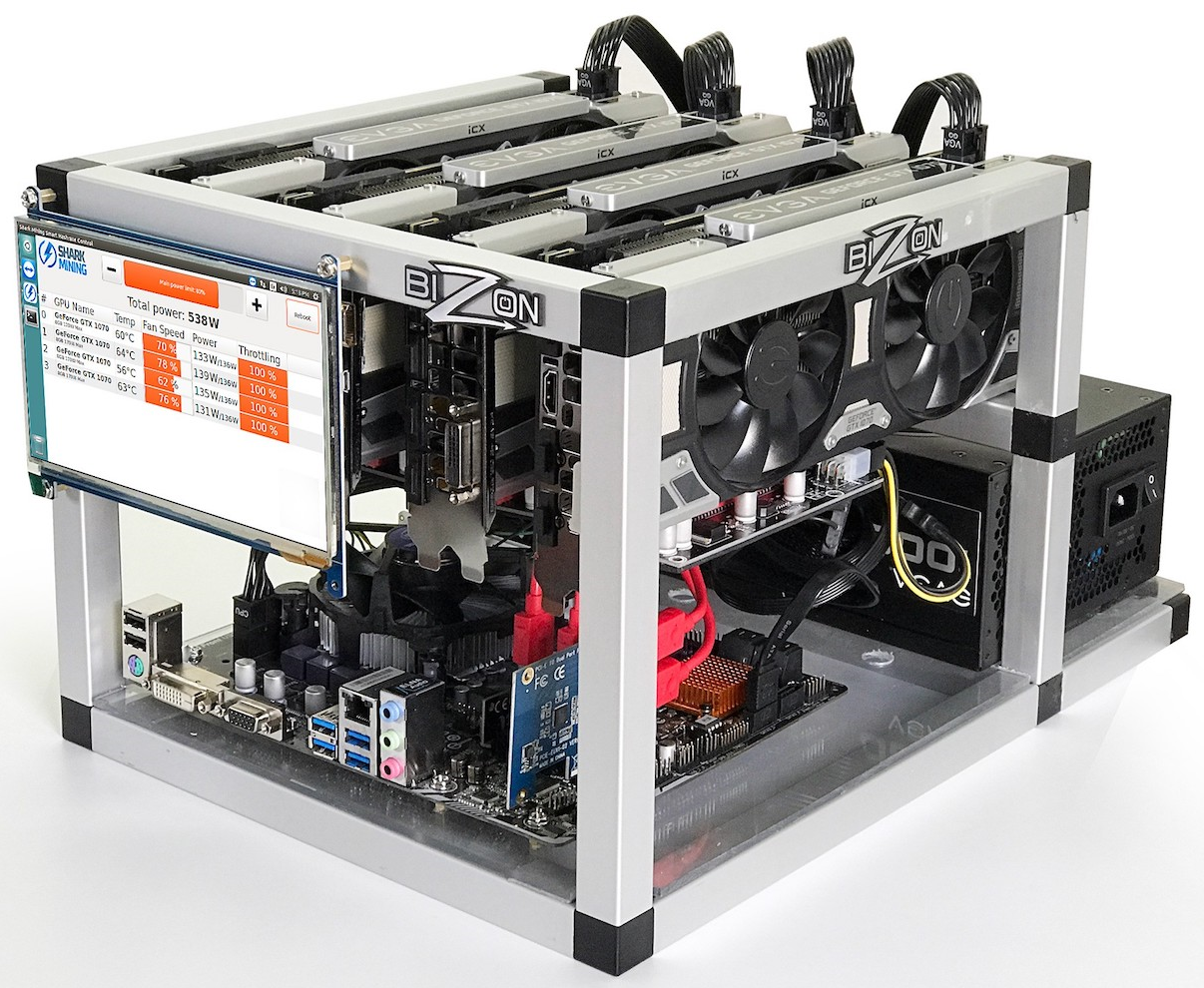
Since a lot of GPUs or ASICs are rigged together, they tend to produce a large amount of heat, hence it is important to have proper airflow available. Here are the requirements of a basic rig, which one can set up on their own:
- Motherboard: A specialized motherboard is required that can support multiple PCI-E slots for multiple GPUs to be connected.
- HD: A minimum hard drive is enough, but better to opt for an SSD for better performance.
- Memory: A minimum of 8 GB or 4 GB of RAM is enough for a mining rig, as mining is more about computation-intensive work.
- GPU, ASIC, or FPGA: These are the most important components in a mining rig, either any one of the configurations can be opted such as GPU-based rig or ASIC-based rig or FPGA-based rig. A mix of all these can also be tried on rigs to figure out which device produces the highest result.
- Case: Since a large number of computational devices are rigged together, they tend to produce a huge amount of heat, hence a proper casing is required to connect these together; airflow inside should be adequate since a large amount of heat can result in loss of hardware or reduction in system-resource usage.
- Power Supply: A standard power supply in a desktop computer cannot work in a mining rig; multiple GPUs require a large amount of electricity, and hence a power supply that can support such a large amount of electricity is required.
Nowadays, pre-built mining rigs are also available; these rigs are of plug-and-play types, with no setup required. Here are some of the most widely used pre-built rigs:
- Shark mining: This is a popular vendor creating various GPU-based rigs supporting numerous coins to mine. They offer various options, from compact to large size rigs.
- Mining Cave: They have options for various rigs, for Nvidia- or AMD-based graphic cards: