Tendermint provides a secure and consistent state machine replication functionality. Its main task is to develop a secure and high-performance, easily replicable state machine. It is Byzantine Fault Tolerant, that is, even if one in three of the machines fail, Tendermint will keep on working.
The two prime components of Tendermint are as follows:
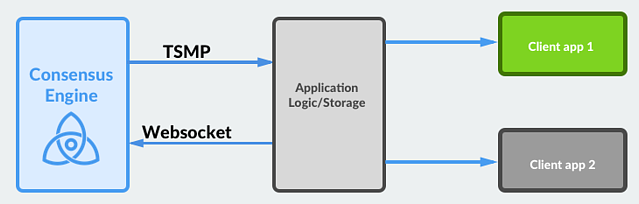
- The Tendermint Core: The Tendermint Core enables secure replication of transactions on each node present in the network. It is a consensus engine.
- The Tendermint Socket Protocol (TMSP): TMSP is an application interface protocol that allows interfacing with any programming language and helps to process transactions.
The Tendermint consensus algorithm is a round-based mechanism where validator nodes initiate new blocks in each round is done. A locking mechanism is used to ensure protection against a scenario when two different blocks are selected for closing at the same height of the blockchain. Each validator node syncs a full local replicated ledger of blocks that contain transactions. Each block contains a header that consists of the previous block hash, timestamp of the proposed block, present block height, and the Merkle root hash of all transactions present in that block.
The following diagram shows the flow between the consensus engine and the client apps via the Tendermint Socket protocol:
Participants of the Tendermint protocol are generally referred to as validators. Each validator takes turns to propose blocks of transactions. They also vote on them just like the Ripple voting system discussed previously. If a block is unable to commit, the protocol moves on to the next round. A new validator then proposes a block for that same height. Voting requires two stages to successfully commit a block. These two stages are commonly known as the pre-vote and pre-commit stage. A block is committed only if more than two in three of the validators pre-commit for the same block and in the same round.
Validators are unable to commit a block for a number of reasons. These would include the current proposer being offline, or issues with the quality or speed of the network. Tendermint also allows the validators to confirm if a validator should be skipped. Each validator waits for a small amount of time to receive a proposal block from the concerned proposer. Only after this voting can take place can they move to the next round. This dependence on a time period makes Tendermint a synchronous protocol despite the fact that the rest of the protocol is asynchronous in nature, and validators only progress after hearing from more than two-thirds of the validator sets. One of the simplifying elements of Tendermint is that it uses the same mechanism to commit a block as it does to skip to the next round.
Tendermint guarantees that security is not breached if we assume that less than one-third of the validator nodes are Byzantine. This implies that the validator nodes will never commit conflicting blocks at the same height. There are a few locking rules that modulate the paths that can be followed. Once a validator pre-commits a block, it is locked on that block. In such cases, it must pre-vote for the block it is to be locked on, and it can only unlock and pre-commit for a new block.