
In Sawtooth, transactions are always part of batches. A batch is a set of transactions that come together and either all succeed or all fail. If a transaction needs to process by itself, then it would be in a single batch containing only that one transaction. Using the shipping company example, the transactions package released and package accepted may be programmed so that they only succeed if their counter-transaction is part of the same batch, forcing a successful handoff or throwing an error. The following diagram shows the data structure of a transaction batch:
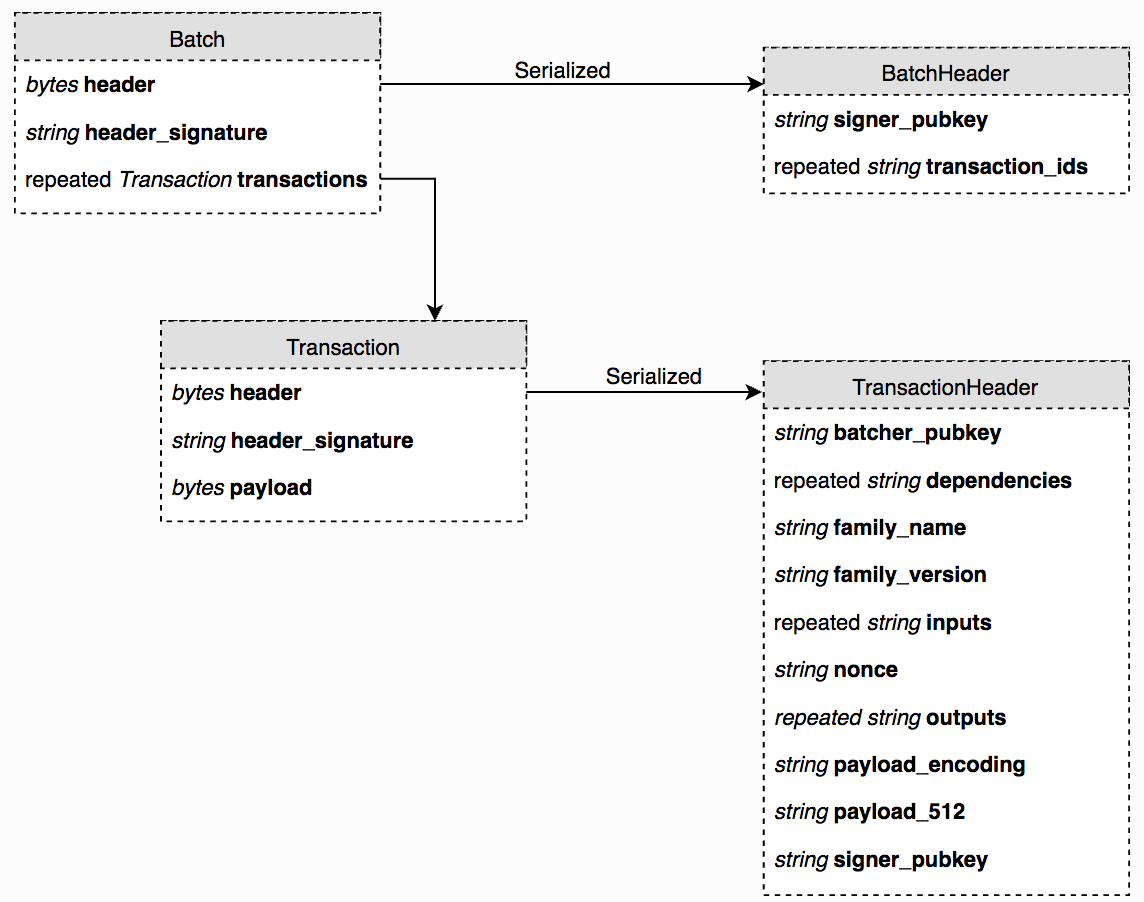
Transactions and batches in Sawtooth are abstracted at a high level so that they can be created by custom transaction families and by arbitrary programming languages. Because of this, it is possible to program smart contracts and transaction families in Java, Python, Go, C++, and JavaScript. To code in any language, there is another restriction on transactions: serialization, or the transition from an in-memory structure on a computer to a fixed binary that can be sent across the network. No matter what the language is, the approach to serialization must have the same output. In Sawtooth, all transactions and batches are encoded in a format called protocol buffers, a format created by Google internally, and released in 2008. Protocol buffers are a solution to having a fixed and high-performance method of data-exchange between computers that is a programming language and computer architecture independent.