Table of Contents for
Mastering C++ Programming

Version ebook / Retour

Cover image for bash Cookbook, 2nd Edition Mastering C++ Programming by Jeganathan Swaminathan Published by Packt Publishing, 2017
  1. Mastering C++ Programming
  2. Title Page
  3. Copyright
  4. Mastering C++ Programming
  5. Credits
  6. About the Author
  7. About the Reviewer
  8. www.PacktPub.com
  9. Why subscribe?
  10. Customer Feedback
  11. Dedication
  12. Table of Contents
  13. Preface
  14. What this book covers
  15. What you need for this book
  16. Who this book is for
  17. Conventions
  18. Reader feedback
  19. Customer support
  20. Downloading the example code
  21. Errata
  22. Piracy
  23. Questions
  24. C++17 Features
  25. C++17 background
  26. What's new in C++17?
  27. What features are deprecated or removed in C++17?
  28. Key features in C++17
  29. Easier nested namespace syntax
  30. New rules for type auto-detection from braced initializer list 
  31. Simplified static_assert 
  32. The std::invoke( ) method
  33. Structured binding
  34. If and Switch local scoped variables
  35. Template type auto-deduction for class templates
  36. Inline variables
  37. Summary
  38. Standard Template Library
  39. The Standard Template Library architecture
  40. Algorithms
  41. Iterators
  42. Containers
  43. Functors
  44. Sequence containers
  45. Array
  46. Code walkthrough
  47. Commonly used APIs in an array
  48. Vector 
  49. Code walkthrough
  50. Commonly used vector APIs
  51. Code walkthrough
  52. Pitfalls of a vector
  53. List 
  54. Commonly used APIs in a list
  55. Forward list
  56. Code walkthrough
  57. Commonly used APIs in a forward_list container
  58. Deque
  59. Commonly used APIs in a deque
  60. Associative containers
  61. Set
  62. Code walkthrough
  63. Commonly used APIs in a set
  64. Map
  65. Code walkthrough
  66. Commonly used APIs in a map
  67. Multiset
  68. Multimap
  69. Unordered sets
  70. Unordered maps
  71. Unordered multisets
  72. Unordered multimaps
  73. Container adapters
  74. Stack
  75. Commonly used APIs in a stack
  76. Queue
  77. Commonly used APIs in a queue
  78. Priority queue
  79. Commonly used APIs in a priority queue
  80. Summary
  81. Template Programming
  82. Generic programming
  83. Function templates
  84. Code walkthrough
  85. Overloading function templates
  86. Code walkthrough
  87. Class template
  88. Code walkthrough
  89. Explicit class specializations
  90. Code walkthrough
  91. Partial template specialization
  92. Summary
  93. Smart Pointers
  94. Memory management
  95. Issues with raw pointers
  96. Smart pointers
  97. auto_ptr
  98. Code walkthrough - Part 1
  99. Code walkthrough - Part 2
  100. unique_ptr
  101. Code walkthrough
  102. shared_ptr
  103. Code walkthrough
  104. weak_ptr
  105. Circular dependency
  106. Summary
  107. Developing GUI Applications in C++
  108. Qt 
  109. Installing Qt 5.7.0 in Ubuntu 16.04
  110. Qt Core
  111. Writing our first Qt console application
  112. Qt Widgets
  113. Writing our first Qt GUI application
  114. Layouts
  115. Writing a GUI application with a horizontal layout
  116. Writing a GUI application with a vertical layout
  117. Writing a GUI application with a box layout
  118. Writing a GUI application with a grid layout
  119. Signals and slots
  120. Using stacked layout in Qt applications
  121. Writing a simple math application combining multiple layouts
  122. Summary
  123. Multithreaded Programming and Inter-Process Communication
  124. Introduction to POSIX pthreads
  125. Creating threads with the pthreads library
  126. How to compile and run
  127. Does C++ support threads natively?
  128. How to write a multithreaded application using the native C++ thread feature
  129. How to compile and run
  130. Using std::thread in an object-oriented fashion
  131. How to compile and run
  132. What did you learn?
  133. Synchronizing threads
  134. What would happen if threads weren't synchronized?
  135. How to compile and run
  136. Let's use mutex
  137. How to compile and run
  138. What is a deadlock?
  139. How to compile and run
  140. What did you learn?
  141. Shared mutex
  142. Conditional variable
  143. How to compile and run
  144. What did you learn?
  145. Semaphore
  146. Concurrency
  147. How to compile and run
  148. Asynchronous message passing using the concurrency support library
  149. How to compile and run
  150. Concurrency tasks
  151. How to compile and run
  152. Using tasks with a thread support library
  153. How to compile and run
  154. Binding the thread procedure and its input to packaged_task 
  155. How to compile and run
  156. Exception handling with the concurrency library
  157. How to compile and run
  158. What did you learn?
  159. Summary
  160. Test-Driven Development
  161. TDD
  162. Common myths and questions around TDD
  163. Does it take more efforts for a developer to write a unit test? 
  164. Is code coverage metrics good or bad?
  165. Does TDD work for complex legacy projects? 
  166. Is TDD even applicable for embedded or products that involve hardware?
  167. Unit testing frameworks for C++
  168. Google test framework
  169. Installing Google test framework on Ubuntu
  170. How to build google test and mock together as one single static library without installing?
  171. Writing our first test case using the Google test framework
  172. Using Google test framework in Visual Studio IDE
  173. TDD in action
  174. Testing a piece of legacy code that has dependency
  175. Summary
  176. Behavior-Driven Development
  177. Behavior-driven development
  178. TDD versus BDD
  179. C++ BDD frameworks
  180. The Gherkin language
  181. Installing cucumber-cpp in Ubuntu
  182. Installing the cucumber-cpp framework prerequisite software
  183. Building and executing the test cases
  184. Feature file
  185. Spoken languages supported by Gherkin
  186. The recommended cucumber-cpp project folder structure
  187. Writing our first Cucumber test case
  188. Integrating our project in cucumber-cpp CMakeLists.txt
  189. Executing our test case
  190. Dry running your cucumber test cases
  191. BDD - a test-first development approach
  192. Let's build and run our BDD test case
  193. It's testing time!
  194. Summary
  195. Debugging Techniques
  196. Effective debugging
  197. Debugging strategies
  198. Debugging tools
  199. Debugging your application using GDB
  200. GDB commands quick reference
  201. Debugging memory leaks with Valgrind
  202. The Memcheck tool
  203. Detecting memory access outside the boundary of an array
  204. Detecting memory access to already released memory locations
  205. Detecting uninitialized memory access
  206. Detecting memory leaks
  207. Fixing the memory leaks
  208. Mismatched use of new and free or malloc and delete
  209. Summary
  210. Code Smells and Clean Code Practices
  211. Code refactoring
  212. Code smell
  213. What is agile?
  214. SOLID design principle
  215. Single responsibility principle
  216. Open closed principle
  217. Liskov substitution principle
  218. Interface segregation
  219. Dependency inversion
  220. Code smell
  221. Comment smell
  222. Long method
  223. Long parameter list
  224. Duplicate code
  225. Conditional complexity
  226. Large class
  227. Dead code
  228. Primitive obsession
  229. Data class
  230. Feature envy
  231. Summary

BDD - a test-first development approach

Just like TDD, BDD also insists on following a test-first development approach. Hence, in this section, let's explore how we could write an end-to-end feature following a test-first development approach the BDD way!

Let's take a simple example that helps us understand the BDD style of coding. We will write an RPNCalculator application that does addition, subtraction, multiplication, division, and complex math expressions that involve many math operations in the same input.

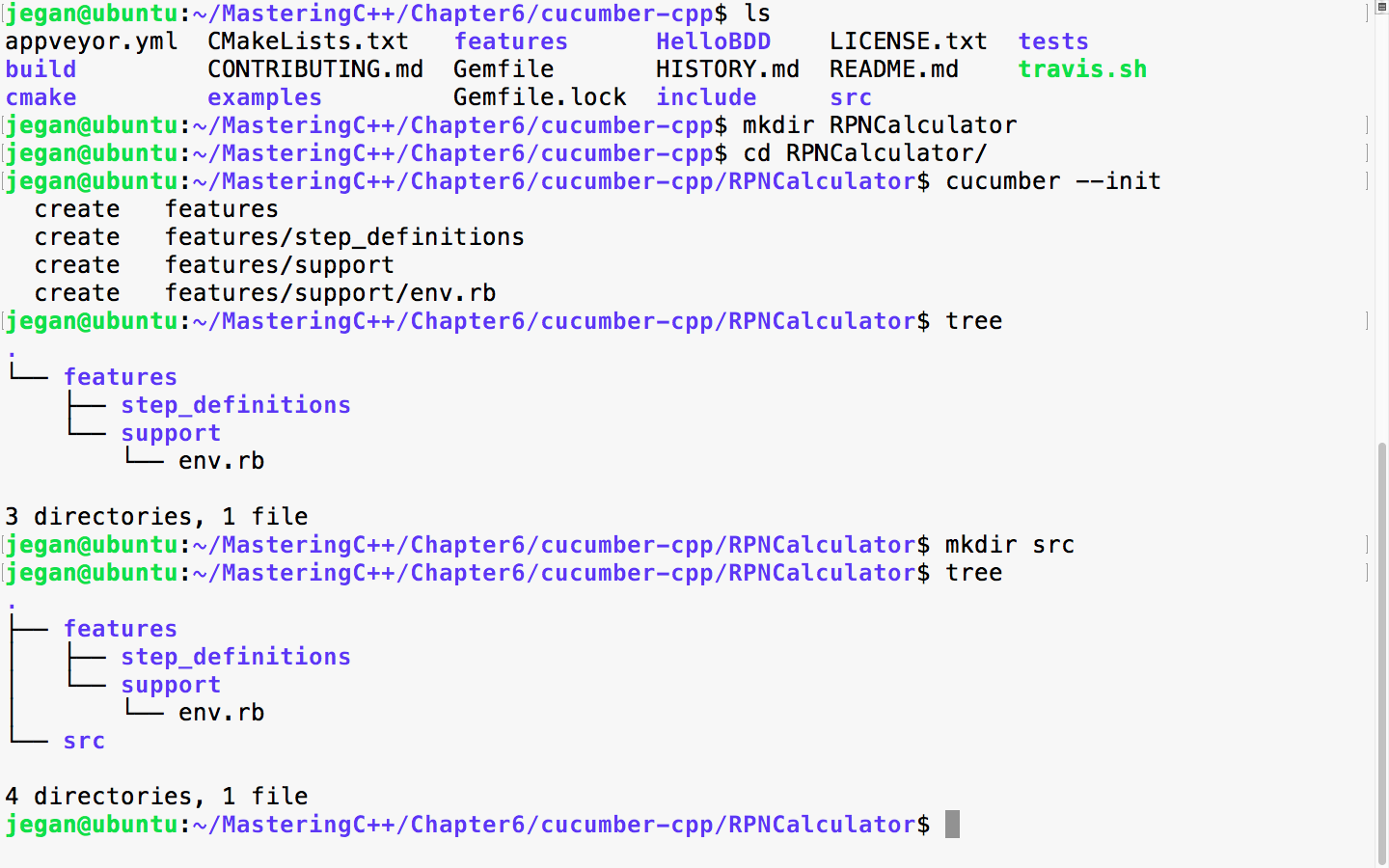
Let's create our project folder structure as per Cucumber standards:

mkdir RPNCalculator
cd RPNCalculator
cucumber --init
tree
mkdir src
tree

The following screenshot demonstrates the procedure visually:
Great! The folder structure is now created. Now, let's create empty files with a touch utility to help us visualize our final project folder structure along with the files:

touch features/rpncalculator.feature
touch features/step_definitions/RPNCalculatorSteps.cpp
touch features/step_definitions/cucumber.wire
touch src/RPNCalculator.h
touch src/RPNCalculator.cpp
touch CMakeLists.txt

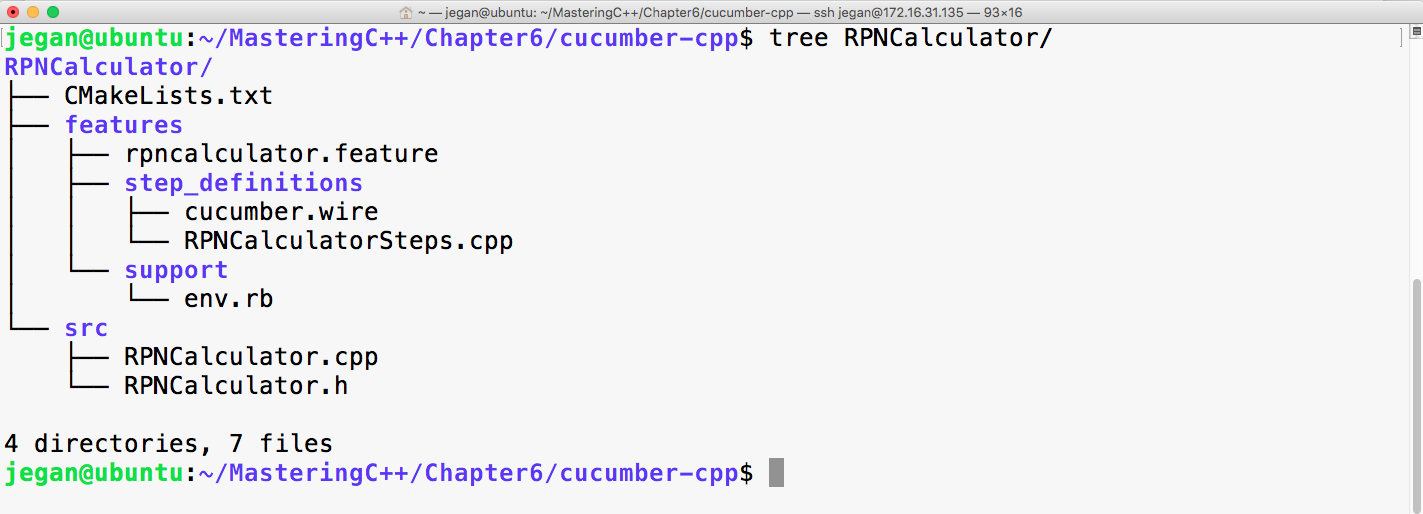
Once the dummy files are created, the final project folder structure will look like the following screenshot:
As usual, the Cucumber wire file is going to look as follows. In fact, throughout this chapter, this file will look same:

host: localhost
port: 3902

Now, let's start with the rpncalculator.feature file, as shown in the following screenshot:
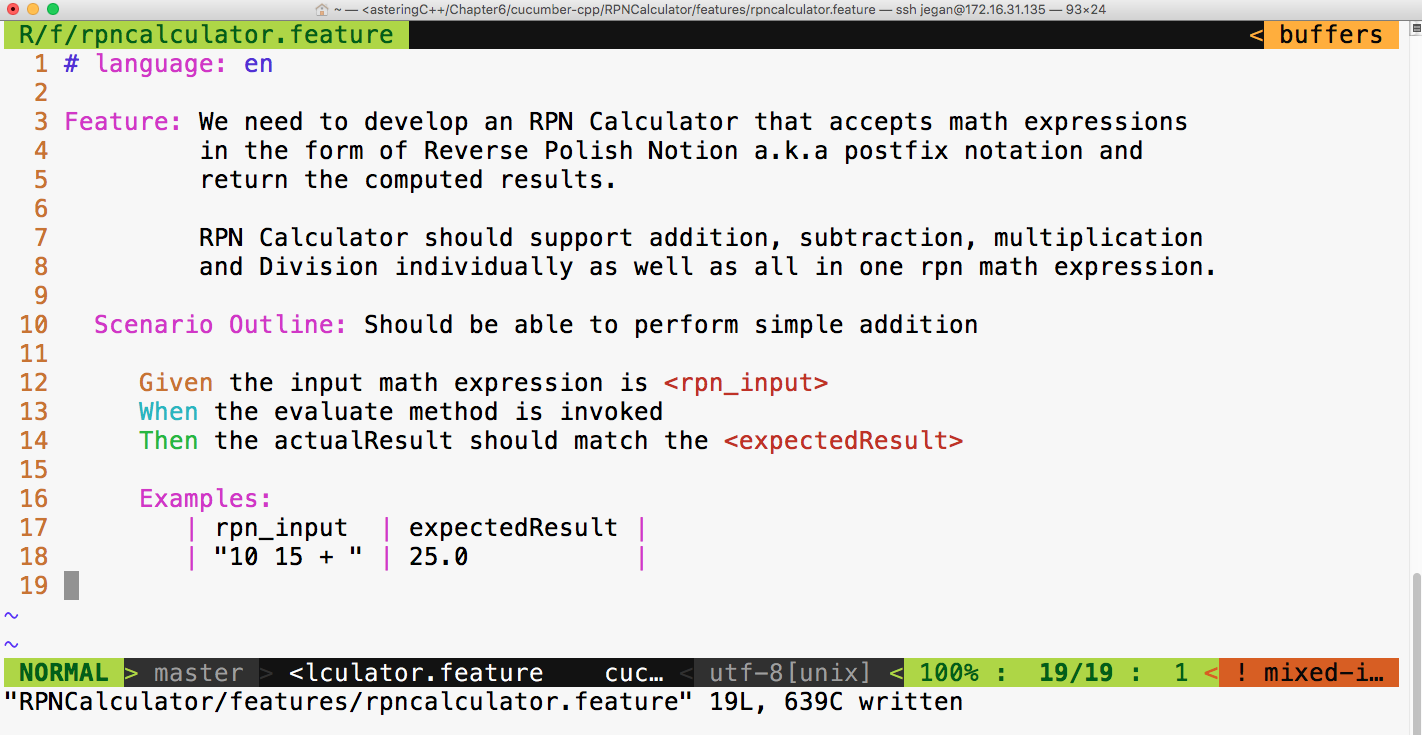

As you can see, the feature description can be pretty elaborate. Did you notice? I have used Scenario Outline in the place of scenario. The interesting part of Scenario Outline is that it allows describing the set of inputs and the corresponding output in the form of a table under the Examples Cucumber section.

If you are familiar with SCRUM, does the Cucumber scenario look pretty close to the user story? Yes, that's the idea. Ideally, the SCRUM user stories or use cases can be written as Cucumber scenarios. The Cucumber feature file is a live document that can be executed. 

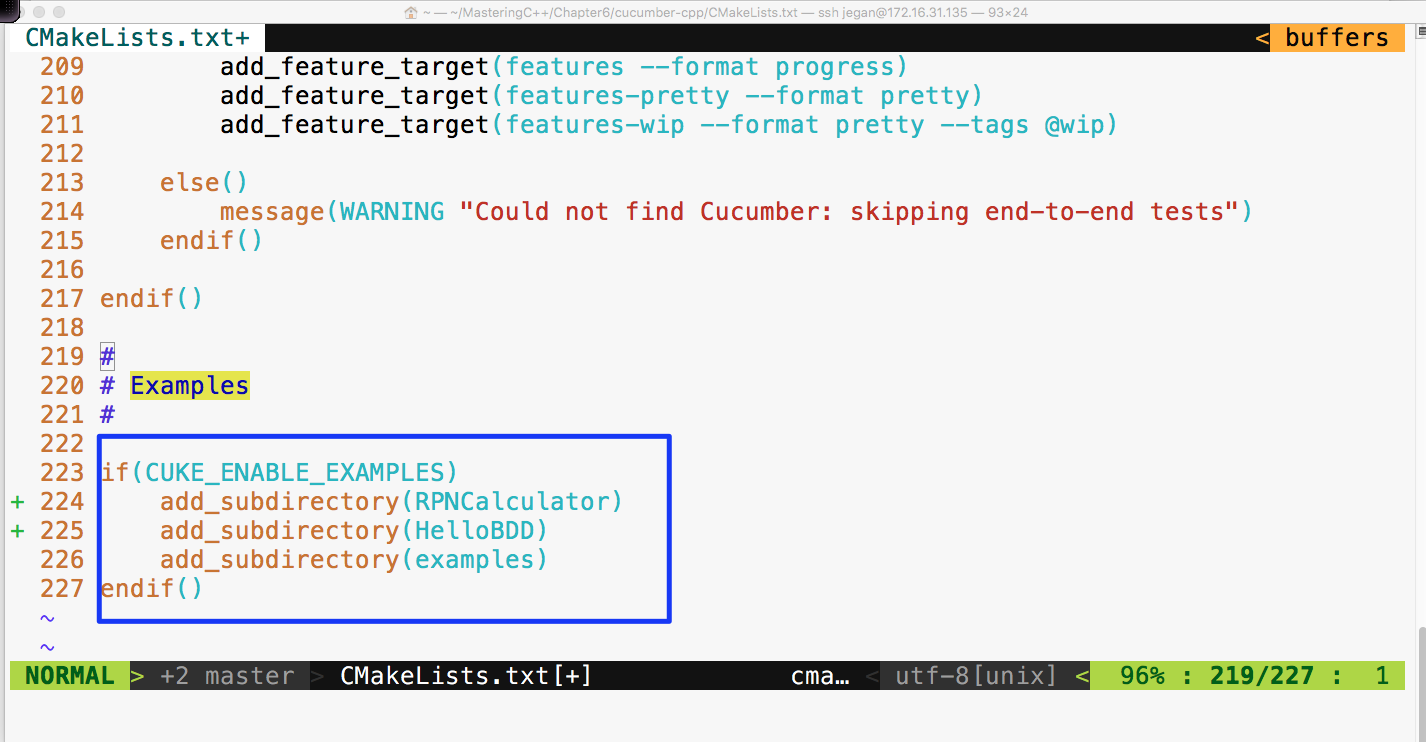
We need to add our project in the CMakeLists.txt file at the cucumber-cpp home directory, as follows:
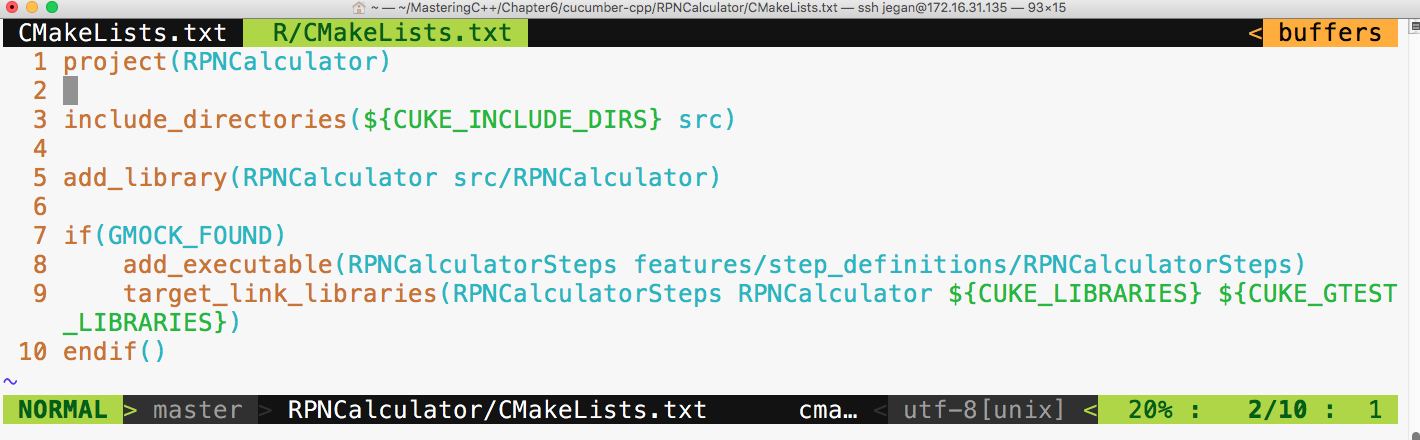
Ensure that CMakeLists.txt under the RPNCalculator folder looks as follows:
Now, let's build our project with the following command from the cucumber-cpp home directory:

cmake --build build

Let's execute our brand new RPNCalculator Cucumber test cases with the following command:

build/RPNCalculator/RPNCalculatorSteps &

cucumber RPNCalculator

The output looks as follows:
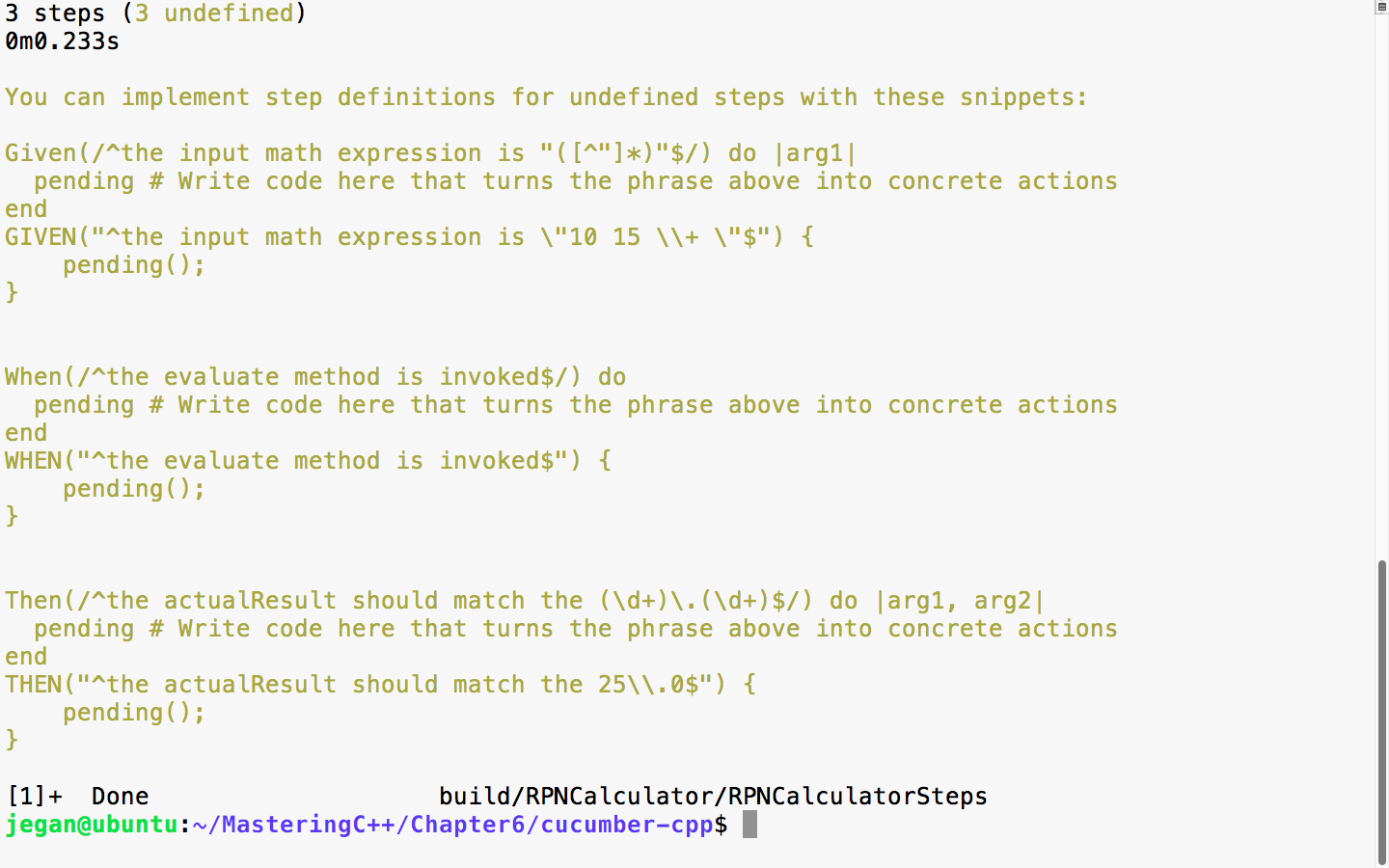
In the preceding screenshot, there are two suggestions for every Given, When, and Then statements we wrote in the feature file. The first version is meant for Ruby and the second is meant for C++; hence, we can safely ignore the step suggestions, which are as follows:

Then(/^the actualResult should match the (d+).(d+)$/) do |arg1, arg2|
pending # Write code here that turns the phrase above into concrete actions
end

As we are yet to implement the RPNCalculatorSteps.cpp file, the Cucumber framework is suggesting us to supply implementations for the previous steps. Let's copy and paste them in the RPNCalculatorSteps.cpp file and complete the steps implementations, as follows:
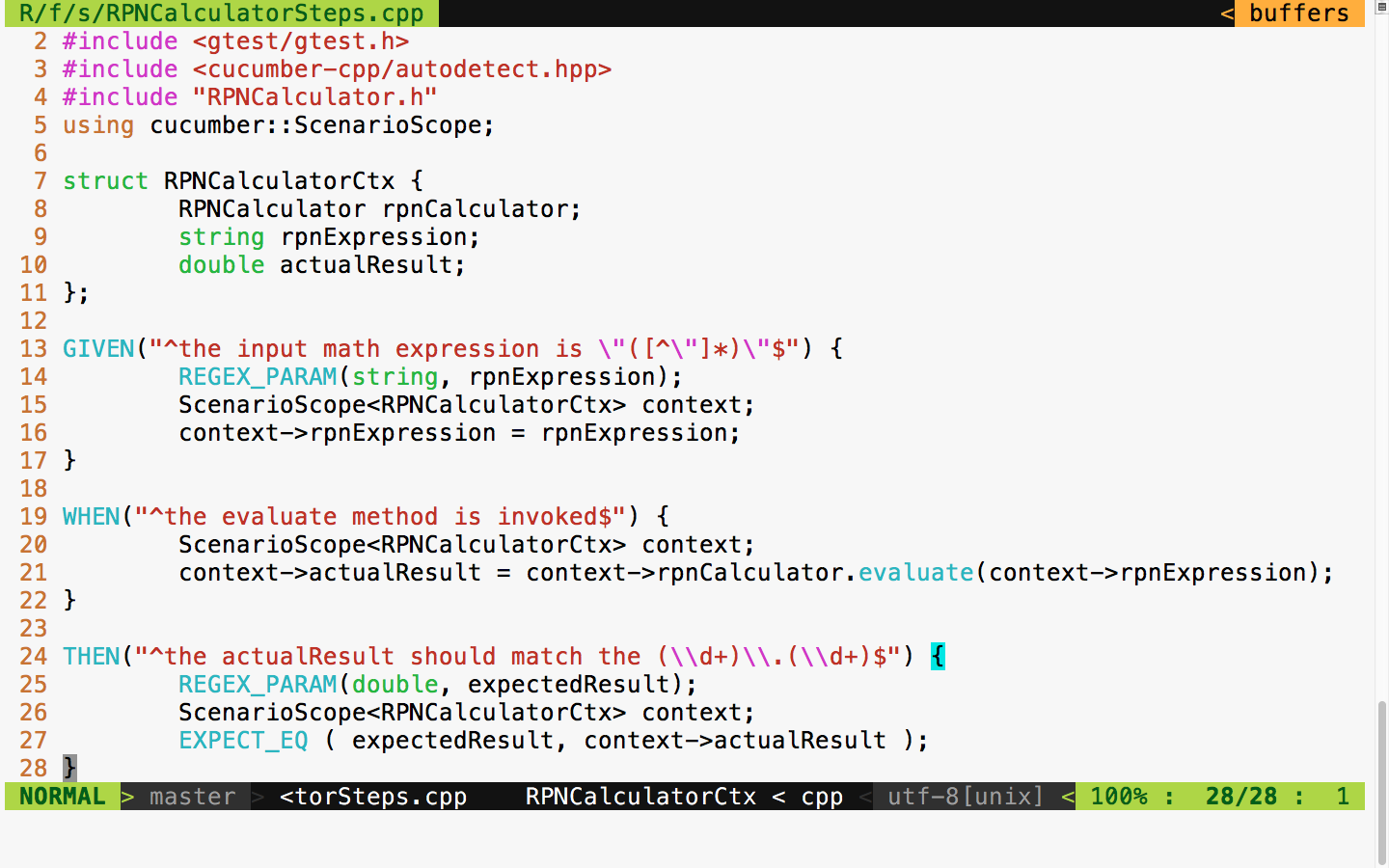

REGEX_PARAM is a macro supported by the cucumber-cpp BDD framework, which comes in handy to extract the input arguments from the regular expression and pass them to the Cucumber step functions. 

Now, let's try to build our project again with the following command:

cmake --build  build

The build log looks as follows:
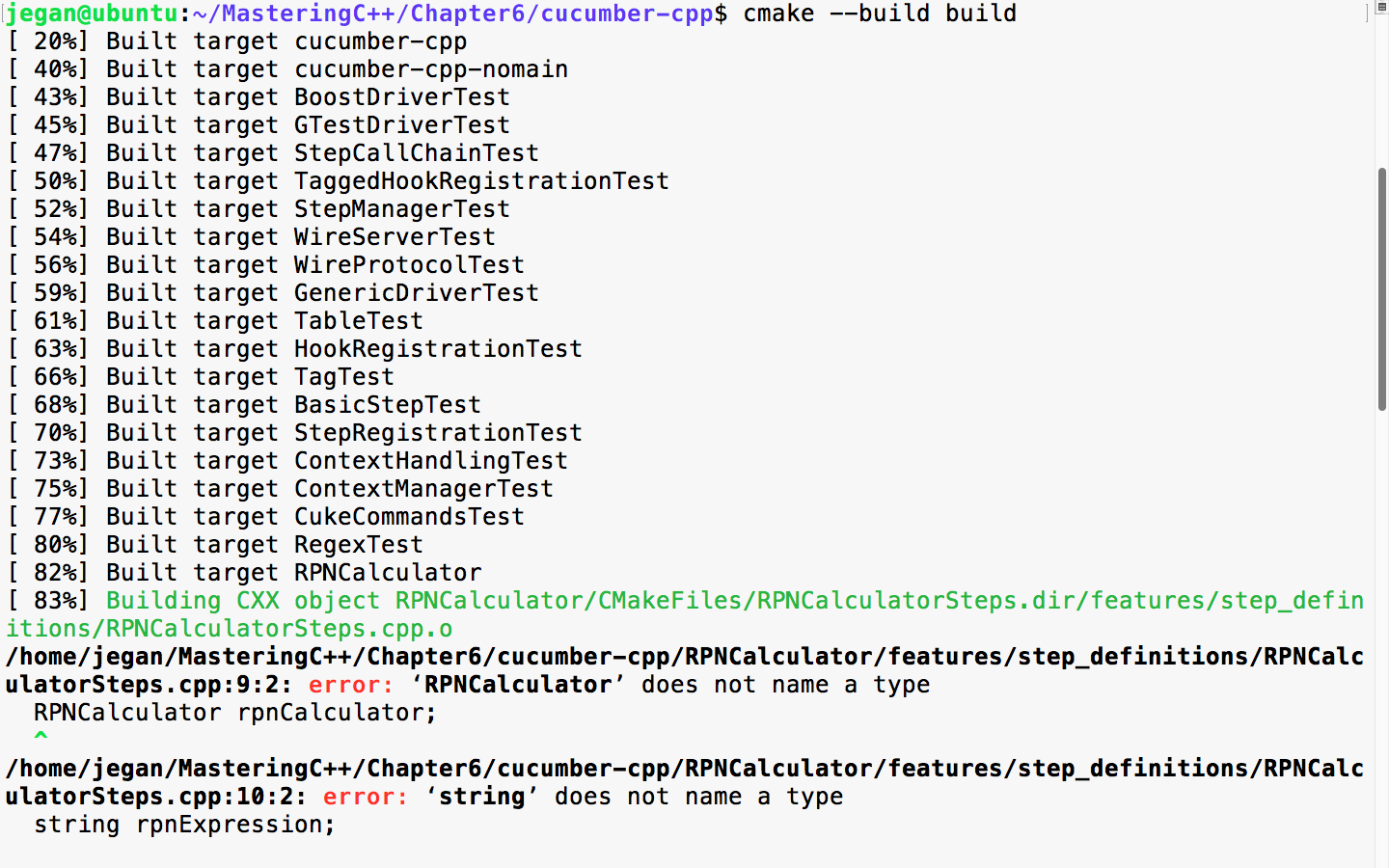
The secret formula behind every successful developer or consultant is that they have strong debugging and problem-solving skills. Analyzing build reports, especially build failures, is a key quality one should acquire to successfully apply BDD. Every build error teaches us something!

The build error is obvious, as we are yet to implement RPNCalculator, as the file is empty. Let's write minimal code such that the code compiles:
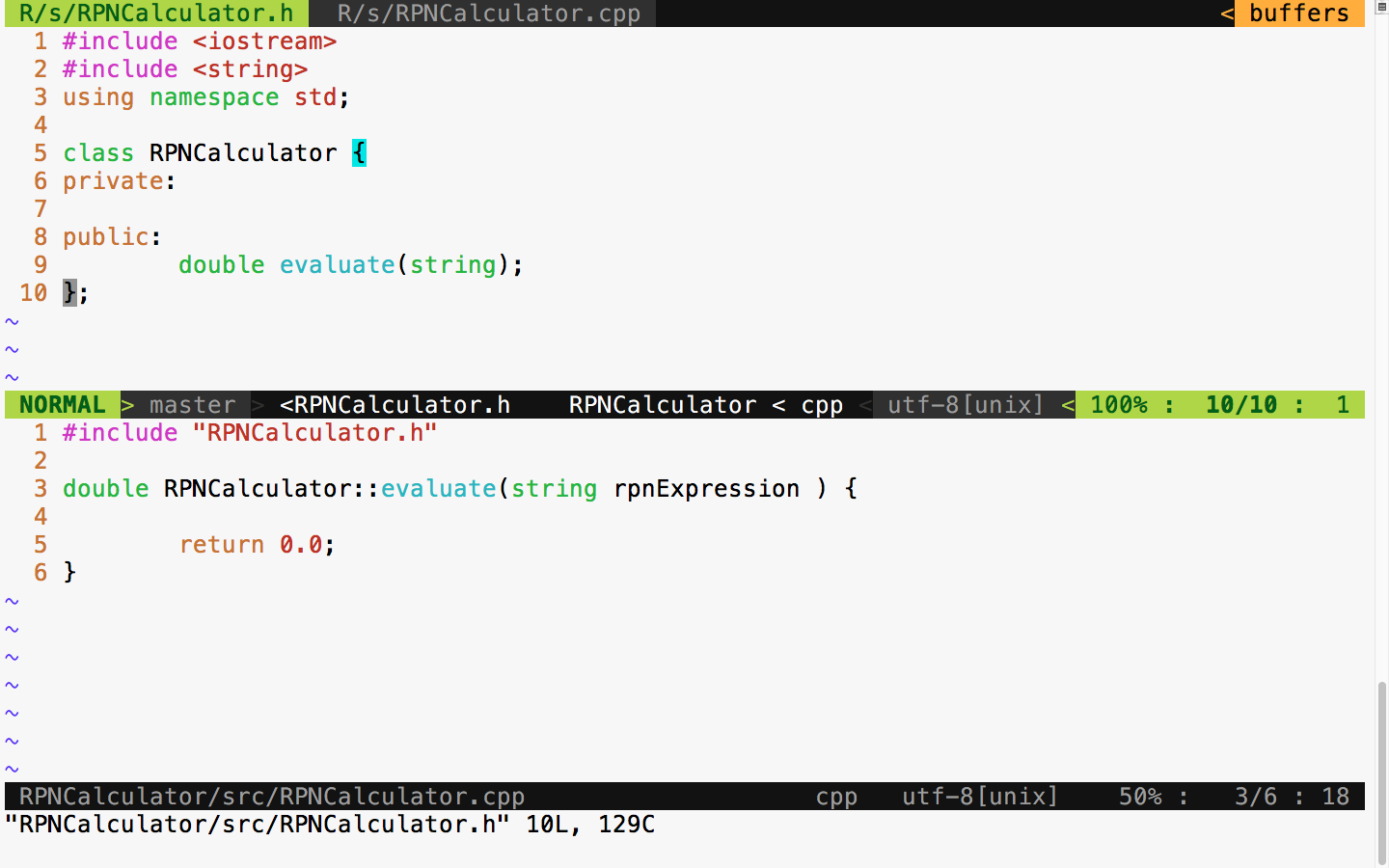
BDD leads to incremental design and development, unlike the waterfall model. The waterfall model encourages upfront design. Typically, in a waterfall model, the design is done initially, and it consumes 30-40% of the overall project effort. The main issue with upfront design is that we will have less knowledge about the feature initially; often, we will have a vague feature knowledge, but it will improve over time. So, it isn't a good idea to put in more effort in the design activity upfront; rather, be open to refactoring the design and code as and when necessary.

Hence, BDD is a natural choice for complex projects.

With this minimal implementation, let's try to build and run the test cases:
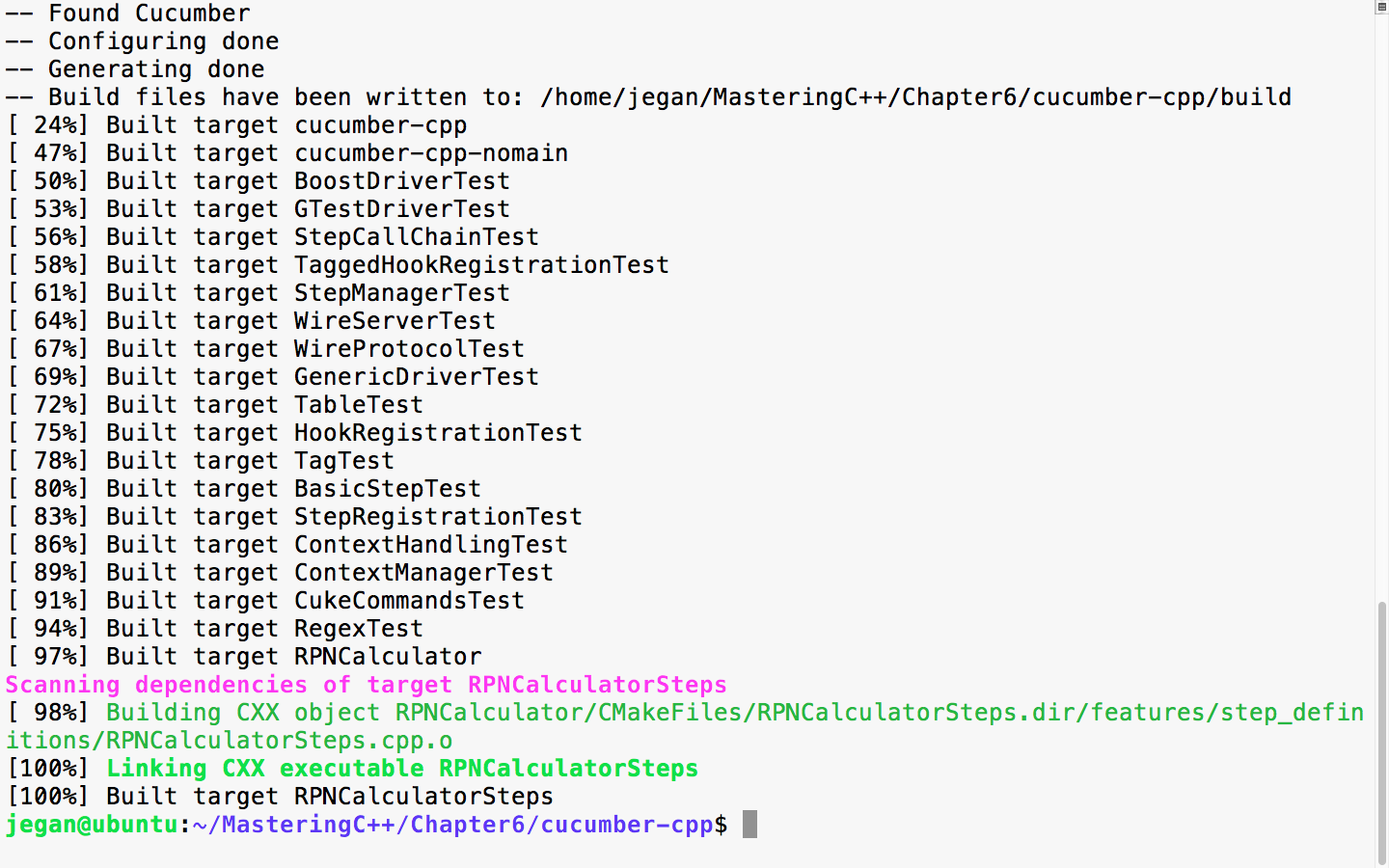
Cool! Since the code compiles without errors, let's execute the test case now and observe what happens:
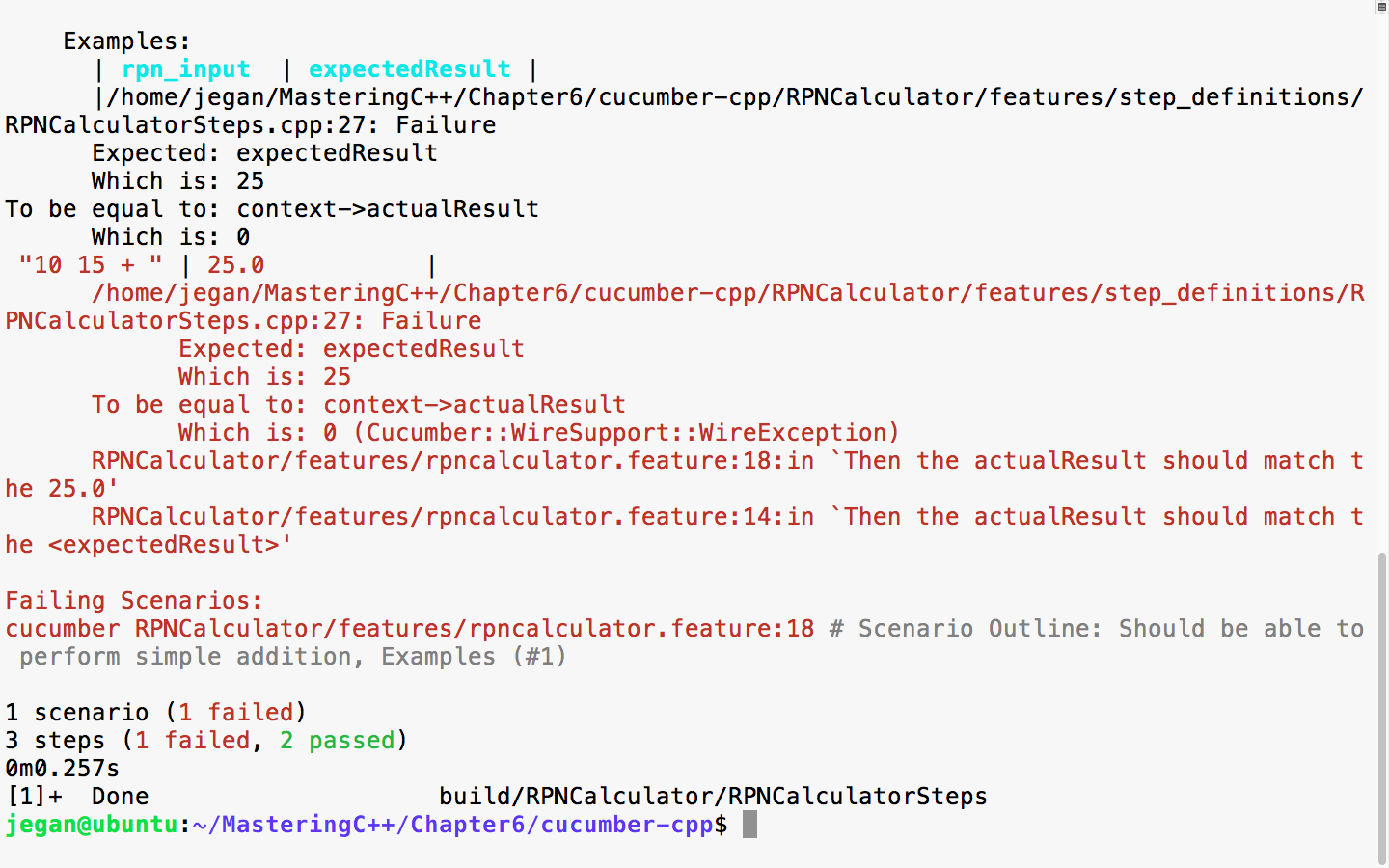
The errors are highlighted in red color as shown in the preceding screenshot by the cucumber-cpp framework. This is expected; the test case is failing as the RPNCalculator::evaluate method is hardcoded to return 0.0.  

Ideally, we had to write only minimal code to make this pass, but I took the liberty of fast forwarding the steps, with the assumption that you have already read Chapter 7Test Driven Development before reading the current chapter. In that chapter, I have demonstrated every step in detail, including the refactoring.


Now, let's go ahead and implement the code to make this test case pass.  The modified RPNCalculator header file looks as follows:
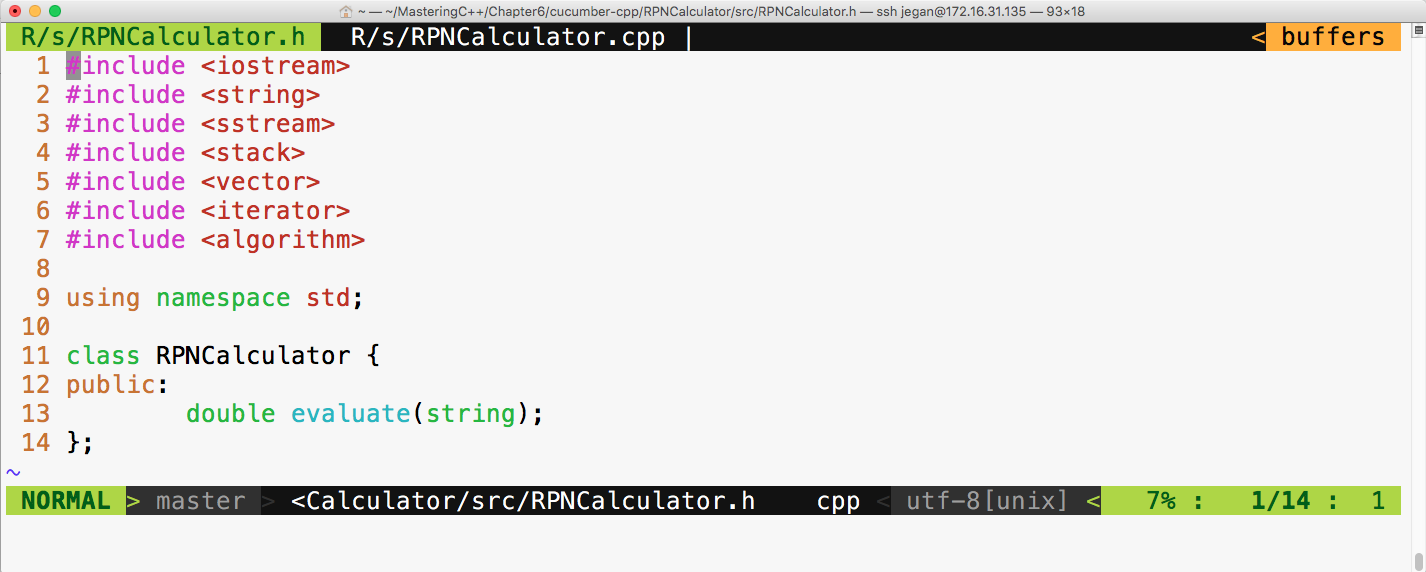
The respective RPNCalculator source file looks as follows:
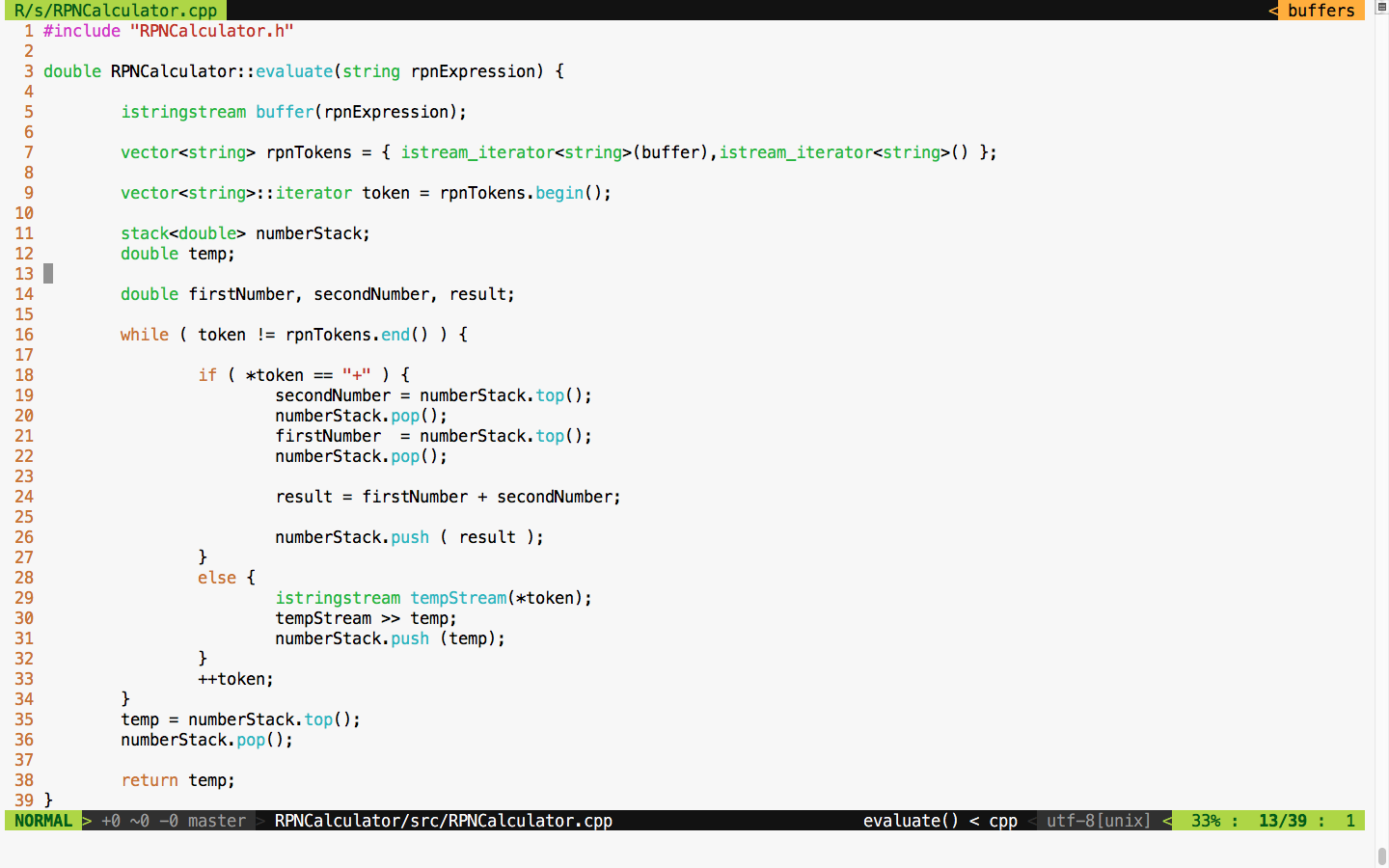
As per BDD practice, note that we have only implemented code that is necessary for supporting the addition operation alone, as per our current Cucumber scenario requirements. Like TDD, in BDD, we are supposed to write only the required amount of code to satisfy the current scenario; this way, we can ensure that every line of code is covered by effective test cases.