Table of Contents for
Ripple Quick Start Guide

Version ebook / Retour

Cover image for bash Cookbook, 2nd Edition Ripple Quick Start Guide by Febin John James Published by Packt Publishing, 2018
  1. Ripple Quick Start Guide
  2. Title Page
  3. Copyright and Credits
  4. Ripple Quick Start Guide
  5. Dedication
  6. About Packt
  7. Why subscribe?
  8. Packt.com
  9. Contributors
  10. About the author
  11. About the reviewer
  12. Packt is searching for authors like you
  13. Table of Contents
  14. Preface
  15. Who this book is for
  16. What this book covers
  17. To get the most out of this book
  18. Download the example code files
  19. Conventions used
  20. Get in touch
  21. Reviews
  22. Getting Started with Ripple
  23. The need for decentralization
  24. Introduction to blockchain
  25. Introduction to Bitcoin
  26. Inefficiencies in payment systems
  27. International money transfer through Bitcoin
  28. Disadvantages of Bitcoin
  29. Ripple
  30. International money transfer through Ripple
  31. The Ripple Protocol
  32. Account creation
  33. Reserve
  34. Transactions
  35. Multisigning
  36. Consensus
  37. Important properties of the consensus protocol
  38. Ledger versions
  39. Validation
  40. Advantages of Ripple
  41. Currency agnostic
  42. Simplified consensus
  43. Low fee
  44. Reduced foreign exchange cost
  45. Pathfinding algorithm
  46. Adaptable cryptography
  47. Anti-spam mechanism
  48. Potential risks of Ripple
  49. Regulatory issues
  50. Trust Issues
  51. Security vulnerabilities
  52. Problems of being an open protocol
  53. Summary
  54. Working with Ripple Currency XRP
  55. Types of wallets
  56. Online wallets
  57. Desktop/mobile wallets
  58. Offline wallets
  59. Hardware wallets
  60. Paper wallets
  61. How do I choose my wallet?
  62. Setting up a Ripple account
  63. Activating the Ripple account
  64. Making an international transfer
  65. Trading XRP
  66. Importing an existing wallet
  67. Setting up an offline wallet
  68. Protecting your Ripples
  69. Don't leave your Ripples on centralized exchanges
  70. Make backups 
  71. Use antivirus software
  72. Disable browser plugins
  73. Store Ripples in multiple wallets 
  74. For big sums, use cold wallets
  75. Use reputable wallets
  76. Important things you must remember
  77. Summary
  78. Applications of Ripple
  79. High speed and low-cost payments 
  80. xCurrent
  81. How does it work?
  82. Advanced payment applications
  83. Cross-currency payments
  84. How does it work?
  85. Checks
  86. How does it work?
  87. Payment channels
  88. How does it work?
  89. Escrow
  90. How does it work?
  91. Initial coin offering
  92. Decentralized exchange
  93. Debunking misconceptions about Ripple
  94. Ripple and XRP are not the same
  95. Funds lockup
  96. No mining
  97. Limited smart contracts
  98. Important things to remember
  99. Summary
  100. Getting Started with the Ripple API
  101. Connecting to the Ripple test network
  102. Setting up the development environment
  103. First Ripple application
  104. Sending money 
  105. Prepare transaction
  106. Sign transaction
  107. Submit transaction
  108. Summary
  109. Developing Applications Using the Ripple API
  110. Sending checks
  111. Cashing checks
  112. Creating a time-held escrow
  113. Creating a conditionally-held escrow
  114. Important things you must remember
  115. Summary
  116. Other Books You May Enjoy
  117. Leave a review - let other readers know what you think

How does it work?

Let's consider a simple example where company X wants to send company Y 500. However, since company X is based in the U.S., they have a U.S. bank account. Company Y has a bank account in Europe. Now, in order for the transfer to be complete, company X's bank should exchange dollars for euros and send it to company Y's bank account.  

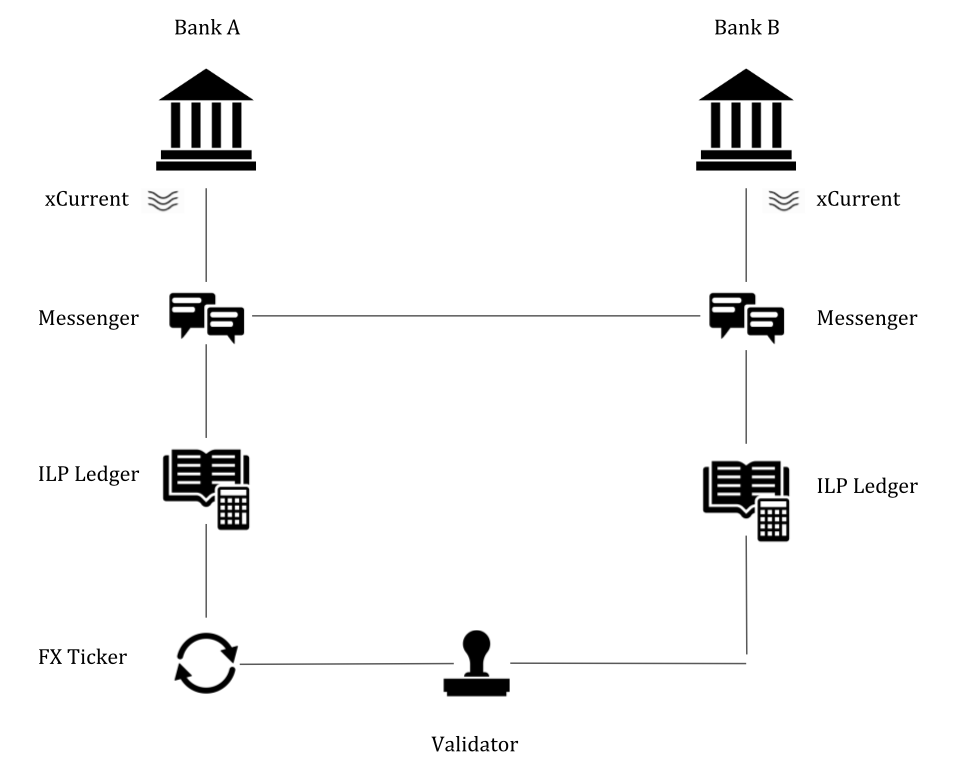
This is where xCurrent software plays an important role. Banks can provide each other with liquidity using xCurrent's ILP ledger and FX ticker components. They can set an exchange rate through and leave xCurrent to manage the heavy lifting of currency exchange and the settlement process.

Before making the transaction, banks will interact with each other through xCurrent's messenger component. They verify their customer's identity and carry out Anti Money Laundering checks. Later, company X's bank will query to find out the processing fee and the exchange cost. They find out the exchange rate of EUR/USD is at 1.5 and the processing fee would be $10. Company X also needs to bear the processing cost of their bank, which is $10. 

Hence, the total amount would be $770 ((500 * 1.5) + 10 + 10). Company X agrees to the amount and the transaction is initiated. The sender bank takes the processing fee of $10. The amount that needs to be transferred is $760.  

These funds are put on hold until the beneficiaries bank shows proof that it has put the same funds on hold to credit company Y. 

Now both banks exchange cryptographic proofs that the amount is on hold. Ripple validators receive this proof and verify it. Once the validator confirms the proof, it directs the ILP ledgers of both banks to release and transfer funds. Hence, an amount of $770 would be debited from company X's account. Simultaneously, company Y's account is credited with 500. This process is atomic, either both of these transfer happens or nothing happens. Hence, the chances of settlement failure are minimized.  

The following diagram describes how different components of xCurrent integrate with the traditional banking system to enable cross-border payments: