Table of Contents for
Learning Web Design, 5th Edition
Version ebook / Retour

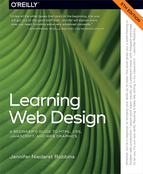
Cover image for bash Cookbook, 2nd Edition Learning Web Design, 5th Edition by Jennifer Robbins Published by O'Reilly Media, Inc., 2018
  1. cover
  2. Learning Web Design, Fifth Edition
  3. lwd5_title_copy
  4. lwd5_title_copy-1
  5. lwd5_contents
  6. Foreword
  7. Preface
  8. Part I. Getting Started
  9. 2. How the Web Works
  10. 3. Some Big Concepts You Need to Know
  11. Part II. HTML for STRUCTURE
  12. 5. Marking Up Text
  13. 6. Adding Links
  14. 7. Adding Images
  15. 8. Table Markup
  16. 9. Forms
  17. 10. Embedded Media
  18. Part III. CSS for Presentation
  19. 12. Formatting Text
  20. 13. Colors and Backgrounds
  21. 14. Thinking Inside the Box
  22. 15. Floating and Positioning
  23. 16. CSS Layout with Flexbox and Grid
  24. 17. Responsive Web Design
  25. 18. Transitions, Transforms, and Animation
  26. 19. More CSS Techniques
  27. 20. Modern Web Development Tools
  28. Part IV. JavaScript for Behavior
  29. 22. Using JavaScript
  30. Part V. Web Images
  31. 24. Image Asset Production
  32. 25. SVG
  33. Part VI. Appendices
  34. B. HTML5 Global Attributes
  35. C. CSS Selectors, Levels 3 and 4
  36. D. From HTML+ to HTML5

Contents

  1. Foreword
  2. Preface
  3. Part I. Getting Started
    1. 1. Getting Started in Web Design
      1. Where Do I Start?
      2. It Takes a Village (Website Creation Roles)
      3. Gearing Up for Web Design
      4. What You’ve Learned
      5. Test Yourself
    2. 2. How the Web Works
      1. The Internet Versus the Web
      2. Serving Up Your Information
      3. A Word About Browsers
      4. Web Page Addresses (URLs)
      5. The Anatomy of a Web Page
      6. Putting It All Together
      7. Test Yourself
    3. 3. Some Big Concepts You Need to Know
      1. A Multitude of Devices
      2. Sticking with the Standards
      3. Progressive Enhancement
      4. Responsive Web Design
      5. One Web for All (Accessibility)
      6. The Need for Speed (Site Performance)
      7. Test Yourself
  4. Part II. HTML for STRUCTURE
    1. 4. Creating a Simple Page
      1. A Web Page, Step-By-Step
      2. Launch a Text Editor
      3. Step 1: Start with Content
      4. Step 2: Give the HTML Document Structure
      5. Step 3: Identify Text Elements
      6. Step 4: Add an Image
      7. Step 5: Change the Look with a Style Sheet
      8. When Good Pages Go Bad
      9. Validating Your Documents
      10. Test Yourself
      11. Element Review: HTML Document Setup
    2. 5. Marking Up Text
      1. Paragraphs
      2. Headings
      3. Thematic Breaks (Horizontal Rule)
      4. Lists
      5. More Content Elements
      6. Organizing Page Content
      7. The Inline Element Roundup
      8. Generic Elements (div and span)
      9. Improving Accessibility with ARIA
      10. Character Escapes
      11. Putting It All Together
      12. Test Yourself
      13. Element Review: Text Elements
    3. 6. Adding Links
      1. The href Attribute
      2. Linking to Pages on the Web
      3. Linking Within Your Own Site
      4. Targeting a New Browser Window
      5. Mail Links
      6. Telephone Links
      7. Test Yourself
      8. Element Review: Links
    4. 7. Adding Images
      1. First, a Word on Image Formats
      2. The img Element
      3. Adding SVG Images
      4. Responsive Image Markup
      5. Whew! We’re Finished
      6. Test Yourself
      7. Element Review: Images
    5. 8. Table Markup
      1. How to Use Tables
      2. Minimal Table Structure
      3. Table Headers
      4. Spanning Cells
      5. Table Accessibility
      6. Row and Column Groups
      7. Wrapping Up Tables
      8. Test Yourself
      9. Element Review: Tables
    6. 9. Forms
      1. How Forms Work
      2. The form Element
      3. Variables and Content
      4. The Great Form Control Roundup
      5. Form Accessibility Features
      6. Form Layout and Design
      7. Test Yourself
      8. Element Review: Forms
    7. 10. Embedded Media
      1. Window-In-A-Window (iframe)
      2. Multipurpose Embedder (object)
      3. Video and Audio
      4. Canvas
      5. Test Yourself
      6. Element Review: Embedded Media
  5. Part III. CSS for Presentation
    1. 11. Introducing Cascading Style Sheets
      1. The Benefits of CSS
      2. How Style Sheets Work
      3. The Big Concepts
      4. CSS Units of Measurement
      5. Developer Tools Right in Your Browser
      6. Moving Forward with CSS
      7. Test Yourself
    2. 12. Formatting Text
      1. Basic Font Properties
      2. Advanced Typography with CSS3
      3. Changing Text Color
      4. A Few More Selector Types
      5. Text Line Adjustments
      6. Underlines and Other “Decorations”
      7. Changing Capitalization
      8. Spaced Out
      9. Text Shadow
      10. Changing List Bullets and Numbers
      11. Test Yourself
      12. CSS Review: Font and Text Properties
    3. 13. Colors and Backgrounds
      1. Specifying Color Values
      2. Foreground Color
      3. Background Color
      4. Clipping the Background
      5. Playing with Opacity
      6. Pseudo-Class Selectors
      7. Pseudo-Element Selectors
      8. Attribute Selectors
      9. Background Images
      10. The Shorthand background Property
      11. Like a Rainbow (Gradients)
      12. Finally, External Style Sheets
      13. Wrapping It Up
      14. Test Yourself
      15. CSS Review: Color and Background Properties
    4. 14. Thinking Inside the Box
      1. The Element Box
      2. Specifying Box Dimensions
      3. Padding
      4. Borders
      5. Margins
      6. Assigning Display Types
      7. Box Drop Shadows
      8. Test Yourself
      9. CSS Review: Box Properties
    5. 15. Floating and Positioning
      1. Normal Flow
      2. Floating
      3. Fancy Text Wrap with CSS Shapes
      4. Positioning Basics
      5. Relative Positioning
      6. Absolute Positioning
      7. Fixed Positioning
      8. Test Yourself
      9. CSS Review: Floating and Positioning Properties
    6. 16. CSS Layout with Flexbox and Grid
      1. Flexible Boxes with CSS Flexbox
      2. CSS Grid Layout
      3. Test Yourself
      4. CSS Review: Layout Properties
    7. 17. Responsive Web Design
      1. Why RWD?
      2. The Responsive Recipe
      3. Choosing Breakpoints
      4. Designing Responsively
      5. A Few Words About Testing
      6. More RWD Resources
      7. Test Yourself
    8. 18. Transitions, Transforms, and Animation
      1. Ease-y Does It (CSS Transitions)
      2. CSS Transforms
      3. Keyframe Animation
      4. Wrapping Up
      5. Test Yourself
      6. CSS Review: Transitions, Transforms, and Animation
    9. 19. More CSS Techniques
      1. Styling Forms
      2. Styling Tables
      3. A Clean Slate (Reset and Normalize.css)
      4. Image Replacement Techniques
      5. CSS Sprites
      6. CSS Feature Detection
      7. Wrapping Up Style Sheets
      8. Test Yourself
      9. CSS Review: Table Properties
    10. 20. Modern Web Development Tools
      1. Getting Cozy with the Command Line
      2. CSS Power Tools (Processors)
      3. Build Tools (Grunt and Gulp)
      4. Version Control with Git and GitHub
      5. Conclusion
      6. Test Yourself
  6. Part IV. JavaScript for Behavior
    1. 21. Introduction to JavaScript
      1. What Is JavaScript?
      2. Adding JavaScript to a Page
      3. The Anatomy of a Script
      4. The Browser Object
      5. Events
      6. Putting It All Together
      7. Learning More About JavaScript
      8. Test Yourself
    2. 22. Using JavaScript
      1. Meet the DOM
      2. Polyfills
      3. JavaScript Libraries
      4. Big Finish
      5. Test Yourself
  7. Part V. Web Images
    1. 23. Web Image Basics
      1. Image Sources
      2. Meet the Formats
      3. Image Size and Resolution
      4. Image Asset Strategy
      5. Favicons
      6. Summing Up Images
      7. Test Yourself
    2. 24. Image Asset Production
      1. Saving Images in Web Formats
      2. Working with Transparency
      3. Responsive Image Production Tips
      4. Image Optimization
      5. Test Yourself
    3. 25. SVG
      1. Drawing with XML
      2. Features of SVG as XML
      3. SVG Tools
      4. SVG Production Tips
      5. Responsive SVGs
      6. Further SVG Exploration
      7. Test Yourself
      8. And...We’re Done!
  8. Part VI. Appendices
    1. A. Answers
    2. B. HTML5 Global Attributes
    3. C. CSS Selectors, Levels 3 and 4
    4. D. From HTML+ to HTML5
      1. An Abbreviated History of HTML
      2. HTML5: More Than Markup
      3. Where We Go From Here

Landmarks

  1. Cover
  2. Table of Contents
Back to top