Table of Contents for
Data Analysis with Open Source Tools
 Data Analysis with Open Source Tools
Published by
O'Reilly Media, Inc., 2010
Data Analysis with Open Source Tools
Published by
O'Reilly Media, Inc., 2010
- Cover
- Data Analysis with Open Source Tools
- O'Reilly Strata Conference
- Data Analysis with Open Source Tools
- Dedication
- A Note Regarding Supplemental Files
- Preface
- 1. Introduction
- I. Graphics: Looking at Data
- 2. A Single Variable: Shape and Distribution
- 3. Two Variables: Establishing Relationships
- 4. Time As a Variable: Time-Series Analysis
- 5. More Than Two Variables: Graphical Multivariate Analysis
- 6. Intermezzo: A Data Analysis Session
- II. Analytics: Modeling Data
- 7. Guesstimation and the Back of the Envelope
- 8. Models from Scaling Arguments
- 9. Arguments from Probability Models
- 10. What You Really Need to Know About Classical Statistics
- 11. Intermezzo: Mythbusting—Bigfoot, Least Squares, and All That
- III. Computation: Mining Data
- 12. Simulations
- 13. Finding Clusters
- 14. Seeing the Forest for the Trees: Finding Important Attributes
- 15. Intermezzo: When More Is Different
- IV. Applications: Using Data
- 16. Reporting, Business Intelligence, and Dashboards
- 17. Financial Calculations and Modeling
- 18. Predictive Analytics
- 19. Epilogue: Facts Are Not Reality
- A. Programming Environments for Scientific Computation and Data Analysis
- B. Results from Calculus
- C. Working with Data
- D. About the Author
- Index
- About the Author
- Colophon
- Copyright
Colophon
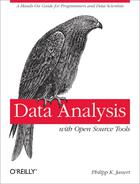
The animal on the cover of Data Analysis with Open Source Tools is a common kite, most likely a member of the genus Milvus. Kites are medium-size raptors with long wings and forked tails. They are noted for their elegant, soaring flight. They are also called “gledes” (for their gliding motion) and, like the flying toys, they appear to ride effortlessly on air currents.
The genus Milvus is a group of Old World kites, including three or four species and numerous subspecies. These kites are opportunistic feeders that hunt small animals, such as birds, fish, rodents, and earthworms, and also eat carrion, including sheep and cow carcasses. They have been observed to steal prey from other birds. They may live 25 to 30 years in the wild.
The genus dates to prehistoric times; an Israeli Milvus pygmaeus specimen is thought to be between 1.8 million and 780,000 years old. Biblical references to kites probably refer to birds of this genus. In Coriolanus, Shakespeare calls Rome “the city of kites and crows,” commenting on the birds’ prevalence in urban areas.
The most widespread member of the genus is the black kite (Milvus migrans), found in Europe, Asia, Africa, and Australia. These kites are very common in many parts of their habitat and are well adapted to city life. Attracted by smoke, they sometimes hunt by capturing small animals fleeing from fires.
The other notable member of Milvus is the red kite (Milvus milvus), which is slightly larger than the black kite and is distinguished by a rufous body and tail. Red kites are found only in Europe. They were very common in Britain until 1800, but the population was devastated by poisoning and habitat loss, and by 1930, fewer than 20 birds remained. Since then, kites have made a comeback in Wales and have been reintroduced elsewhere in Britain.
The cover image is from Cassell’s Natural History, Volume III. The cover font is Adobe ITC Garamond; the text font is Adobe’s Meridien-Roman; the heading font is Adobe Myriad Condensed; and the code font is LucasFont’s TheSansMonoCondensed.