Table of Contents for
Building PHP Applications with Symfony™, CakePHP, and Zend® Framework
 Building PHP Applications with Symfony™, CakePHP, and Zend® Framework
Published by
Wrox, 2011
Building PHP Applications with Symfony™, CakePHP, and Zend® Framework
Published by
Wrox, 2011
- Copyright
- Credits
- ABOUT THE AUTHORS
- ACKNOWLEDGMENTS
- Introduction
- 1. Introducing Symfony, CakePHP, and Zend Framework
- 2. Getting Started
- 3. Working with Databases
- 4. Your First Application in the Three Frameworks
- 5. Forms
- 6. Mailing
- 7. Searching
- 8. Security
- 9. Templates
- 10. AJAX
- 11. Making Plug-ins
- 12. Web Services
- 13. Back End
- 14. Internationalization
- 15. Testing
- 16. User Management
- 17. Performance
- 18. Summary
- A. Web Resources
- B. CodeIgniter, Lithium, and Agavi with Code Examples
- GLOSSARY OF ACRONYMS AND TECHNICAL TERMS
The more you know, the more you realize you know nothing.
WHAT'S IN THIS CHAPTER?
Pros and cons of the three frameworks.
Table of features.
Final comparison.
First of all, we want to say thank you for reading such a thick book and staying with us for so long! We hope you found it helpful and informative.
This is the part many of you have been waiting for: the final comparison of the three frameworks. It goes far beyond listing their unique features; we will mercilessly point out all their advantages and disadvantages here.
We want to start with the big picture: this section presents lists of features for each framework, both good and bad. We've listed only unique traits; if all frameworks perform similarly in an area, that area is not included here. These lists are far from complete and exhaustive, and of course they are affected by our personal experiences, including those we gained while writing this book.
Symfony is a great tool for real professionals. It is full-featured and strictly follows all good coding practices.
Here is our list of Symfony's advantages:
Doctrine object-relational mapping (ORM)–integrated; easy to switch to Propel in a few steps (Chapter 3).
Model classes can be generated based on schema or on database tables using command-line interface (CLI) tools. This accelerates the development process (Chapter 4).
A lot of plug-ins are available in one place, most of which are well documented, divided into categories. (Used in many chapters; making a plug-in is covered in Chapter 11)
Provides interesting plug-ins that introduce additional widgets and validators, extending form-building capabilities (Chapter 5).
Form elements encapsulation allows for easy creation of your own widgets and validators (Chapter 5).
Provides plug-ins for Sphinx and Lucene search engines (Chapter 7).
CLI tools dedicated for testing (Chapter 15).
PHPUnitplug-in available for Symfony 1.x;PHPUnitis integrated with Symfony 2.0 (Chapter 15).Symfony 2.0 is integrated with the Twig template engine that introduces its own template language and keeps high performance (Chapter 9).
Built-in mechanism that protects against cross-site request forgery (CSRF) attacks (Chapter 8).
Forms are filtered by the framework engine (Chapter 8).
Some good content management systems (CMSs) are available; many others are available also as plug-ins (Chapter 13).
Very good debugging tools (debugging in general — Chapter 15).
Version 2.0 upcoming as the first new version among the featured frameworks.
Here is our list of Symfony's disadvantages:
The default testing framework of Symfony 1.x is the Lime framework, which leaves much to be desired (Chapter 15).
Some plug-ins are dedicated for old versions of Symfony or are not documented at all, which greatly degrades their quality.
Symfony's documentation can be described only as good, while there are many frameworks for which it is excellent.
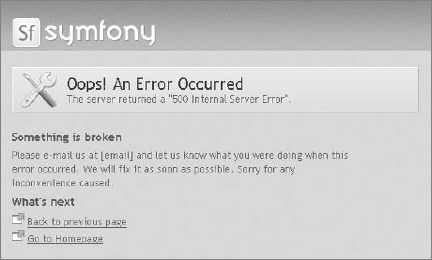
Symfony is great when you finally get to know it. But until you learn how to use it properly, the "500 Internal Server Error" screen (Figure 17-1) will be a common sight for you. Symfony has a great debugger tool with detailed log files, but you have to know how to use it, too. This can be very annoying for beginners.
CakePHP combines very rapid development and friendliness. It is very intuitive and provides a great tutorial base, which makes using it a real pleasure and allows fast progress even for beginners.
The advantages of CakePHP include the following:
CakePHP offers its own ORM solution, and it is good enough (Chapter 3).
AppModelprovides a few basic methods to realize create, read, update, and delete (CRUD) operations, soAppModelis a generic model class. It allows you to very easily create your methods in models or extend inherited ones (Chapter 4).Great integration of models with forms without much coding (Chapter 4).
Although there is no official support, there are a few community components and tutorials for Sphinx, Apache, Lucene, and Google Search integration (Chapter 7).
SimpleTest testing suite integrated (Chapter 15).
Web interface for test execution — an awesome feature (Chapter 15)!
CLI tools for test execution (Chapter 15).
Delivers the
Sanitizeclass that allows you to filter or clean user input (Chapter 8).Security salt defined in a config file, which helps to secure your application against CSRF attacks (Chapter 8).
A lot of tutorials and code snippets in the Bakery — the official CakePHP resource site at
http://bakery.cakephp.org/.Some nice CMS solutions — both simple and advanced (Chapter 13).
The disadvantages of CakePHP include the following:
Controller and model are connected very tightly. This is hard to hack when you want a custom behavior. Also, every controller has a
$usesfield enabled by default, which means it expects to use a model.Does not support Lucene or Sphinx search engines out of the box (Chapter 7).
No Selenium test suite support by default (Chapter 15).
Debug level for production is set to zero by default — error hiding is not really a good practice.
Sticks to PHP4 support for no apparent reason. Hopefully, CakePHP 2.0 will abandon it.
Slow performance (Chapter 17).
Some people argue that ZF is not a framework at all, but a library of useful classes. That makes some sense as ZF is loosely coupled and not really into the ORM thing. It means that it is flexible and easily extensible, but also quite "neutral" (the lists of advantages and disadvantages are both much shorter compared with other frameworks).
Encapsulates form elements as decorators (Chapter 5).
Supports Apache Lucene out of the box (Chapter 7).
PHPUnitis integrated with ZF, too (Chapter 15).Provides a few functions and filters to escape user input (Chapter 8).
Supports plug-ins through
Zend_Plugin(Chapter 11).A few CMSs available, all trying to keep an enterprise impression (Chapter 13).
Great high-quality documentation.
Good performance speed (Chapter 17).
DbTableis not a real ORM. You have to write three different files full of code to use one model (Chapters 3, 4, and 17).There is no plug-in repository for Zend Framework.
It's heavy: 25MB and thousands of files (Chapter 2).
The following table summarizes and compares all the features of the three frameworks that you have observed while reading this book.
SYMFONY | CAKEPHP | ZEND FRAMEWORK | |
|---|---|---|---|
SCAFFOLDING | |||
Dedicated IDE | Netbeans | None now; will be supported by Netbeans 7 | Netbeans, Zend Studio (based on Eclipse) |
Code generation | Great CLI tools | A few CLI tools | Poor CLI tools |
VIEW | |||
Helpers | Core helpers available, easy to use | There are core helpers for most common tasks, easy to use | Core helpers available, easy to use |
Template engine | Twig for Symfony2 | A bunch of useful helpers only | Zend_view |
Additional template engines | Smarty3 available as plug-in | Smarty and Dwoo can be integrated | Smarty and Dwoo can be integrated |
COMMUNITY | |||
Plug-ins | Lots and all in one place | Some, but scattered | None |
Documentation | Good documentation; some official books published | Excellent, well organized, all in one place, lots of examples | Huge, well organized, lots of examples |
Video tutorials | Only a few on YouTube | Nice screencasts, a few paid videos, too | A good number of well-done videos |
Localization | Helper functions, XML translation files | POT files | |
Internationalization | Doctrine i18n support | CLI tools, schema | |
Database | Supported by Doctrine, available out of the box | Supported, CLI tools available | Not available out of the box; possible to implement |
ORM | |||
Default ORM | Doctrine | Cake's ORM | Zend's DbTable |
ORM support | Very easy to switch to Propel | Possible switch to Doctrine or Propel | Possible switch to Doctrine or Propel |
MAILING | |||
Default mailer | swiftMailer | Cake Mail component | Zend_Mail |
TESTING | |||
Testing framework | PHPUnit | SimpleTest + web testing | PHPUnit |
Selenium integration support | Through PHPUnit | Add-on needed | Through PHPUnit |
SEARCHING | |||
Default search engine | Doctrine Search; Lucene and Sphinx as plug-ins | Doesn't support natively | Built-in Apache Lucene support |
And the winner is you! Now you know all three frameworks with their features and weaknesses. We hope that you have paid attention to code examples in this book, and perhaps even executed most of them. So you should be familiar with all frameworks and know which one best fulfills your needs.
Well, if you really need our guidance, we can help you make the decision. Just read the following summary and decide which description fits you best. These are partially our personal opinions, so you may not agree with them, of course.
Symfony is a good all-purpose framework. It is very configurable, has great features, and provides tons of plug-ins, mostly useful. With the release of Symfony 2.0, we have a feeling that this framework is generally a half step ahead of the others, but this situation may change soon. If we wanted to point out a decisive winner, we would have said it explicitly.
The bad thing about Symfony is its very steep learning curve. When you finally get to know it, it is great, but many people spend significant time trying to learn it, only to finally switch to another framework, and they are successful at once. There are more intuitive and better-documented frameworks, which in many cases is the decisive factor in rapid web development. We have observed, however, that many people who like Linux operating systems feel good with Symfony and enjoy configuring it to their liking.
CakePHP is also full-featured, but in contrast to Symfony, it is nearly configuration-less and much simpler to use. Simpler is usually faster, and this is the main goal of web frameworks: to speed up the development process! That's why if you are new to PHP frameworks or web development in general, CakePHP may be a much better choice for you. It is also great if you want to make a relatively simple website quickly — baking with Cake is lightning fast!
The convention-over-configuration approach has its price, however. You must know this convention and follow it in your code, which makes the learning curve still rather steep and decreases the framework's flexibility. To make things worse, CakePHP cannot use object-oriented features of PHP 5.0 due to its support for PHP 4.0. This is good when your PHP hosting or PHP skills are five years obsolete and not upgradeable, but in other cases it is a drawback.
Zend Framework generally needs more coding than the previous two solutions to achieve the same effects. On the other hand, Zend Framework doesn't impose its own conventions and it doesn't need much configuration. We have also noticed that many Java programmers like ZF with its library-like approach. It is the preferred solution in these two situations:
When you don't need a full framework, but rather a library of components to support your work without taking control over it
If you want to buy the full Zend suite
ZF is very popular among corporate users, because with Zend Studio support it is a really great framework and we would love to see it open-sourced (or at least free for use) this way. However, without Zend Studio support ZF lacks several important features, the greatest drawback being its lack of an ORM mapper. Of course, you can install Doctrine quite easily, but it's not supported by the framework itself.