Table of Contents for
Hands-On Cryptography with Python

Version ebook / Retour

Cover image for bash Cookbook, 2nd Edition Hands-On Cryptography with Python by Samuel Bowne Published by Packt Publishing, 2018
  1. Hands-On Cryptography with Python
  2. Title Page
  3. Copyright and Credits
  4. Hands-On Cryptography with Python
  5. Packt Upsell
  6. Why subscribe?
  7. PacktPub.com
  8. Contributor
  9. About the author
  10. Packt is searching for authors like you
  11. Table of Contents
  12. Preface
  13. Who this book is for
  14. What this book covers
  15. To get the most out of this book
  16. Download the example code files
  17. Download the color images
  18. Conventions used
  19. Get in touch
  20. Reviews
  21. Obfuscation
  22. About cryptography
  23. Installing and setting up Python
  24. Using Python on Mac or Linux
  25. Installing Python on Windows
  26. Caesar cipher and ROT13
  27. Implementing the Caesar cipher in Python
  28. ROT13
  29. base64 encoding
  30. ASCII data
  31. Binary data
  32. XOR
  33. Challenge 1 – the Caesar cipher
  34. Challenge 2 – base64
  35. Challenge 3 – XOR
  36. Summary
  37. Hashing
  38. MD5 and SHA hashes
  39. What are hashes?
  40. Windows password hashes
  41. Getting hashes with Cain
  42. MD4 and Unicode
  43. Cracking hashes with Google
  44. Cracking hashes with wordlists
  45. Linux password hashes
  46. Challenge 1 – cracking Windows hashes
  47. Challenge 2 – cracking many-round hashes
  48. Challenge 3 – cracking Linux hashes
  49. Summary
  50. Strong Encryption
  51. Strong encryption with AES
  52. ECB and CBC modes
  53. ECB
  54. CBC
  55. Padding oracle attack
  56. Strong encryption with RSA
  57. Public key encryption
  58. RSA algorithm
  59. Implementation in Python
  60. Challenge – cracking RSA with similar factors
  61. Large integers in Python
  62. What's next?
  63. Cryptography within IoT
  64. ZigBee cryptographic keys
  65. Complexity of ZigBee key management
  66. Bluetooth – LE
  67. Summary
  68. Other Books You May Enjoy
  69. Leave a review - let other readers know what you think

Challenge 1 – cracking Windows hashes

After a review of Windows hashing and an example of 1-digit hashing, we will give you two challenges—one with a 2-digit password and one with a 7-digit password. Here's how Windows hashes look in Python:

The algorithm uses hashlib to do an MD4 for the hash of the password, but before you do that, encode in Unicode which is utf-16le, and then calculate the hexdigest of the results to get the long number, The number starts with 464, in this case, which is a Windows password hash.

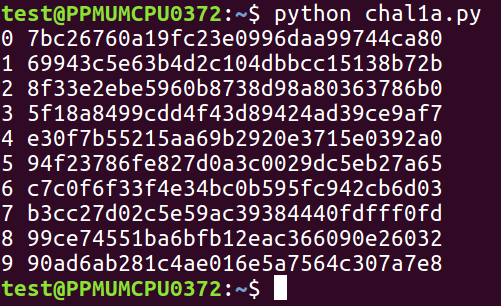
Thus, you can write a program that will try all the characters in this string, which will consist of 10 digits, and then calculate the hash for each one of them. You will be left with a simple dictionary with 10 values:
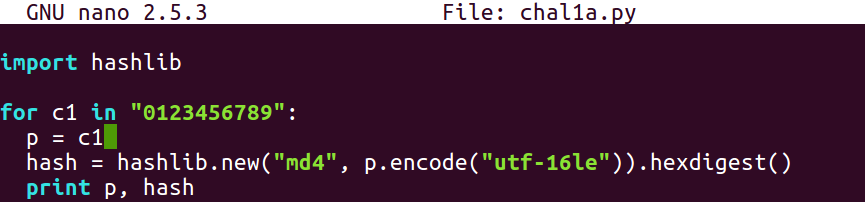
You can crack this 1-digit hash using a 1-digit password as follows:
So, here's a challenge. The password is a 2-digit one between 00 and 99, and this is the hash:

So, you have to make a loop that tries 100 possible values.

The next one is a 7-digit password, and this is the hash:
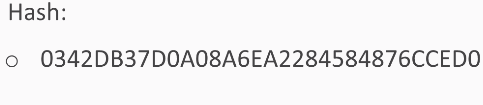
So, you'll have to try 10 million values. That will only take a few seconds, and that's why Windows password hashes are so very weak—you can try many millions of them per second.