
When we talk about using cryptography within IoT, we are talking about using cryptography across many layers of the communication stack. If we look at the OSI model, we can see that crypto is used at Layer 2 and up with linking operating at level 2, networking operating at layer 3, and transporting operating at layer 4:
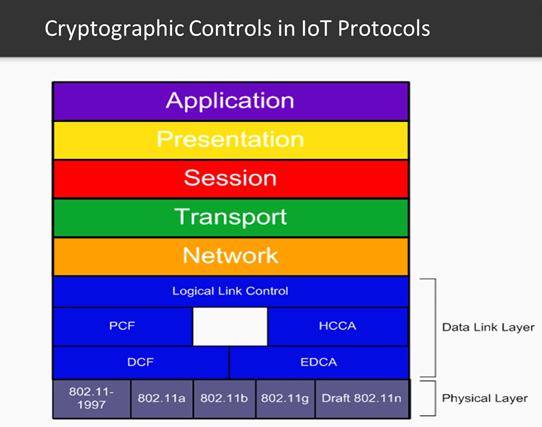
At the Application Layer, Cryptography is also used to protect communication through both authentication and encryption. Before we begin our description about specific cryptographic approaches for IOT protocols, let’s first talk about the ready availability of exploitation tools for existing wireless protocols. As IOT matures, keep in mind that there are many tools available to exploit IOT wireless communication protocols and these tools will continue to rapidly keep up with new technologies introduced to support the IOT.
For example, looking at Wi-Fi 802.11, which was introduced in 1989, the AirCrack tool was introduced in 2004 and to this day is still a popular and well-supported tool. There are also many tools available to exploit Bluetooth communication and cellular communication.
Besides this, keys that drive crypto must be securely managed both at the device (module) level as well as throughout an enterprise. Let’s explore some of them.