Table of Contents for
Learning Linux Shell Scripting
 Learning Linux Shell Scripting
Published by
Packt Publishing, 2015
Learning Linux Shell Scripting
Published by
Packt Publishing, 2015
- Cover
- Table of Contents
- Learning Linux Shell Scripting
- Learning Linux Shell Scripting
- Credits
- About the Author
- Acknowledgments
- About the Reviewers
- www.PacktPub.com
- Preface
- What you need for this book
- Who this book is for
- Conventions
- Reader feedback
- Customer support
- 1. Getting Started and Working with Shell Scripting
- Tasks done by shell
- Working in shell
- Learning basic Linux commands
- Our first script – Hello World
- Compiler and interpreter – difference in process
- When not to use scripts
- Various directories
- Working more effectively with shell – basic commands
- Working with permissions
- Summary
- 2. Drilling Deep into Process Management, Job Control, and Automation
- Monitoring processes using ps
- Process management
- Process monitoring tools – top, iostat, and vmstat
- Understanding "at"
- Understanding "crontab"
- Summary
- 3. Using Text Processing and Filters in Your Scripts
- IO redirection
- Pattern matching with the vi editor
- Pattern searching using grep
- Summary
- 4. Working with Commands
- Command substitution
- Command separators
- Logical operators
- Pipes
- Summary
- 5. Exploring Expressions and Variables
- Working with environment variables
- Working with read-only variables
- Working with command line arguments (special variables, set and shift, getopt)
- Understanding getopts
- Understanding default parameters
- Working with arrays
- Summary
- 6. Neat Tricks with Shell Scripting
- The here document and the << operator
- The here string and the <<< operator
- File handling
- Debugging
- Summary
- 7. Performing Arithmetic Operations in Shell Scripts
- Using the let command for arithmetic
- Using the expr command for arithmetic
- Binary, octal, and hex arithmetic operations
- A floating-point arithmetic
- Summary
- 8. Automating Decision Making in Scripts
- Understanding the test command
- Conditional constructs – if else
- Switching case
- Implementing simple menus with select
- Looping with the for command
- Exiting from the current loop iteration with the continue command
- Exiting from a loop with a break
- Working with the do while loop
- Using until
- Piping the output of a loop to a Linux command
- Running loops in the background
- The IFS and loops
- Summary
- 9. Working with Functions
- Passing arguments or parameters to functions
- Sharing the data by many functions
- Declaring local variables in functions
- Returning information from functions
- Running functions in the background
- Creating a library of functions
- Summary
- 10. Using Advanced Functionality in Scripts
- Using the trap command
- Ignoring signals
- Using traps in function
- Running scripts or processes even if the user logs out
- Creating dialog boxes with the dialog utility
- Summary
- 11. System Startup and Customizing a Linux System
- User initialization scripts
- Summary
- 12. Pattern Matching and Regular Expressions with sed and awk
- sed – noninteractive stream editor
- Using awk
- Summary
- Index
Command line arguments are required for the following reasons:
- They inform the utility or command as to which file or group of files to process (reading/writing of files)
- Command line arguments tell the command/utility which option to use
Check the following command line:
student@ubuntu:~$ my_program arg1 arg2 arg3
If my_command is a bash Shell script, then we can access every command line positional parameters inside the script as follows:
$0 would contain "my_program"    # Command
$1 would contain "arg1"      # First parameter
$2 would contain "arg2"      # Second parameter
$3 would contain "arg3"      # Third parameter
The following is the summary of positional parameters:
|
$0 |
Shell script name or command |
|
$1–$9 |
Positional parameters 1–9 |
|
${10} |
Positional parameter 10 |
|
$# |
Total number of parameters |
|
$* |
Evaluates to all the positional parameters |
|
$@ |
Same as $*, except when double quoted |
|
"$*" |
Displays all parameters as "$1 $2 $3", and so on |
|
"$@" |
Displays all parameters as "$1" "$2" "$3", and so on |
Let's create a script param.sh as follows:
#!/bin/bash
echo "Total number of parameters are = $#"
echo "Script name = $0"
echo "First Parameter is $1"
echo "Second Parameter is $2"
echo "Third Parameter is $3"
echo "Fourth Parameter is $4"
echo "Fifth Parameter is $5"
echo "All parameters are = $*"
Then as usual, give execute permission to script and then execute it:
./parameter.sh London Washington Delhi Dhaka Paris
Output:
Total number of parameters are = 5
Command is = ./parameter.sh
First Parameter is London
Second Parameter is Washington
Third Parameter is Delhi
Fourth Parameter is Dhaka
Fifth Parameter is Paris
All parameters are = London Washington Delhi Dhaka Paris
Many times we may not pass arguments on the command line, but we may need to set parameters internally inside the script.
We can declare parameters by the set command as follows:
$ set USA Canada UK France
$ echo $1
USA
$ echo $2
Canada
$ echo $3
UK
$ echo $4
France
We can use this inside the set_01.sh script as follows:
#!/bin/bash
set USA Canada UK France
echo $1
echo $2
echo $3
echo $4
Run the script as:
$ ./set.sh
Output:
USA
Canada
UK
France
|
Table declare Options | |
|---|---|
|
Option |
Meaning |
|
–a | |
|
–f | |
|
–F | |
|
–i | |
|
–r | |
|
–x | |
We give commands as follows:
set One Two Three Four Five
echo $0      # This will show command
echo $1       # This will show first parameter
echo $2
echo $*    # This will list all parameters
echo $#    # This will list total number of parameters
echo ${10} ${11}  # Use this syntax for parameters for 10th and
         # 11th parameters
Let us write script set_02.sh as follows:
#!/bin/bash
echo The date is $(date)
set $(date)
echo The month is $2
exit 0
Output:
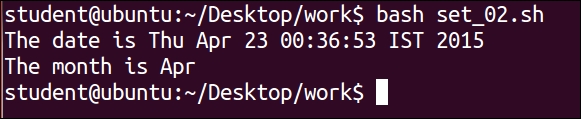
In the script $(date), the command will execute and the output of that command will be used as $1, $2, $3 and so on. We have used $2 to extract the month from the output.
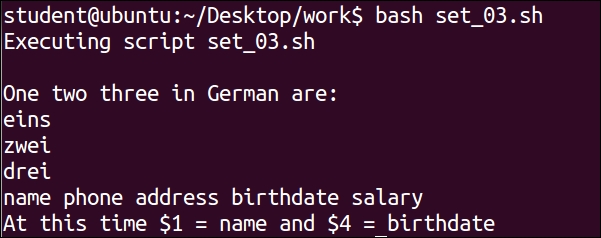
Let's write script set_03.sh as follows:
#!/bin/bash

echo "Executing script $0"
echo $1 $2 $3

set eins zwei drei
echo "One two three in German are:"
echo "$1"
echo  "$2"
echo  "$3"

textline="name phone address birthdate salary"
set $textline
echo  "$*"
echo 'At this time $1 = ' $1 'and $4 = ' $4
Output:
Using shift, we can change the parameter to which $1 and $2 are pointing to the next variable.
Create a script shift_01.sh as follows:
#!/bin/bash
echo "All Arguments Passed are as follow : "
echo $*
echo "Shift By one Position :"
shift
echo "Value of Positional Parameter $ 1 after shift :"
echo $1
echo "Shift by Two Positions :"
shift 2
echo "Value of Positional Parameter $ 1 After two Shifts :"
echo $1
Execute the command as follows:
$ chmod +x shift_01.sh
$ ./shift_01.sh One Two Three Four
Output:
student@ubuntu$ ./shift_01.sh One Two Three Four
All arguments passed are as follows:
One Two Three Four
Shift by one position.
Here, the value of the positional parameter $1 after shift is:
Two
Shift by two positions.
The value of the positional parameter $1 after two shifts:
Four
We observed that initially $1 was One. After shift, $1 will be pointing to Two. Once shift is done, the value in position 1 is always destroyed and is inaccessible.
Create a shift_02.sh script as follows:
#!/bin/bash

echo '$#: ' $#
echo '$@: ' $@
echo '$*: ' $*
echo
echo '$1 $2 $9 $10 are: ' $1 $2 $9 $10
echo

shift
echo '$#: ' $#
echo '$@: ' $@
echo '$*: ' $*
echo
echo '$1 $2 $9 are: ' $1 $2 $9

shift 2
echo '$#: ' $#
echo '$@: ' $@
echo '$*: ' $*
echo
echo '$1 $2 $9 are: ' $1 $2 $9

echo '${10}: ' ${10}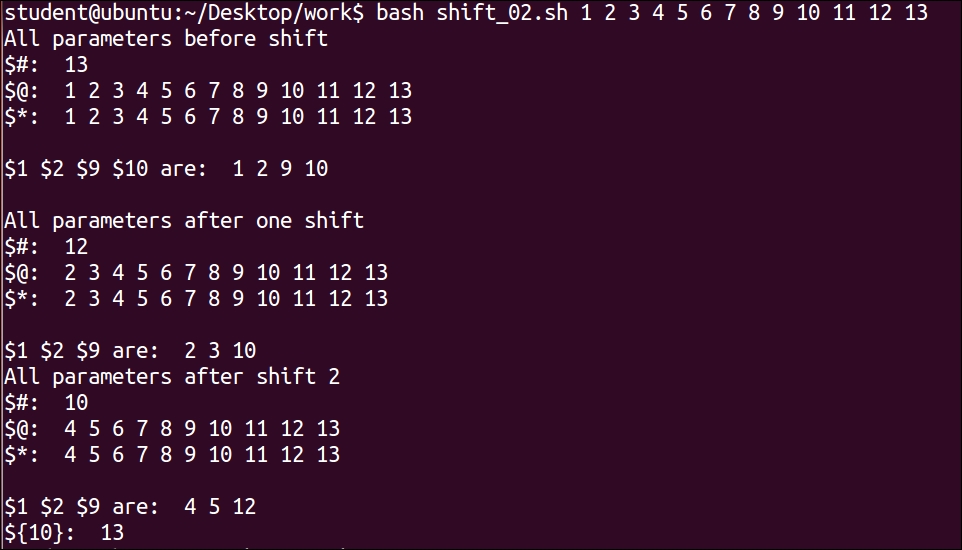
In this script execution, the following output shows:
- Initially,
$1to$13were numerical values 1 to 13, respectively. - When we called the command shift, then
$1shifted to number2and accordingly all $numbers are shifted. - When we called the command shift
2, then$1shifted to number 4 and accordingly all $numbers are shifted.
In certain situations, we may need to reset original positional parameters.
Let's try the following:
set Alan John Dennis
This will reset the positional parameters.
Now $1 is Alan, $2 is John, and $3 is Dennis.
Inside the scripts, we can save positional parameters in a variable as follows:
oldargs=$*
Then, we can set new positional parameters.
Later on, we can bring back our original positional parameters as follows:
set $oldargs